
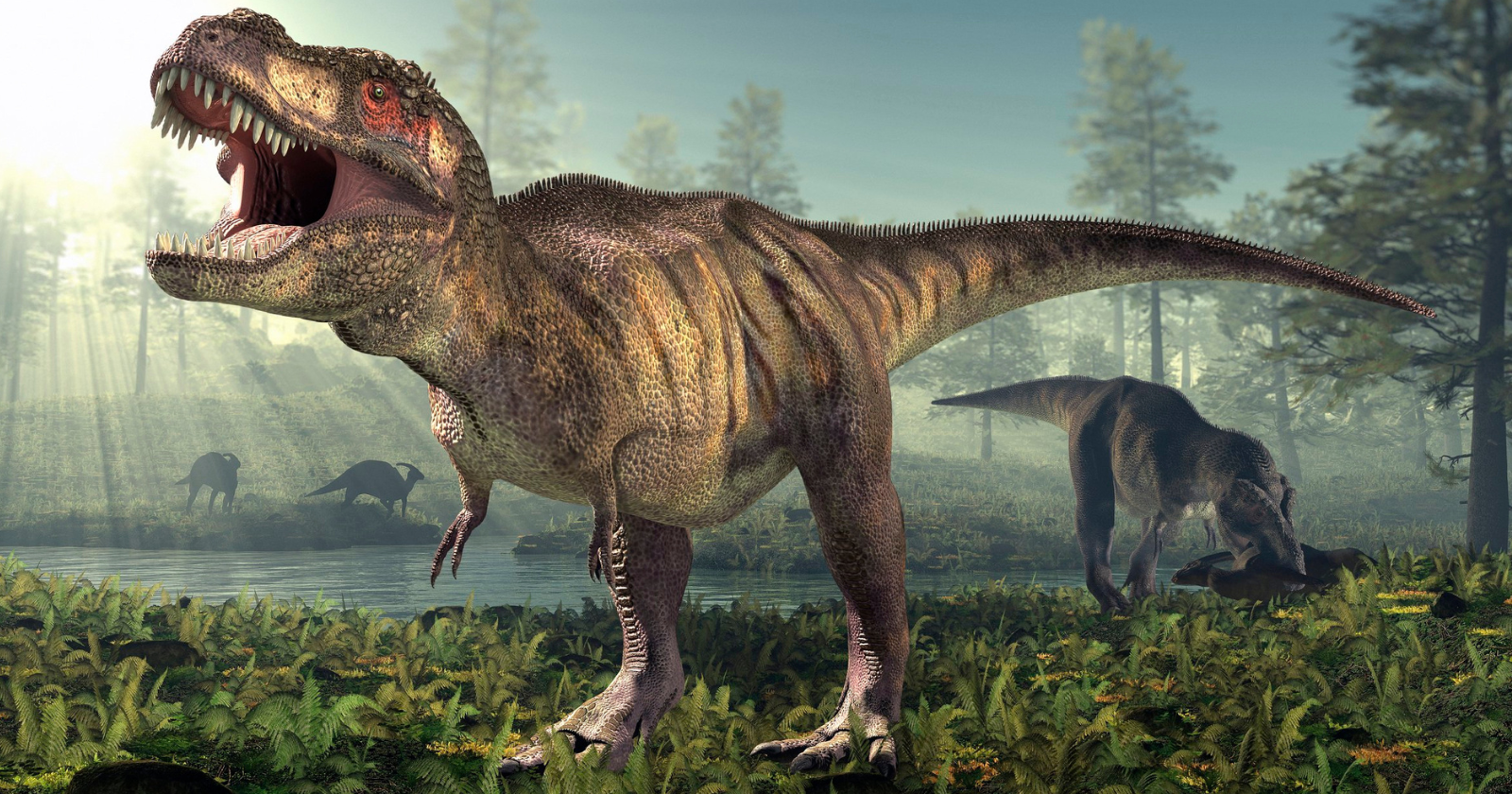
The popular mental image of the Mesozoic Era treats it as a single long period in which dinosaurs lived together, in roughly the configurations that toy companies have arranged them. Tyrannosaurus rex and Stegosaurus are among the most familiar pairings, often shown facing off in films, books, and the plastic dinosaur sets that have been a fixture of childhood for several generations. The actual fossil record places these two animals so far apart in time that the comparison is closer to imagining a human meeting an early prosimian primate than to imagining contemporaries. The time gap between T. rex and Stegosaurus is about 83 million years. The time gap between T. rex and the present day is about 66 million years. By the only measurement that matters, deep time, T. rex is closer to us than to Stegosaurus. Anatomically modern Homo sapiens only appeared roughly 300,000 years ago, which is a rounding error against the 66-million-year span and does not change the comparison materially.
The arithmetic is straightforward and the dates are well-constrained. According to the Natural History Museum’s overview of the Cretaceous Period, the dinosaurs most strongly associated with the popular image of “the age of dinosaurs,” including Tyrannosaurus rex and Triceratops, only lived at the very end of the Cretaceous, between roughly 68 and 66 million years ago. The Cretaceous Period itself, the museum’s expert Susie Maidment notes, is nearly 80 million years long, “so there’s a lot of turnover in that time.” The dinosaurs at the start of the Cretaceous were not the same dinosaurs that lived at the end. The Jurassic, the period before the Cretaceous, ended 145 million years ago. That is when Stegosaurus and the other large herbivores of the period, including Diplodocus and Brachiosaurus, were already going extinct or declining.
When the two species actually lived
Stegosaurus lived during the Late Jurassic, between approximately 155 and 145 million years ago. The Natural History Museum’s Stegosaurus specimen page, describing the most complete Stegosaurus skeleton in any public collection outside the United States, dates the species to about 150 million years ago. The closest contemporary predators of Stegosaurus were not T. rex but Allosaurus and Ceratosaurus, the dominant theropods of the Late Jurassic in the western United States, in what is now Wyoming, Colorado, and Utah.
Tyrannosaurus rex lived only during the final two million years of the Mesozoic. According to National Museums Scotland, the species inhabited forested river valleys in western North America during the Late Cretaceous, became extinct about 66 million years ago, and was contemporary with Triceratops and other late-Cretaceous fauna that the Jurassic dinosaurs would not have recognised. T. rex‘s closest contemporary herbivorous prey species included ceratopsids, hadrosaurs, and ankylosaurs, all of which evolved long after Stegosaurus. There was no possibility of T. rex encountering Stegosaurus in any natural habitat. The two animals are separated by roughly the same span of time that separates T. rex from the early primates of the Paleocene.
What 83 million years actually looks like
The way most people fail to grasp this comparison is the way most people fail to grasp deep time generally. Eighty-three million years is approximately the length of the entire Cretaceous Period, and about seventeen million years longer than the entire Cenozoic Era — the so-called “Age of Mammals” that has elapsed since the dinosaur extinction. According to a 2012 piece in Smithsonian Magazine by the palaeontology writer Riley Black, the gap between Apatosaurus and Tyrannosaurus is comparable, with about 83 million years separating Allosaurus from Triceratops. “Consider how much life has changed in the past 66 million years,” Black wrote. “Now consider that even more time separated T. rex from Stegosaurus.” The “age of dinosaurs,” in the singular sense the phrase implies, was not a single age at all.
The implications extend further if you look earlier. The first dinosaurs, like Eoraptor and Herrerasaurus, evolved roughly 230 million years ago, in the Late Triassic. They are twice as far from T. rex, in chronological terms, as Stegosaurus is. The dinosaur clade spans an interval of evolutionary time longer than the time elapsed since the dinosaurs disappeared. To group them all into a single “age” treats a 165-million-year span as a single moment, in the same way the geological record of, say, the entire age of mammals is sometimes summarised in a textbook chapter.
What T. rex would have seen
The editorial framing that places T. rex as a relative latecomer is, paradoxically, the framing that has the most explanatory power. If T. rex had somehow encountered a Stegosaurus fossil while it was alive, it would have been encountering a dinosaur that was, from its perspective, ancient. The bones would have been roughly the same age, relative to a living T. rex, as a T. rex fossil is now relative to a living human. A T. rex palaeontologist, had one existed, would have studied Stegosaurus as a creature from a different geological era, separated by tens of millions of years of intervening evolution. The closest T. rex ever came to Stegosaurus was through the medium of buried bones.
That is the framing that the popular phrase “the age of dinosaurs” tends to obscure. The dinosaurs were not a community of contemporaries. They were a long-lived clade whose internal history is longer than the history of every mammal lineage combined. T. rex and Stegosaurus happen to be the two dinosaurs that everyone learns first, which is what makes the time-distance between them surprising. The same surprise would attach to any pairing across two distant periods of the Mesozoic. The dinosaurs lived a very long time. Most of the time, they were not living together.
