
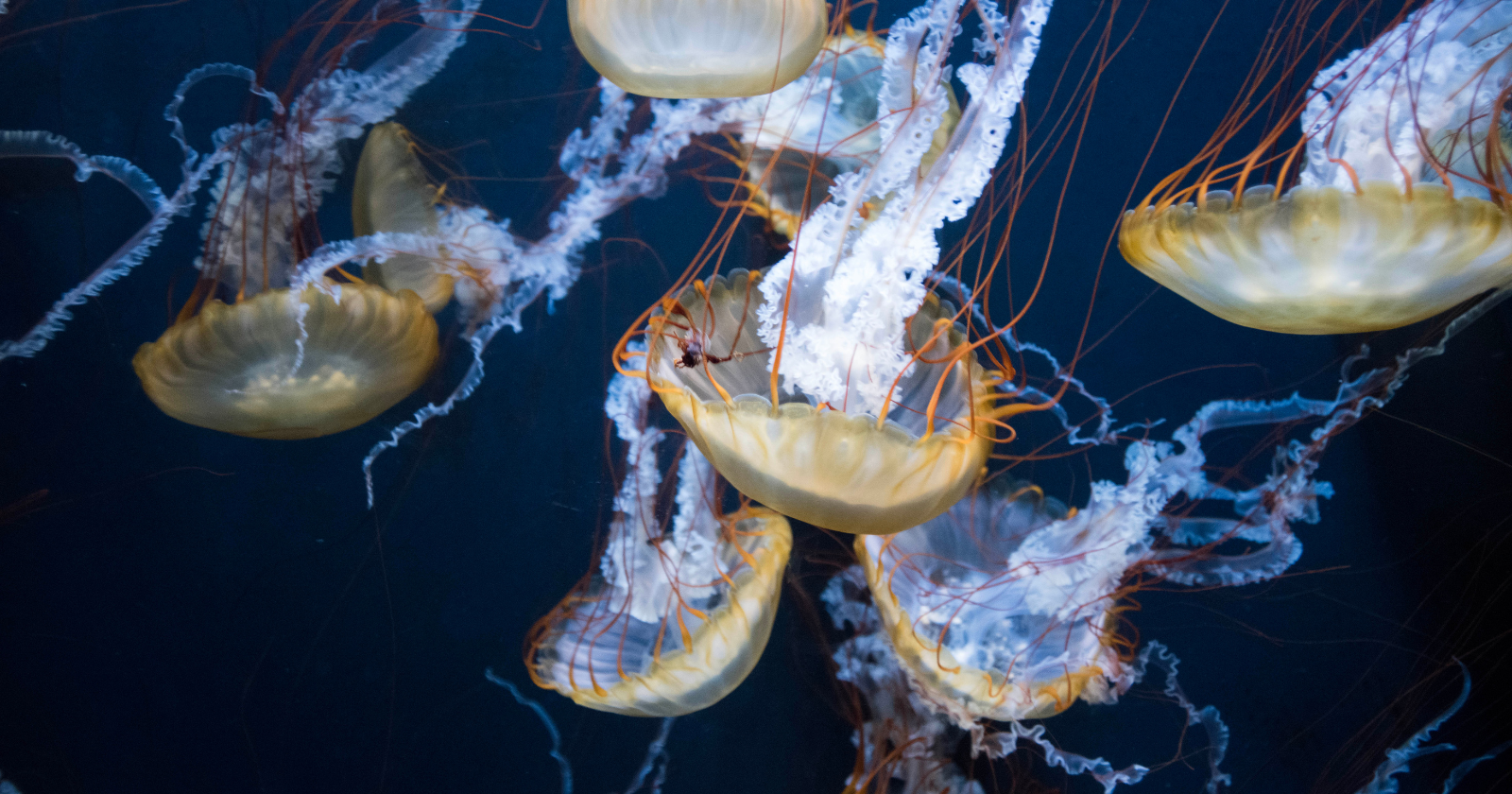
In the warm coastal waters of the Mediterranean, and now globally distributed via ship ballast water, lives a translucent jellyfish about the size of a pinky-nail clipping, with a bright red stomach visible through its bell. Turritopsis dohrnii looks unremarkable. It feeds on plankton, swims at the mercy of currents, and gets eaten in large numbers by fish, sea turtles, and other predators that consume jellyfish without much discrimination. What distinguishes T. dohrnii from the thousands of other jellyfish species is what happens when one of these medusae becomes injured, starved, sick, or simply old. Instead of dying, the animal can transform itself back into its juvenile polyp stage and start its life over.
The phenomenon was first described in 1992 by Giorgio Bavestrello and colleagues at the University of Genoa, working with Christian Sommer at Ruhr University Bochum. Bavestrello and Sommer had collected specimens of what they assumed was a typical hydrozoan jellyfish, intending to rear them for unrelated research. Instead, they observed that under stress, the medusae did not die. They settled to the bottom, lost their swimming ability, contracted into a “cyst” of cells with no medusa-like features, and then over 24 to 72 hours regrew as polyps — the juvenile colonial stage that normally precedes the adult medusa in the jellyfish life cycle. According to a September 2025 feature in The Scientist on the species, Stefano Piraino of the University of Salento, who had been involved in the investigation since the early 1990s and was lead author on the foundational 1996 paper characterising the cellular mechanism, recalled the initial reaction: “This was certainly a point of interest for the media, because they claimed that we had discovered the elixir of immortality.”
How the reversal works
The cellular process underlying the reversal is called transdifferentiation. In ordinary animal development, cells start out as undifferentiated stem cells, gradually commit to specific lineages (muscle, nerve, epithelium, and so on), and then remain in their committed state for the rest of the cell’s life. In T. dohrnii, this is not what happens. Under stress, fully differentiated cells in the medusa change their commitment, transforming into cells of a different lineage entirely. Muscle cells become epithelial cells. Tissues that had specialised for one function reorganise into tissues with another function. The overall result is a complete reorganisation of the animal’s body plan, from adult medusa to juvenile polyp, accomplished by reprogramming the cells already present rather than by generating new ones from a reserve of stem cells.
Not every medusa can perform the reversal. According to tissue-excision experiments published in 1996 by Piraino, Boero, Aeschbach and Schmid in the Biological Bulletin, the transformation of medusae into polyps occurs only if differentiated cells of the exumbrellar epidermis (the outer cell layer) and part of the gastrovascular system (the circulatory canal system) are present in the dying medusa. Severely damaged individuals with these tissues missing cannot complete the reversal and die. A 2021 transcriptomic study of the species, building on the 1996 cellular work, identified gene expression changes in the cyst stage that include upregulation of telomere maintenance, DNA repair pathways, and developmental transcription factors, alongside silencing of regulators that normally maintain cellular commitment. The transition appears to be controlled by stress signals that include senescence: as the medusa ages, the same pathways that trigger reversal under injury become active spontaneously.
What the genome shows
The most extensive genetic analysis of the species came in 2022 from Maria Pascual-Torner, Carlos López-Otín, and colleagues at the University of Oviedo, who published the first whole-genome assembly of T. dohrnii alongside a comparison genome of Turritopsis rubra, a sister species that the team described as incapable of postreproductive rejuvenation. According to the Pascual-Torner team’s paper in PNAS, T. dohrnii carries approximately double the number of genes associated with DNA repair and damage protection compared with T. rubra, as well as variants in genes affecting cell division regulation and telomere stability. During the life-cycle-reversal process, the team observed activation of pluripotency-associated transcription factors comparable to the Yamanaka factors used in mammalian cell reprogramming, and silencing of polycomb repressive complex 2 targets that normally maintain differentiated cell states.
The Pascual-Torner paper has been formally contested in the same journal. In a 2023 PNAS letter, Maria Pia Miglietta of Texas A&M University at Galveston argued that the central premise of the comparative genomic analysis — that T. rubra is incapable of postreproductive rejuvenation — is incorrect. According to Miglietta, the paper that the Pascual-Torner team cited as evidence of T. rubra‘s incapacity never actually tested the species’ rejuvenation capacity. The implication is that the genetic differences identified between the two species may not be the differences that explain T. dohrnii‘s immortality, because the comparison may be between two species that are both capable of the trick. The Pascual-Torner team responded to Miglietta’s critique in a published reply. The dispute remains active and the genetic basis of the rejuvenation remains, for now, less settled than the original paper’s framing implied.
The qualifications on “immortal”
Two important qualifications attach to the popular “immortal jellyfish” framing. The first is that the rejuvenation is theoretical rather than practical. T. dohrnii medusae are constantly eaten by predators in their natural habitat, killed by parasites, and otherwise removed from the population by ordinary causes of mortality. The species’ ability to reverse its life cycle does not protect it from being eaten. The “biological immortality” claim refers to the absence of an inherent senescence limit on the cellular machinery, not to the persistence of any individual jellyfish.
The second qualification is that the genus contains several species with varying degrees of life-cycle-reversal capacity. The Pascual-Torner team noted in their 2022 paper that Turritopsis sp.5 and Turritopsis sp.2 can also undergo reversal at earlier stages, though both lose the capacity at sexual maturity. T. dohrnii, on the Pascual-Torner reading, is the only species that maintains the full capacity in adult medusae. On Miglietta’s reading, T. rubra may share the capacity as well. The strong claim that T. dohrnii is the only species capable of this feat is therefore better described as the prevailing view rather than as a settled fact.
What is settled is that the reversal happens, that it is unlike anything observed in other multicellular animals at this scale, and that the cellular and genetic mechanisms involved overlap with the same pathways that mammalian regenerative medicine has been trying to control for therapeutic purposes. The 2012 Nobel Prize in Physiology or Medicine was awarded jointly to Sir John Gurdon and Shinya Yamanaka for the discovery that mature mammalian cells can be reprogrammed to become pluripotent — Gurdon for showing in 1962 that the nucleus of a differentiated cell still contains all the developmental potential of a stem cell, and Yamanaka for showing in 2006 that introducing four specific transcription factors could reprogram adult skin cells into induced pluripotent stem cells. The jellyfish appears to use a related toolkit, naturally and at the level of the whole organism, for a purpose that mammals cannot replicate. Whether that toolkit will eventually inform human medicine is one of the more interesting open questions in regenerative biology.
