
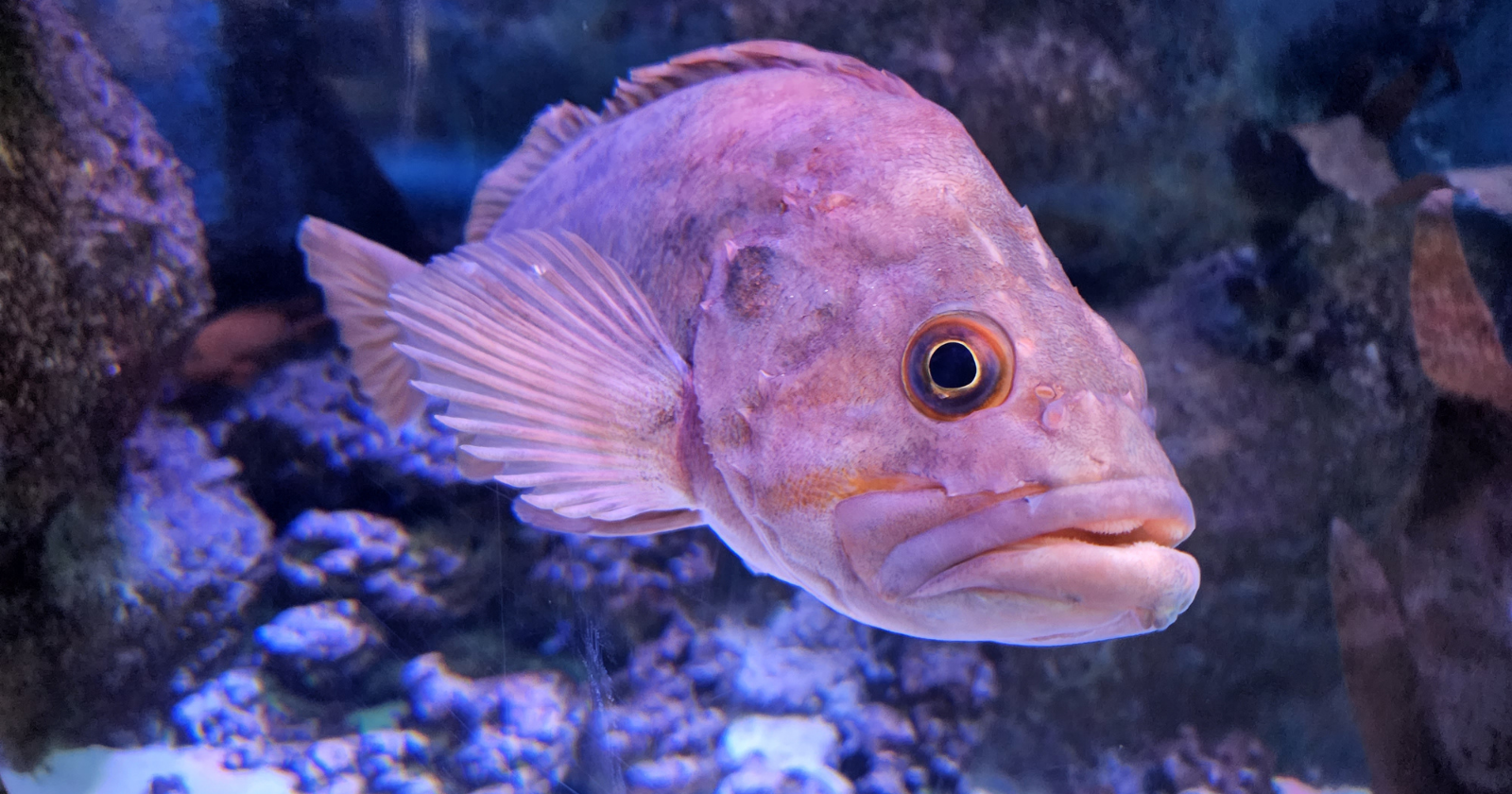
In the deep, cold waters of the North Pacific, between Japan and the Aleutian Islands, lives a slow-growing red fish called the rougheye rockfish, Sebastes aleutianus. The species has been on the menu in restaurants from Vancouver to Seoul for decades, usually labelled simply as “rockfish” or, less accurately, as rock cod or red snapper. What is not usually advertised on the menu is that the rougheye rockfish is among the longest-lived vertebrates on Earth. The oldest documented individual ever caught was 205 years old. Caught today, that same fish would have hatched in 1821, four decades before the American Civil War began and a decade before Charles Darwin set off from Plymouth on the voyage that produced On the Origin of Species.
The current scientific picture of why the rougheye lives so long, and how it does it, comes from a 2021 paper in Science by Sree Rohit Raj Kolora and Gregory Owens, working as co-first authors in the lab of Peter Sudmant at the University of California, Berkeley. The paper, “Origins and evolution of extreme lifespan in Pacific Ocean rockfishes”, sequenced and compared the genomes of 88 species of rockfish to identify the genetic features associated with the rougheye’s remarkable longevity. The findings have implications well beyond fisheries science, because the same genus contains species that live only 11 years, and the contrast offers a rare natural experiment in the genetic basis of aging.
How long the rougheye actually lives
The genus Sebastes contains roughly 137 known species of rockfish, distributed throughout the North Pacific. Their lifespans vary enormously. The calico rockfish lives about a decade. The yelloweye rockfish lives 140 years. The rougheye rockfish lives more than 200. According to Scientific American’s coverage of the 2021 study, this is one of the most rapid radiations of lifespan among vertebrates ever recorded: the rockfish genus diversified into its current range of life-history strategies over roughly 10 million years, with closely related species ending up with lifespans that differ by a factor of 20 or more.
Determining the age of individual fish to the year is, on its own, an interesting piece of biology. The standard method is otolith reading. Fish carry small calcium-carbonate structures in their inner ears called otoliths, which add a thin annual growth layer for every year of the fish’s life, in the same way trees add growth rings. Counting the rings in a thin slice of an otolith gives the fish’s age. For very old fish, the technique is supplemented by radiometric dating methods, including lead-210 and radium-226 isotope analysis, and by bomb radiocarbon dating, which uses the elevated carbon-14 levels produced by atmospheric nuclear tests in the 1950s as a temporal marker. A fish older than 70 years should show no detectable bomb-era carbon signal in its otolith core, because the core formed before 1950.
Why it can do this
The rougheye’s longevity emerges from a combination of life-history and genetic factors. The environment helps. Rockfish at depth live in cold water, often near 4 degrees Celsius, which slows metabolism and is generally associated with longer lifespans across the animal kingdom. They also grow large, with adult rougheyes reaching about a metre in length, and larger body size correlates with longer life in fish for the usual reasons of reduced predation pressure and slower growth rates.
The Kolora and Owens team’s contribution was to identify the genetic underpinnings layered on top of these life-history features. According to Sudmant in interviews accompanying the paper’s release, size at maturity and the depth at which a fish lives can together predict about 60 percent of lifespan variation across rockfish species. “We can explain 60% of the variation in lifespan just by looking at the size at maturity and the depth at which a fish lives,” Sudmant said. The remaining 40 percent is attributable to genetic factors that operate independently of size and depth. The team identified 137 longevity-associated genes that are repeatedly enriched in long-lived rockfish species. Many of these are involved in DNA repair pathways, which protect against the accumulation of mutations over a long life. Others are in the insulin signalling pathway, which has been linked to lifespan in organisms ranging from fruit flies to humans. The long-lived rockfish species also show expansions in the butyrophilin family of immune-modulatory genes, which appears to be a distinctive feature of the longest-lived rockfish lineages and may help reduce inflammation-related damage over time.
The cost of long life
Living for two centuries comes with biological trade-offs. The rougheye matures very slowly. A typical rougheye does not reach reproductive maturity until around 20 years old, by which point a calico rockfish has already cycled through two complete generations. Once mature, the rougheye can produce roughly 700,000 eggs per year, and continue producing them for as much as 150 years of life. But this reproductive output is back-loaded: the early years are committed to growth, and a rougheye that dies young leaves few offspring behind.
That fact has direct consequences for the species’ vulnerability to fishing. As The Fisheries Blog has noted in its discussion of the Kolora et al. paper, total lifetime fecundity of the rougheye rockfish only matches that of shorter-lived, faster-maturing species like the black rockfish if the rougheye is allowed to live to its maximum lifespan. Harvest pressure that removes individuals before they have had time to reproduce for several decades reduces the species’ reproductive output disproportionately compared with shorter-lived species. NOAA Fisheries and the relevant Canadian and Alaskan management bodies have flagged rougheye and similar long-lived deep-sea fish as among the species most vulnerable to overfishing for this reason. A fishery that takes the largest, oldest individuals can collapse a long-lived species’ breeding population in a few decades, and rebuilding the lost age structure can take centuries.
What this means for fisheries
The implications for management are unusual. Most fish populations recover from overfishing on timescales of 5 to 30 years, depending on the species’ generation time. A rougheye rockfish population recovers, if it recovers at all, on timescales that are not far short of human historical memory. A school of rougheyes wiped out by trawling in 1950 might only have rebuilt its age structure to pre-fishing levels by, optimistically, the late 22nd century. The slow demographics that allow individuals to live for 200 years are the same slow demographics that make populations correspondingly slow to recover from any disturbance.
The rougheye rockfish caught for dinner tonight is not necessarily 200 years old; commercial catches typically take younger individuals, and the population’s mean age is shifting downward under continuing fishing pressure. But the fact that some individuals at the bottom of the North Pacific have been swimming through the same waters since the early 1800s, predating most of modern industrial civilisation, gives the species a quiet claim to one of the more impressive lifespans on Earth, and a place in the small group of vertebrates that have outlasted their human contemporaries by an order of magnitude.
