
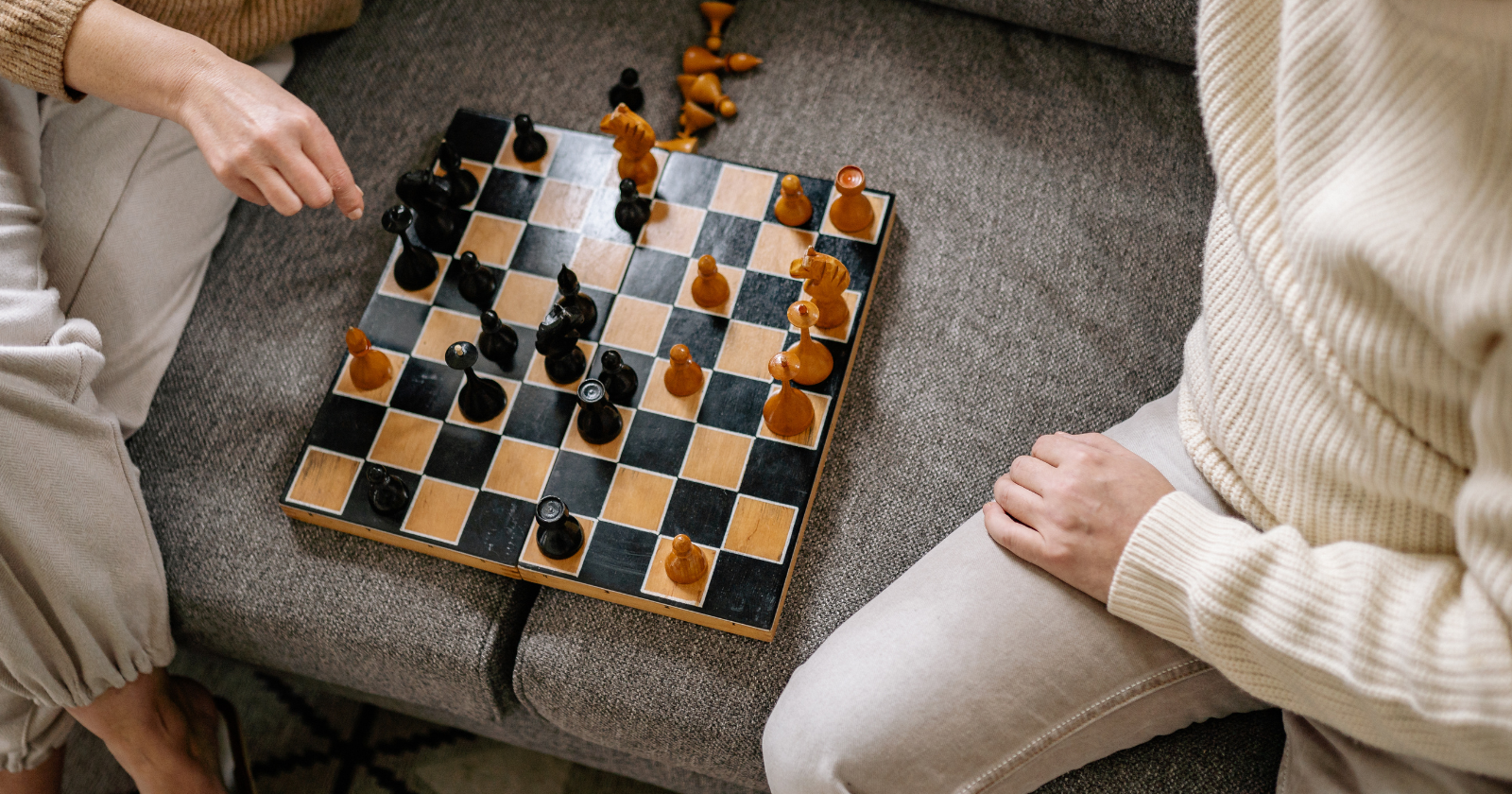
The American mathematician Claude Shannon, working at Bell Labs in 1949, sat down with a pencil and a sheet of paper and tried to estimate how many distinct games of chess could in principle be played. His method was a rough back-of-the-envelope calculation, but the result was startling enough that he included it in a paper published the following year. According to the Wikipedia reference on the Shannon number, Shannon assumed that each player faces an average of about 30 legal moves on each turn, giving roughly 30 × 30 ≈ 900 possible move pairs per turn — about 10³. He further estimated that an average game lasts about 40 such move pairs, or 80 half-moves (called “plies” in chess notation). Multiplying these together, Shannon arrived at his now-famous lower bound for the number of possible chess games: approximately 10^120, a 1 followed by 120 zeros.
The figure is large enough to be difficult to compare with anything in the physical universe. The estimated number of atoms in the observable universe is on the order of 10^80, generally cited as somewhere between 10^78 and 10^82 depending on the cosmological model. The number of possible chess games therefore exceeds the number of atoms in the observable universe not by a factor of 2 or 10 or 1,000, but by a factor of approximately 10^40 — by 40 orders of magnitude. Shannon’s number is so large that it cannot be exhausted, indexed, or stored by any physical computing device of any conceivable design. The chess board, with its 64 squares and 32 pieces, contains a possibility space that no resource in the universe could ever fully enumerate.
Why the number is so large
The reason chess explodes combinatorially despite its modest board size is the exponential growth of decision trees. After just one ply, there are 20 possible positions. After two plies, 400. After four plies — two full turns from each side — the number of possible game sequences is 197,281, or just under 200,000. After eight plies, four full turns, the figure climbs to nearly 85 billion. The growth continues unchecked, doubling and redoubling with each additional half-move, for roughly the next 72 moves of a typical game. Shannon’s 1950 calculation captured this growth using a simple exponential — about 10^3 possibilities per turn raised to the 40th power, giving 10^120. The exact number depends on assumptions about average game length and branching factor, but no matter how the assumptions are varied, the figure remains stupendous.
According to a 2019 review of game complexity estimation by mathematicians Alexander Yong and David Yong, the British mathematician G. H. Hardy at one point proposed an even larger estimate — approximately 10^(10^50), which the Yongs describe as a “second order exponential.” Hardy’s number includes pathological games that have no strategic content (pieces shuffling back and forth indefinitely, for example, within the rules of the 50-move draw and threefold repetition limits). Shannon’s 10^120 is a more conservative estimate restricted to plausible game lengths and structures. Either way, the qualitative point is the same: chess sits in a possibility space that exceeds anything material in nature.
The number of distinct chess positions, as opposed to distinct chess games, is much smaller — on the order of 10^43 to 10^46 — because many different move orders can produce the same position on the board. Even this smaller figure, however, is still much larger than the atoms in any single solar system, galaxy, or galactic supercluster. Either way the chess board is measured, its mathematical depth exceeds the depth of the physical universe.
Why this hasn’t stopped the computers
The combinatorial size of chess was, for the first several decades of computing, regarded as a fundamental barrier to machine play. Shannon himself, in the same 1950 paper, noted that solving chess by brute-force enumeration was impossible and would remain so. No computer could ever examine even a meaningful fraction of the possible game tree. Chess would, the early theorists assumed, remain a problem that required something humanlike — pattern recognition, intuition, strategic understanding — rather than raw computation.
This turned out to be wrong, but not because computers became fast enough to enumerate chess. They never did, and they never will. What changed was the algorithmic approach. Modern chess engines do not attempt to examine all 10^120 possible games. They instead use techniques that drastically prune the game tree: alpha-beta pruning, which discards branches of play that cannot improve on the best line already found; sophisticated evaluation functions that score positions without examining all their consequences; transposition tables that recognise positions reached by different move orders; opening books that encode centuries of human knowledge about typical first moves; and endgame tablebases that contain perfectly-solved play for all positions with seven or fewer pieces remaining. The combination allows modern engines to find very strong moves while examining only a vanishingly small fraction of the possibility space.
The breakthrough came in 1997, when IBM’s Deep Blue defeated the reigning world champion Garry Kasparov 3½-2½ in a six-game match. According to the National Museums Liverpool reference on chess and the Shannon number, Deep Blue’s victory ended a decade-long contest between IBM’s engineers and Kasparov, who had defeated an earlier version of the same program 4-2 in 1996. Deep Blue used customised hardware and conventional alpha-beta search at depths of 12 to 40 ply, evaluating roughly 200 million positions per second. The 1997 match marked the first time a computer had defeated a sitting world champion under standard tournament conditions. From that point onward, computer chess strength has grown approximately monotonically.
What modern engines can do
The current generation of chess engines is in a category of its own. According to a 2026 review of chess engines and their ratings, modern engines such as Stockfish 17 and Leela Chess Zero now register Elo ratings consistently above 3500 on computer-versus-computer rating lists, with some engines exceeding 3600. By comparison, the current world champion’s Elo rating sits at approximately 2800. As a 2022 statistical analysis by researchers at the University of Chicago and George Mason University documented, Magnus Carlsen, widely regarded as the strongest human player in history, peaked at 2882 in 2014 and has never exceeded that figure despite a decade of further play. The gap between the strongest engine and the strongest human is now around 700 Elo points.
In Elo-rating mathematics, a gap of 400 points implies that the higher-rated player wins approximately 91 percent of games. A gap of 700 points implies a winning probability approaching 99 percent in classical time controls, with the remaining 1 percent largely accounted for by draws rather than losses. Carlsen himself has commented in interviews that he no longer plays training games against engines, because there is no point — the engine wins every time. In a 2017 milestone, according to a Chess.com reference on the AlphaZero engine, DeepMind’s AlphaZero programme taught itself chess from scratch using only the rules and self-play, reaching Stockfish-level strength after about four hours of training and defeating the then-current version of Stockfish in a 100-game match after nine hours of training. The match score was 28 wins to AlphaZero, 0 losses, and 72 draws. AlphaZero’s neural-network approach has since been incorporated into open-source engines like Leela Chess Zero, which now plays at a level comparable to or exceeding Stockfish.
The paradox is therefore complete. Chess remains mathematically unsolved — the game tree of 10^120 possibilities is too vast for any conceivable computer to fully evaluate, and the question of whether chess is a draw or a forced win for White from the starting position remains formally open. But chess is also no longer a contest between humans and machines in any meaningful sense. The combinatorial space that Shannon thought would protect chess from computer mastery turned out to be irrelevant: engines have learned to play extraordinarily well without ever needing to enumerate it. The number that exceeds the atoms in the observable universe by 40 orders of magnitude is real, the engine that beats every human grandmaster who has ever lived is also real, and the apparent contradiction between them resolves into a single fact about how problems can be solved without being solved completely.
