
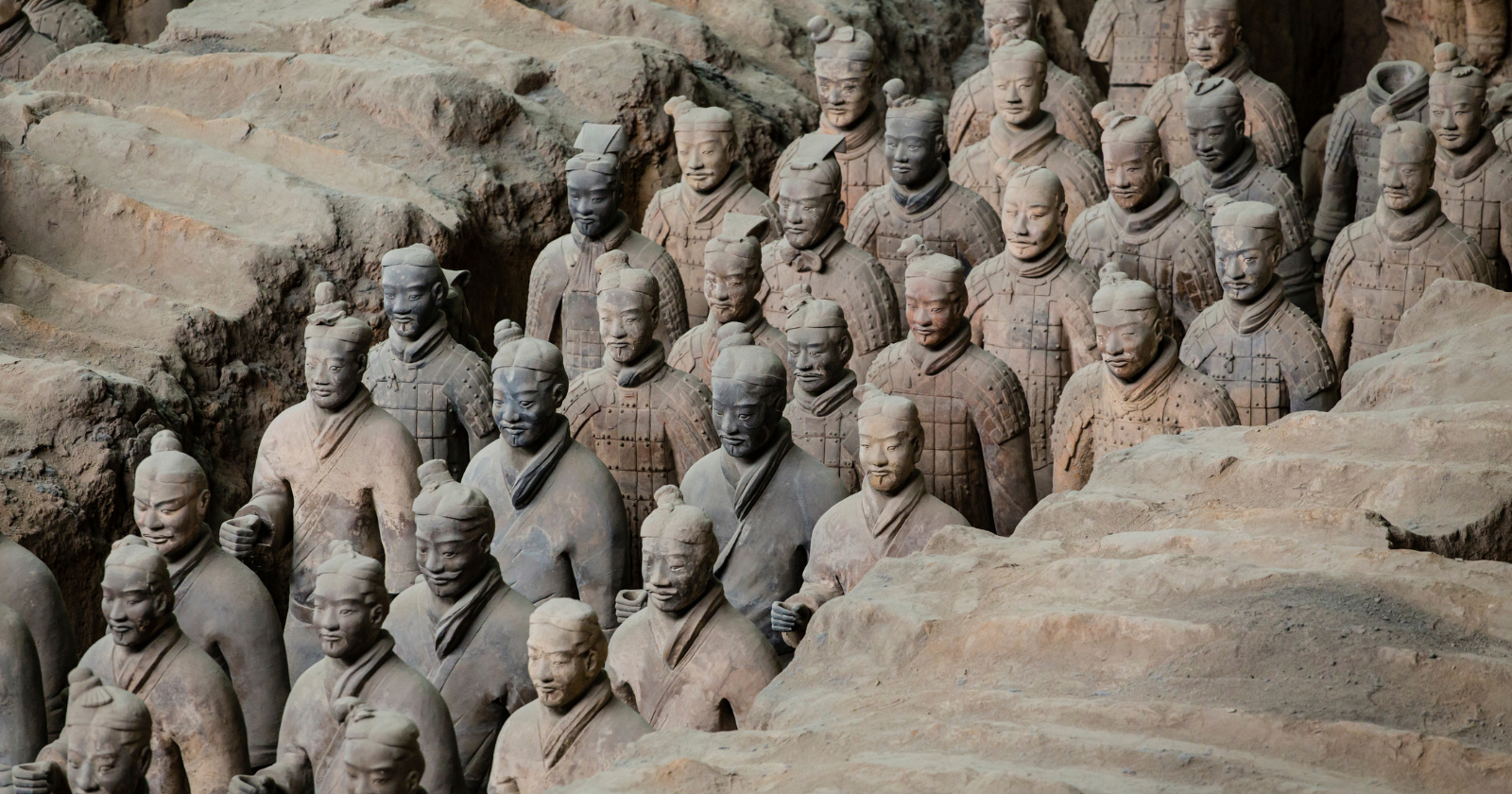
On the morning of 29 March 1974, a Chinese farmer named Yang Zhifa, working with five of his brothers and a neighbour named Wang Puzhi, was digging a well in the dry agricultural land east of Xi’an when his shovel struck what he initially mistook for a Buddhist statue. The object was made of terracotta, about the size of a man, and had been buried in the dry sandy soil for so long that no living person in the surrounding villages had any idea it was there. Yang reported the find to local authorities. Provincial archaeologists arrived. Over the subsequent weeks, months, and years, what had been initially understood as a single sculpture was revealed to be the easternmost element of a vast military formation containing approximately 8,000 individually crafted, life-sized terracotta soldiers, accompanied by 130 chariots, 520 horses, and 150 cavalry mounts — all arranged in battle formation, all facing east, all positioned in three deep underground pits approximately 1,500 metres east of an earthen mound that had been visible in the surrounding landscape for the entire history of Chinese civilisation without anyone understanding what it covered.
According to a comprehensive reference summary of the Mausoleum of the First Qin Emperor and its archaeological history, the mound itself is the visible above-ground portion of a much larger underground necropolis, constructed over 38 years from 246 BC to 208 BC by a workforce estimated by ancient sources at 700,000 people. The mound is shaped as a truncated stepped pyramid. Its current height, after approximately 2,200 years of natural erosion, is approximately 51 metres according to UNESCO’s official measurement, though it is widely cited in popular and tourist sources at the more frequently-encountered figure of 76 metres — which may refer to a less-eroded historical measurement, or to the original constructed height before millennia of weathering. The base of the mound covers approximately 250,000 square metres. The terracotta army to its east is, by every available archaeological assessment, only one element of a complex that extends across approximately 56 square kilometres in total — incorporating inner and outer walled enclosures, ritual buildings, workshops, stables, armoury pits, model pond systems containing bronze waterfowl, accompanying chambers containing figures of court officials, acrobats, musicians, and the personal household staff the emperor expected to take with him into the afterlife.
The chamber that no one has entered
At the centre of this vast complex, beneath the visible mound itself, sits the actual burial chamber of the emperor — a structure that archaeological surveys, magnetic anomaly studies, and ground-penetrating radar have collectively located, mapped, and characterised in considerable detail without anyone ever physically entering it. The chamber is believed to measure approximately 80 metres east to west, 50 metres north to south, and 15 metres in height, with a perimeter wall constructed of rammed earth approximately 30 to 40 metres thick. Estimates of the chamber’s depth below the surface vary; most Chinese archaeologists place it at approximately 30 metres, though some Western researchers have proposed substantially deeper figures. The chamber sits within an underground palace complex covering approximately 180,000 square metres. None of this has ever been excavated. The decision not to excavate is not, by any account, a matter of technical impossibility. It is a deliberate choice driven by conservation concerns, by Chinese heritage law, and by hard lessons learned during the original 1970s terracotta army excavation, when the figures emerged from the soil still bearing their original vivid paint colours — pinks, greens, blues, reds, traces of gold leaf — which curled, flaked, and faded within minutes of contact with the dry Xi’an air. The lacquer coating beneath the paint, once exposed to atmospheric oxygen, deteriorates so rapidly that figures excavated using 1970s techniques are now visible as the familiar terracotta-grey colour that has become globally iconic — a colour that none of them possessed at the moment of their original manufacture.
As reported by an IFLScience overview of the conservation concerns and practical hazards surrounding the unopened tomb chamber, the contemporary archaeological consensus is that opening the tomb chamber with current technology would result in the irreversible destruction of an unknown but potentially vast quantity of organic material — textiles, lacquerware, painted surfaces, possibly the emperor’s own remains, possibly inscribed materials made from silk or bamboo, possibly the elaborate architectural decorations that ancient sources describe as filling the chamber. The Chinese State Administration of Cultural Heritage has formally adopted the position that excavation will be deferred indefinitely, until conservation technologies advance to the point where the contents can be preserved as they are exposed. The mound, in the meantime, remains as it has been for 2,200 years.
The mercury
The most striking detail in the ancient documentary record of the tomb is the description provided by the Han dynasty historian Sima Qian in his Records of the Grand Historian (Shiji), composed approximately one century after Qin Shi Huang’s death. Sima Qian’s account describes the burial chamber as containing a miniature reconstruction of the emperor’s territorial empire — with the seas, rivers, and major waterways of unified China represented as flowing channels of liquid mercury, kept in motion by mechanical means, beneath a ceiling inlaid with pearls and precious stones representing the constellations of the night sky. The account also mentions automatic crossbow traps to deter intruders, candles made from “man-fish” fat (probably whale or seal blubber) calculated to burn for very long periods, and the deliberate sealing of the chamber’s workers and craftsmen inside the tomb after the burial to prevent them from revealing its secrets. For most of the past two thousand years, this account was treated as a mixture of historical record and dynastic legend, with the more elaborate elements assumed to be exaggeration for political effect.
As detailed in a 2020 paper in Scientific Reports describing remote-sensing measurements of atmospheric mercury above the tomb mound, a team using mobile differential absorption lidar — a laser-based remote sensing technique capable of detecting atomic mercury vapour in the open atmosphere at extremely low concentrations — measured mercury levels above the mound that were several times the ambient background concentration of the surrounding region. The mercury vapour concentrations reached up to 27 nanograms per cubic metre at specific points around the mound, against a regional background of approximately 5 to 10 nanograms per cubic metre. Earlier soil sampling studies, conducted across 54 measurement points on and around the mound, had found mercury concentrations averaging approximately 205 parts per billion, with one specific point reaching 1,440 parts per billion. The lidar team estimated a mercury out-flux of approximately 5×10⁻⁸ kilograms per second through the mound’s surface — small in absolute terms, but consistent with a substantial volume of liquid mercury sealed beneath, slowly escaping as vapour through micro-cracks in the structural sealing. Sima Qian’s 2,200-year-old account, the team concluded, was substantially more accurate than later historians had assumed. The mercury rivers, in some form, appear to actually be there. The tomb chamber remains, by every available indication, exactly where it was placed in 210 BC — undisturbed, unentered, and according to current Chinese government policy, will remain that way until the species develops the conservation technology necessary to open it without destroying what is inside.