

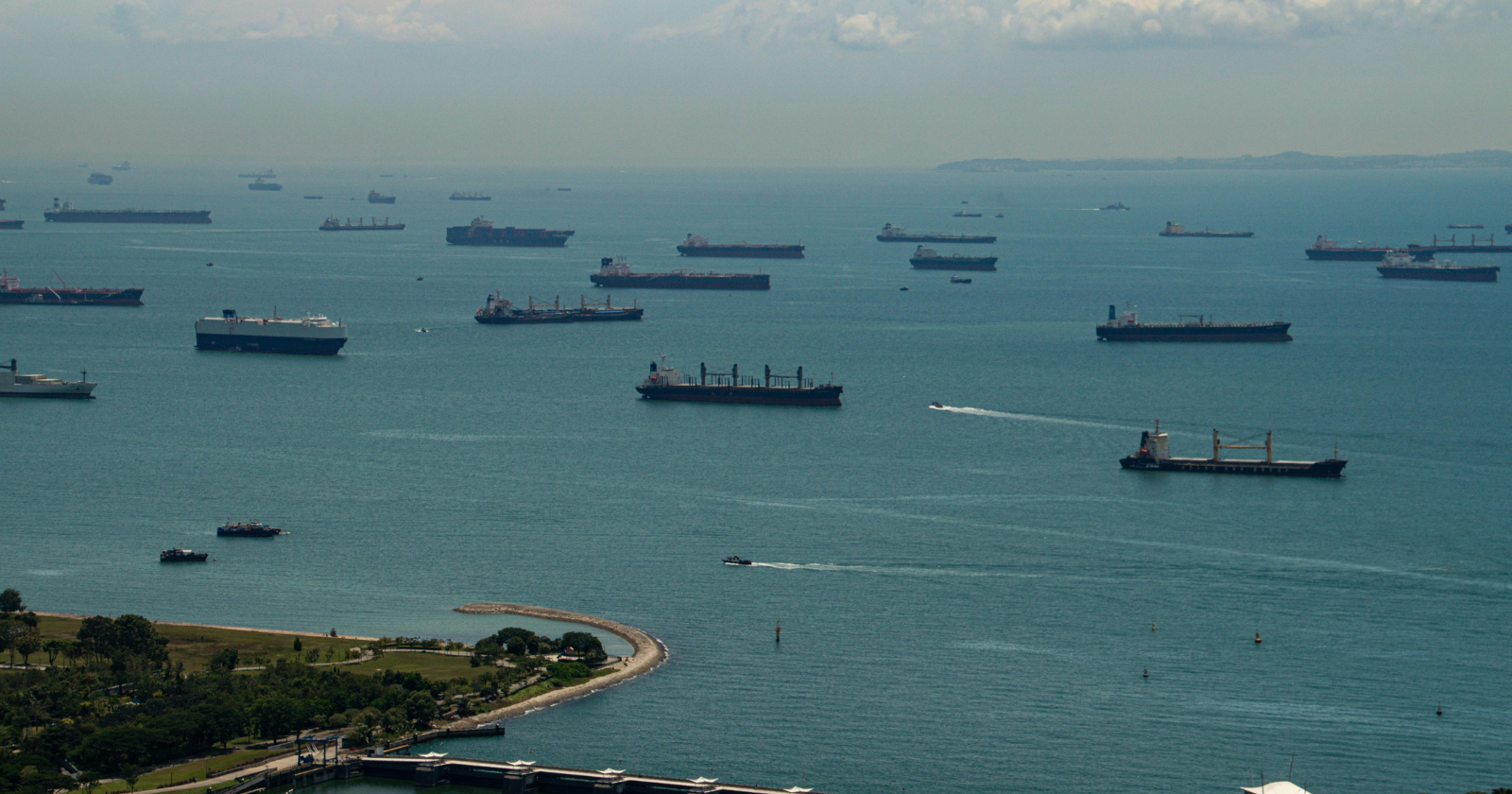
The Strait of Hormuz, the narrow sea passage linking the Persian Gulf to the Gulf of Oman and the open ocean, normally carries about 20 million barrels of oil a day. That is roughly a fifth of global oil consumption and, by the International Energy Agency’s accounting, close to a quarter of all seaborne oil trade. Since late February that flow has been throttled, briefly restored, and, as of this week, cut off again.
Its width is the figure most descriptions lead with. At its narrowest, the passage measures about 33 kilometres across.
The part that matters for shipping is much tighter than that.
What the passage normally carries
Under a traffic separation scheme administered in Omani waters, tankers move through two one-way lanes, each roughly 3.2 kilometres wide, split by a buffer of similar width. It runs about 167 kilometres end to end and averages around 60 metres deep, enough for the largest crude carriers afloat. Depth is not the limiting factor. The coastline is: a single funnel bordered by Iran to the north and Oman’s Musandam Peninsula to the south, with no comparable alternative for most of the countries that depend on it.
Crude is not the only cargo. About a fifth of the world’s liquefied natural gas passes through the same lanes, most of it from Qatar, along with, in normal years, up to 30 per cent of internationally traded fertiliser. Saudi Arabia, the UAE, Kuwait, Iraq, Qatar, Bahrain and Iran all route exports out through Hormuz, and the great majority of it heads to Asia.
What closing it actually did
On 28 February 2026 the United States and Israel launched airstrikes on Iran. Within days Iran declared the strait closed and began enforcing it, laying mines, boarding ships and warning vessels away. Tanker traffic fell to almost nothing. By 21 April the International Maritime Organization reported that roughly 20,000 mariners and 2,000 ships were stranded inside the Gulf, unable to leave.
The scale of the shut-in has few precedents. The Council on Foreign Relations put it at more than 10 million barrels a day of oil and around 300 million cubic metres a day of LNG, sustained for over 100 days. Prices moved with it. Brent crude touched a wartime high of about 126 US dollars a barrel on 30 April, its highest in four years and up from around 70 before the war, before easing back.
Why there is no easy detour
Part of what makes Hormuz so hard to route around is that the alternatives are thin. Only Saudi Arabia and the UAE operate crude pipelines that bypass the strait, the Saudi east-west line to the Red Sea and the UAE’s line from Habshan to Fujairah. The IEA estimates between 3.5 and 5.5 million barrels a day of spare capacity on those routes, well short of what normally moves through it, and the logistics of redirecting that much oil at speed have never been fully tested.
There is a second problem underneath the first. Most spare oil production capacity sits in Saudi Arabia, behind the same passage. A prolonged closure does not only stop the barrels already moving; it can also strand the reserve that markets would otherwise lean on to cover the gap.
Where things stand now
For a few weeks in June the strait looked as though it might reopen. An interim agreement between Washington and Tehran, signed on 17 June, lifted the blockade and let tankers move again, and by early July departures had briefly returned to near their pre-war range, with Brent easing toward 70 dollars.
That did not hold. Over three consecutive weekends the two sides traded strikes. On 11 July Iran fired on a commercial ship in the strait and said it was closing the waterway until further notice. Trump called the June ceasefire over. On 13 July, after announcing a reimposed naval blockade and a system of tolls, the US struck Iran again. Brent climbed back above 83 dollars, and the data firm Kpler reported that crossings had fallen by more than half in a week.
Oman is circulating a proposal to split traffic into two managed corridors, one through Omani waters under pre-war rules and one through Iranian waters requiring Tehran’s approval. It has not been agreed. As of 14 July the strait is closed, the blockade is back, and the ceasefire that briefly reopened it is over.
Little slack sits behind the strait, and the past five months have made that plain. So much energy moves through this one passage that the routes around it cannot cover a prolonged loss. The near-term questions are concrete: whether Oman’s corridor plan is accepted, whether a durable ceasefire can outlast the last one, and how long the closure holds this time. None has a settled answer.