
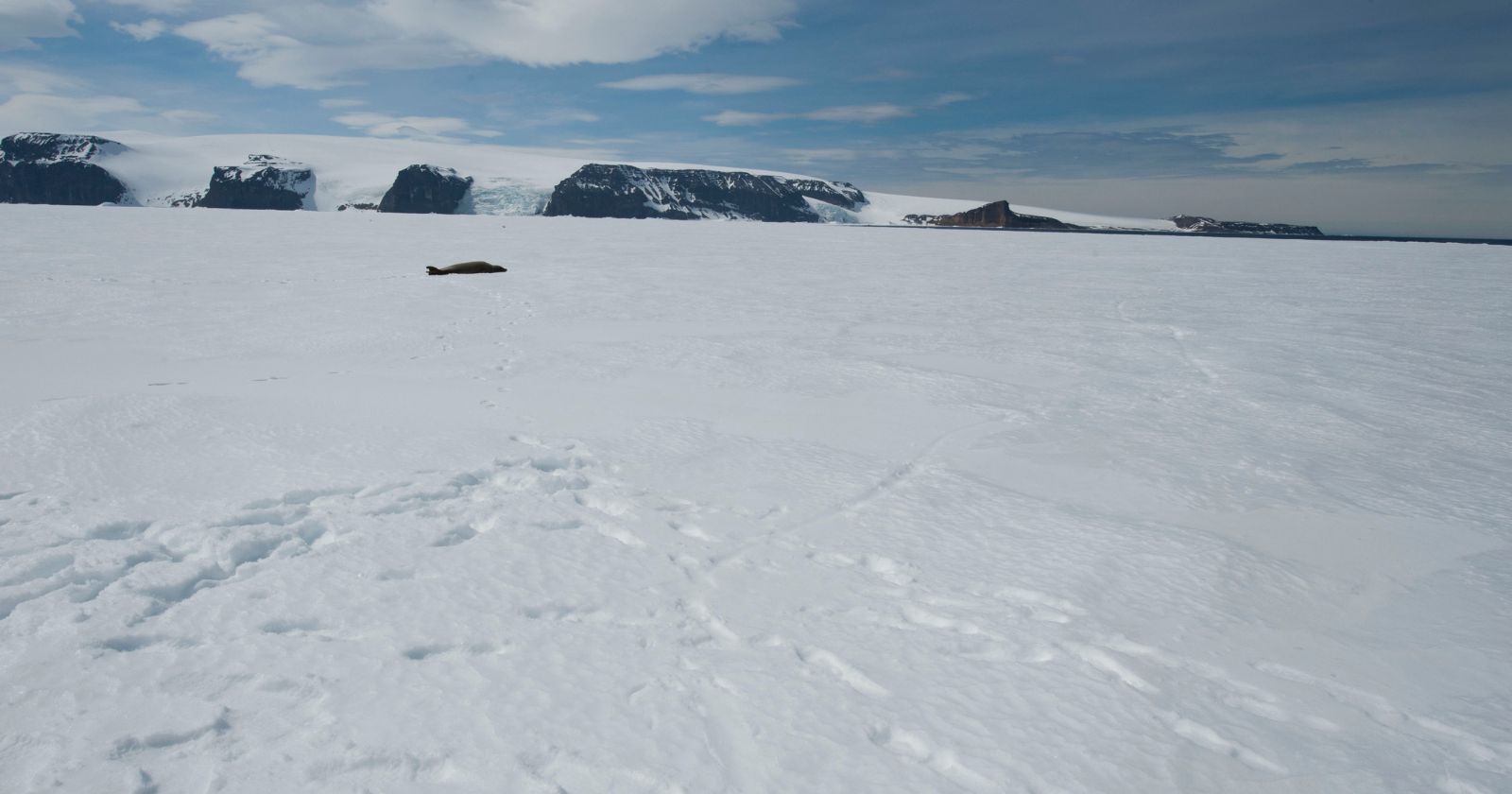
The Sahara is the standard answer to the question “what is the world’s largest desert,” and it is also wrong. The Sahara is the largest hot desert on Earth, covering roughly 9.2 million square kilometres of North Africa. By the standard scientific definition, however, a desert is not a place where it is hot. It is a place where it does not rain. National Geographic’s reference page on deserts puts it directly: “A desert is actually just a place that has very little precipitation.” Under that definition, the largest desert on Earth is the continent of Antarctica, which covers about 14.2 million square kilometres and is, by area, more than 50% larger than the Sahara.
The conventional threshold for classifying a region as a desert is fewer than 250 millimetres (about 10 inches) of precipitation per year. Antarctica meets that threshold across essentially its entire surface. According to Britannica’s article on Antarctic climate, the average precipitation across the continent is about 166 millimetres per year, equivalent to roughly 6.5 inches of water. Across the high inland polar plateau, the figure falls to about 50 millimetres or less. The Sahara, for comparison, averages about 76 millimetres per year, with its hyperarid cores in the central Libyan Desert and the Tanezrouft region of Algeria receiving less than 20 millimetres. On an average-per-square-kilometre basis, the Sahara is the drier of the two. What makes Antarctica the larger desert is the sheer scale of the surface that qualifies.
Why temperature is the wrong yardstick
The reason heat does not enter the desert definition is that the ecological problem deserts pose is water scarcity. Plants and animals in arid regions are limited by the absence of moisture, regardless of whether that moisture would have arrived as rain, snow, mist, or fog if conditions had been different. A region where almost no water reaches the ground from the atmosphere is hostile to most forms of life, whether it sits at 50 degrees Celsius in the Algerian Sahara or at minus 60 in the East Antarctic plateau. The two environments are physically very different but biologically analogous. Both are mostly empty of the kind of life that depends on regular access to liquid water.
This is also why polar deserts are called deserts in the technical sense. The Arctic, with about 13.7 million square kilometres of dry tundra and ice, is the world’s second-largest desert. The Sahara is third. Together, the two polar deserts cover roughly twice the area of the Sahara. According to the British Antarctic Survey’s “Discovering Antarctica” educational resource, the precipitation deficit on the Antarctic continent is not a result of moisture being absent from the atmosphere but of extremely cold air being unable to hold much water vapour in the first place. The relative humidity of air at the South Pole is often as low as 0.03%. Cold air has dramatically less moisture-carrying capacity than warm air, which is why even relatively humid Antarctic coastal regions deposit far less snow than weather systems at lower latitudes would produce as rain.
The driest places in Antarctica
Within the continent, the McMurdo Dry Valleys on the coast of Victoria Land are the most extreme example of polar aridity. The Dry Valleys are almost entirely free of ice, despite sitting on the most ice-covered continent on Earth. The Transantarctic Mountains form a natural barrier that blocks moisture-laden air from the Southern Ocean from reaching them. Powerful katabatic winds, gravity-driven downslope winds flowing off the East Antarctic plateau, then strip away whatever residual moisture remains and accelerate evaporation. The result is a hyper-arid environment that has been used by NASA as a terrestrial analogue for Mars, on the grounds that conditions on the floor of Wright Valley or Taylor Valley are closer to surface conditions on Mars than anywhere else on Earth.
An even more extreme example, also within the Dry Valleys region, is the Friis Hills. According to a 2013 report in Live Science drawing on research presented at the Geological Society of America, no water has flowed across the Friis Hills for approximately 14 million years. The hills rise about 600 metres above Taylor Valley, and the surrounding mountains, cold temperatures, and constant wind have produced a precipitation deficit so durable that ancient lake beds and tundra-moss fossils preserved on the hilltops record a vanished climate from a warmer geological epoch, with nothing having reset the landscape since.
Some areas within the broader Dry Valleys region are believed not to have received any significant precipitation, snow or rain, for close to two million years. This is the dimension on which Antarctica genuinely owns the dryness record. The Sahara’s hyperarid cores receive very little rain, but they do receive some. Parts of the Antarctic continent appear to have received essentially none for geological epochs.
Putting the comparison in scale
The full picture is roughly this. Antarctica covers about 14.2 million square kilometres and receives an average of 166 millimetres of precipitation per year, with much of its interior receiving 50 millimetres or less. The Sahara covers about 9.2 million square kilometres and receives an average of about 76 millimetres of precipitation per year, with its driest cores receiving close to none. Both qualify as deserts under the conventional definition. Antarctica is the larger of the two by approximately 50%; the Sahara is the drier of the two on an average basis. What the two share is the underlying physical condition that makes a desert a desert, the absence of liquid water reaching the ground in quantities sufficient to sustain ordinary terrestrial life.
The familiar mental image of a desert, with rolling dunes, palm trees, and a beating sun, captures one variety of arid environment particularly well. It does not capture the largest one. The world’s largest desert is a continent of ice the size of the United States and Mexico combined, sitting at the bottom of the globe, where parts of the interior have not received significant precipitation in millions of years, and where the term “drought” would have to be redefined to mean anything at all.
