
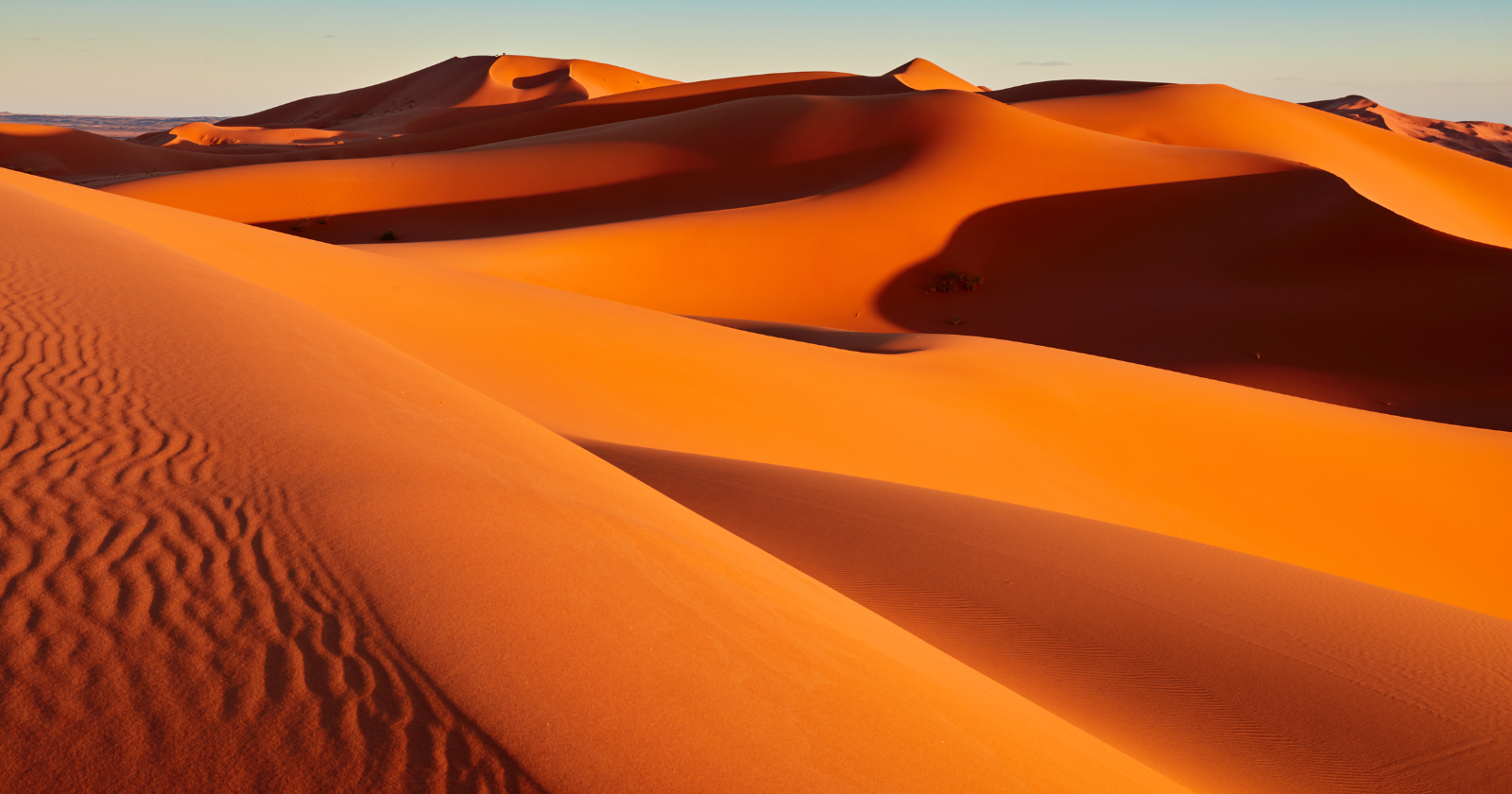
If you had walked across what is now the Algerian Sahara around 6,000 BCE, you would not have recognised the terrain. The dunes that now stretch for thousands of kilometres did not exist. The dry rock plateaus were covered in grasses and shrubs. Rivers ran through valleys that have been bone dry for millennia.
The mega-Lake Chad system, which today survives as a small remnant on the borders of Chad, Niger, Nigeria, and Cameroon, was as large as the modern Caspian Sea — roughly 360,000 square kilometres of standing fresh water. Hippopotamuses wallowed in shallow pools. Giraffes browsed the trees. Elephants, rhinoceroses, aurochs, antelope, and crocodiles populated a green and well-watered ecosystem that geologists now refer to as the African Humid Period or, more colloquially, the Green Sahara.
The most striking evidence of this lost world is not in the geological record but on the rock walls of the Sahara itself. Tens of thousands of paintings and engravings survive at sites including Tassili n’Ajjer in Algeria, Gabal El Uweinat on the Libya-Egypt-Sudan border, the Acacus mountains in Libya, and the Tibesti range in Chad. The images, attributed to the people who lived through the African Humid Period and its end, show hippos in watering holes, men hunting giraffes, herds of cattle, swimmers in lakes, scenes of pastoral village life. According to the Nature Scitable reference on the Green Sahara, drawing on the work of paleoclimatologists Peter deMenocal and Jessica Tierney, the German explorer Heinrich Barth was the first European to encounter this rock art in the mid-1800s, and noted in his journals that the paintings “bear testimony to a state of life very different from that which we are accustomed to see now in these regions.”
What caused the green Sahara
The African Humid Period was not an accident. It was the predictable consequence of slow changes in the geometry of Earth’s orbit around the Sun. According to a NOAA paleoclimatology reference on the end of the African Humid Period, the relevant orbital cycle is the precession of the equinoxes, which has a period of approximately 23,000 years. The cycle slowly shifts the timing of Earth’s perihelion — the point in its orbit closest to the Sun — relative to the seasons. Around 11,000 years ago, perihelion coincided with Northern Hemisphere summer, producing approximately 7 percent more summer solar radiation in the Northern tropics than today. The increased summer heating strengthened the African monsoon, drawing moisture northward from the equatorial Atlantic and pushing the rain belt deep into what is now the Sahara. Rainfall in the region during the peak of the African Humid Period was approximately 10 times what it is today.
The same orbital cycle that caused the Green Sahara also ended it. As precession slowly shifted the timing of perihelion, Northern Hemisphere summer solar radiation gradually decreased over several thousand years. The monsoon weakened. The rainfall belt retreated south. By approximately 5,000 to 6,000 years ago, the orbital forcing had returned to roughly modern values, and the climate of North Africa began to revert to its long-term arid baseline.
How fast it happened
The orbital forcing changed gradually, but the ecological consequences may not have. The question of how quickly the Green Sahara actually collapsed into desert has been the subject of intense scientific debate for the past 25 years, and there is not a settled consensus. According to a 2013 MIT analysis of dust records from ocean sediment cores by Jessica Tierney and colleagues, sediment cores from the Atlantic Ocean off the coast of West Africa show a sharp increase in windblown dust beginning roughly 5,000 years ago — consistent with the rapid transition that the popular framing of the African Humid Period assumes. Some interpretations of the dust record suggest the transition from vegetated to desert conditions occurred within one to two centuries, possibly faster in some locations.
A competing interpretation, published in a 2008 paper in Science by Stefan Kröpelin and colleagues, argues that the termination was substantially more gradual. The Kröpelin team analysed pollen and microfossil records from a sediment core in Ounianga in northern Chad — one of the few locations with continuous lake deposits spanning the entire Holocene. Their data show grassland and tree cover declining gradually from approximately 6,000 to 2,700 years ago, with the modern desert ecosystem fully established only at the more recent date. Their conclusion was that “today’s desert ecosystem and regional wind regime were established around 2700 calendar years before the present,” and that the termination was “gradual rather than abrupt.” The reconciliation between the two views may be regional. Some areas of the Sahara, particularly the western and central regions where the dust records originate, may have transitioned faster. The eastern Sahara, where the Kröpelin cores were collected, may have transitioned more slowly. Both findings can be empirically correct at the same time.
The vegetation feedback loop
The reason the desertification may have happened faster than the orbital forcing alone predicts involves a feedback loop that climate scientists call the vegetation-albedo coupling. Vegetated land surfaces are dark and absorb solar radiation, warming the local atmosphere and producing convective rainfall. Bare desert surfaces are light and reflective, sending solar radiation back into space and suppressing local rainfall. As the African monsoon weakened, some patches of Saharan vegetation died first; the bare ground left behind reflected more sunlight, reduced local evaporation and convection, and accelerated the drying of nearby still-vegetated areas. Once the feedback loop started, it could push the entire system from “green” to “desert” much faster than the underlying orbital forcing was changing.
This kind of feedback-driven tipping point is one of the more concerning aspects of the African Humid Period story from a contemporary perspective. The Sahara did not transition slowly and smoothly. At least in some regions, it appears to have transitioned through a nonlinear cascade in which gradual external forcing produced a sudden ecosystem collapse. Climate scientists studying potential tipping points in the modern climate system — the Amazon rainforest, Arctic sea ice, the West Antarctic Ice Sheet — frequently cite the Green Sahara termination as the clearest paleoclimatic example of such a cascade. The orbital forcing that ended the Green Sahara was very small in absolute terms. The biological and climatic response was very large. The two were connected by feedback loops that, once triggered, ran much faster than the underlying physical driver.
What it left behind
The people who lived through the end of the Green Sahara left behind a substantial archaeological record that historians and archaeologists are still working to understand. Cattle pastoralism, introduced into the region around 7,000 to 6,000 BCE, became increasingly difficult to sustain as the rainfall declined. Populations migrated outward from the drying Sahara in multiple directions. A substantial body of archaeological evidence suggests that some of these refugee populations moved east into the Nile Valley, where they contributed to the population concentration that eventually produced the rise of ancient Egyptian civilisation around 3,500 BCE. The exodus from the Sahara, in other words, may have been one of the underlying drivers of the first great civilisation of the ancient world.
The rock paintings that survive today are the most visible remnant of the lost ecosystem. At Tassili n’Ajjer alone, archaeologists have catalogued approximately 15,000 separate engravings and paintings, spanning the period from approximately 12,000 BCE through the end of the African Humid Period and into the early stages of the modern arid Sahara. Some of the paintings show animals — hippos, elephants, giraffes — that have not been present in the region for more than 5,000 years. The paintings, made on rock walls in a relatively dry environment, have survived in remarkably good condition; the lakes and animals they depict have not. The Sahara today is the world’s largest hot desert, covering approximately 9.2 million square kilometres of North Africa, and is currently expanding southward at a rate of approximately 10 percent per century. The Green Sahara, by every available indication, will eventually return — orbital cycles being what they are — but not for another 12,000 to 15,000 years.
