

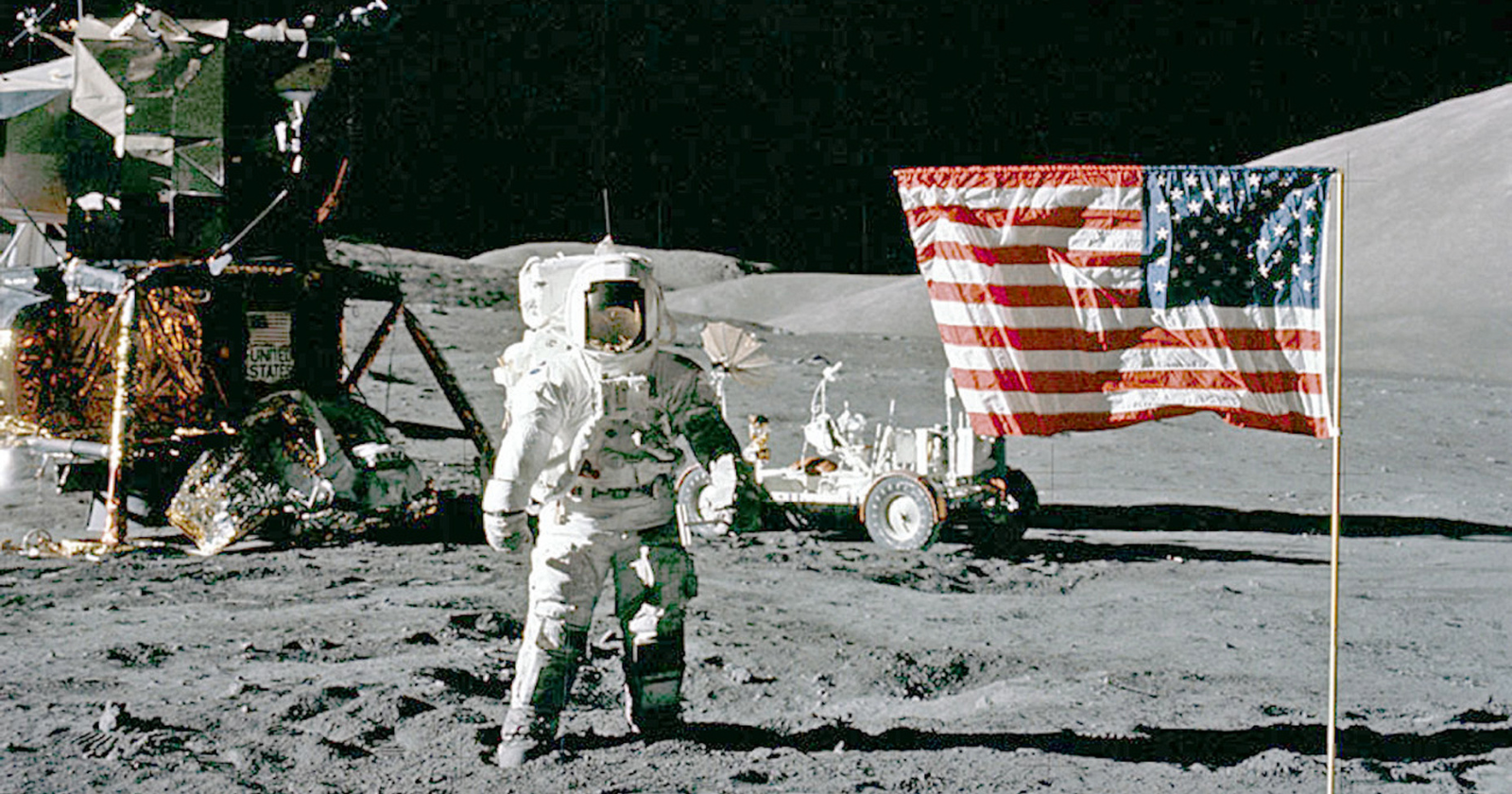
The popular framing of the question — why has no human walked on the Moon since 1972? — usually proceeds as though there is some technical answer to be found. The rockets must have stopped working. The engineering must have been forgotten. The expertise must have been lost in the half-century since Apollo 17 splashed down. The actual answer is substantially simpler and substantially less satisfying. The Apollo programme was not cancelled because it stopped being possible. It was cancelled because it stopped being useful for what it had been built to accomplish. The capability question is a downstream consequence of a political question that was settled in the early 1970s, when the American government decided that the goal of beating the Soviet Union to the Moon — having been achieved on 20 July 1969 with Apollo 11 — was no longer worth paying for, and that the remaining momentum of the Apollo programme should be redirected toward other priorities.
According to the Smithsonian National Air and Space Museum’s editorial reconstruction of the Apollo cancellations, the decisions to end the lunar programme were made in a sequence that began almost immediately after Apollo 11’s success. By December 1969 — five months after Neil Armstrong’s first footstep — one of President Richard Nixon’s top aides told NASA that “the President says that he doesn’t have enough money within the next couple of years and must accept limitation of [space] activity” and that Nixon “did not see the need to go to the moon six more times.” On 4 January 1970, the Apollo 20 mission was formally cancelled. In September 1970, Apollos 18 and 19 followed. The remaining missions — Apollos 14 through 17, the latter three already in advanced preparation — were allowed to proceed and were completed by December 1972. The Saturn V production line was shut down in 1970. The remaining unflown Saturn Vs were sent to museums, where they remain as the largest functional rockets ever built, permanently grounded.
Why the political momentum collapsed
The Kennedy speech of 25 May 1961 — “I believe that this nation should commit itself to achieving the goal, before this decade is out, of landing a man on the moon and returning him safely to the earth” — was framed in terms of national capability and human aspiration, but the actual policy logic that funded it was strategic competition with the Soviet Union. The Soviets had launched Sputnik in 1957, put Yuri Gagarin into orbit in April 1961 (six weeks before Kennedy’s speech), and were widely perceived to be ahead of the United States in space capability. The Apollo programme was, in essential terms, a national project to recover technological prestige from a position of perceived inferiority. It was funded at scales that no comparable peacetime project before or since has matched — peaking at approximately 4.4 percent of the entire US federal budget in 1966.
The strategic logic for that funding evaporated essentially the moment Armstrong stepped off the lunar module ladder in July 1969. The Soviets, by 1969, had already effectively conceded the lunar race — their N1 super-heavy rocket failed in four successive test launches between 1969 and 1972, and the Soviet crewed lunar programme was wound down quietly. There was no longer any external competitor to beat. There was no longer any strategic prestige to be gained from continued lunar landings. And the public, which had supported Apollo as a Cold War project, had never developed the underlying enthusiasm for lunar exploration as a scientific or exploratory enterprise that would have been required to sustain funding in the absence of the Cold War rationale. Polls throughout the late 1960s consistently showed that a majority of Americans thought Apollo was not worth the cost, even at the peak of the programme’s popularity.
The internal NASA decisions
Per The Planetary Society’s analysis of how Nixon shaped the post-Apollo NASA, the popular blame placed on Nixon for ending Apollo is partially deserved but oversimplifies the institutional dynamics. NASA itself, under Administrator Thomas Paine, agreed to terminate Saturn V production and cancel later Apollo missions in order to free up budget for the post-Apollo programmes the agency wanted to pursue — an experimental space station that would become Skylab, and a reusable spacecraft that would become the Space Shuttle. The choice was framed within NASA as a redirection of resources from the now-completed lunar landing programme toward new objectives, rather than as an abandonment of human spaceflight. The institutional case for shutting down the Saturn V line was that it was no longer needed for the missions the agency intended to pursue, and that maintaining a manufacturing line for a rocket the agency was not going to use would have consumed budget that could be spent on the Shuttle.
That decision turned out to be one of the more consequential institutional choices of the post-Apollo era. The Shuttle programme that NASA selected as its successor to Apollo was, by every available assessment, a substantially less ambitious vehicle than what the Saturn V could have supported, while also being substantially more expensive per launch than Apollo had been. The Shuttle operated from 1981 to 2011, completed 135 missions, lost two crews and 14 astronauts in catastrophic accidents, and never carried humans beyond low Earth orbit. The capability that had allowed twelve men to walk on the Moon between 1969 and 1972 was, by the time the last Saturn V was sent to a museum in the mid-1970s, no longer institutionally sustainable. Restarting it would require essentially rebuilding the entire programme from scratch — which is what NASA’s Artemis programme has, in fact, been attempting to do for the past several years, at substantial cost and with substantial delays.
What “lost capability” actually means
As covered by AmericaSpace’s detailed history of the Apollo cancellations, the popular claim that humanity “lost the capability” to return to the Moon is partially true and partially misleading. The engineering knowledge from Apollo was documented and survives in archives, technical reports, and the institutional memory of the relatively small number of engineers from the era who are still alive. The capability that was lost is not the knowledge itself but the institutional infrastructure that supported it: the Saturn V manufacturing line, the supplier networks, the specialised workforce, the test facilities, and the political-economic configuration that allowed roughly 400,000 people working across NASA and its contractor network to be mobilised on a single objective with a national-priority budget. None of these things are recoverable in their original form. They have to be rebuilt, which is essentially what the Artemis programme is now doing, and which is partly why the rebuild has taken decades and substantially exceeded its original budget.
The deeper point is that the question “why has no one been back to the Moon in fifty-three years?” has the same answer as the question “why was anyone there in the first place?” The Apollo programme was a Cold War project that happened to produce, as a byproduct, the most ambitious feat of exploration in human history. When the Cold War rationale for the project ended, the project ended. The capability that had been built for the project was allowed to decay because the institutional reasons for maintaining it had decayed first. The current revival of crewed lunar exploration — through Artemis, through China’s parallel programme, through the commercial-spaceflight ecosystem that has emerged over the past decade — is taking place because new institutional reasons have emerged: geopolitical competition with China, commercial interest in lunar resources, scientific interest in the lunar south pole, and a renewed sense in several capitals that human presence beyond Earth orbit is strategically valuable. Whether the new reasons will sustain a sustained human presence on the Moon, or whether the next round of lunar landings will be followed by another half-century pause, depends on whether the institutional infrastructure being built now is durable enough to survive the eventual evaporation of whatever specific political momentum is currently funding it. The Apollo experience suggests that this is not a question to be answered with technological optimism.