
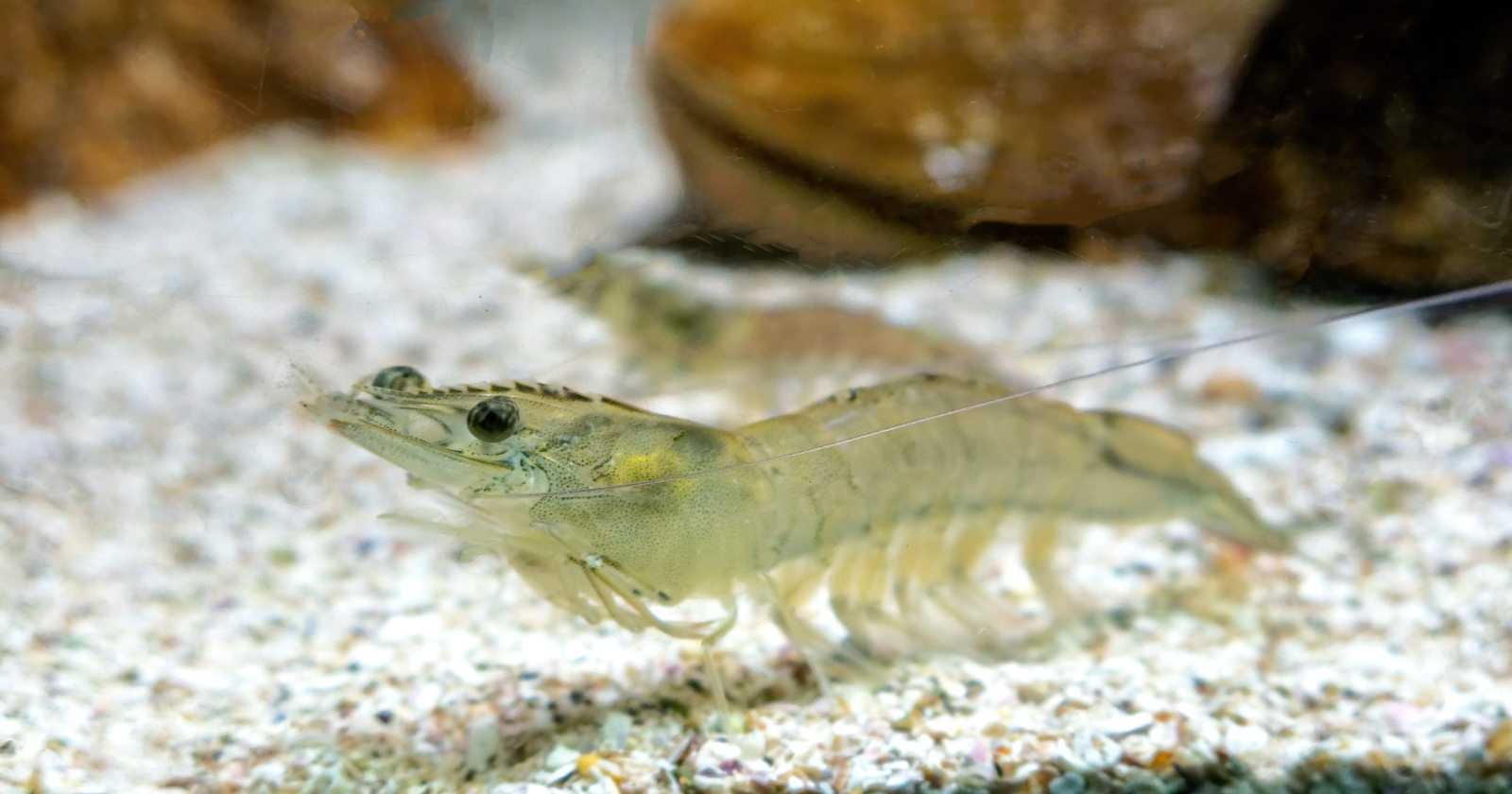
A snapping shrimp does not need to touch what it kills. It cocks one oversized claw, holds it under tension, and releases; the claw shuts in well under a millisecond. The animal a few millimetres away dies from a pressure wave thrown off by a bubble that forms, and then violently collapses, in the water the claw has flung forward.
That was the finding at the centre of a 2000 paper in Science by Michel Versluis, Barbara Schmitz, Anna von der Heydt and Detlef Lohse, working on the species Alpheus heterochaelis. Using high-speed imaging synchronised with hydrophone recordings, the team showed that the loud snap arrives at the instant the cavitation bubble collapses, not at the instant the claw closes.
What the 2000 paper actually showed
This is a study in fluid physics more than brute mechanical force. When the claw snaps shut, it drives a jet of water forward at roughly 25 metres per second. That is fast enough to pull the local pressure below the vapour pressure of water, which lets a pocket of vapour open up in the jet’s wake. Surrounding water then rushes back and crushes it. The collapse produces the crack, and the crack is loud. Snapping shrimp are among the more persistent sources of underwater noise on shallow reefs, something acousticians had documented as far back as F. Alton Everest and colleagues in a 1948 paper in the Journal of the Acoustical Society of America.
The correction we find useful in the Versluis work is small and exact: the sound and the stunning effect that comes with it both belong to the bubble’s collapse, not the claw’s closing.
The flash, and the number everyone repeats
A year later came the follow-up. Writing in Nature in 2001, Lohse, Schmitz and Versluis reported that each bubble collapse also throws off a brief flash of light, far too faint to see with the naked eye. They called it shrimpoluminescence, by analogy with sonoluminescence, the light emitted by bubbles driven with ultrasound.
That flash matters for what it implies. To emit at the wavelengths observed, the interior of the bubble at the moment of collapse must reach extreme conditions, which the authors put at a temperature of at least 5,000 kelvin. That is the figure that has travelled, usually in the form “hotter than the surface of the Sun.”
That number deserves careful handling. Five thousand kelvin is a lower bound inferred from the light, not a value read off a thermometer. The Sun’s visible surface sits at roughly 5,800 kelvin, so the bubble interior is in the same neighbourhood rather than clearly above it. And the heat is confined to a bubble a fraction of a millimetre across, for a span measured in fractions of a microsecond. As a matter of scale the comparison holds, as long as the scale stays in view.
Why the heat is not the weapon
Here the popular version tends to slip.
The flash is the vivid part, so it gets treated as the point. The authors were clear that it is not. In their reading the light is a by-product of the collapse and carries no obvious biological function. What the shrimp actually uses is the shockwave, the same pressure front responsible for the sound.
So the sequence that kills runs mechanical, then hydrodynamic, then acoustic. The claw moves. A bubble forms and collapses. A pressure wave spreads out and stuns or kills a small crab, worm or rival shrimp close by. The thousands of degrees inside the bubble are real, but they are a side effect of the event, not the thing doing the damage.
Cavitation, from ship propellers to a plasma device
Cavitation itself is not exotic. It is a routine and costly problem in engineering, where collapsing bubbles pit and erode ship propellers, pump impellers and turbine blades over time. The shrimp does deliberately, and without harm to itself, what engineers spend money trying to prevent. That contrast is part of why the animal has drawn attention from fluid dynamicists as much as biologists.
Modelling has continued since. A 2017 paper in Scientific Reports by Phoevos Koukouvinis and colleagues at City University in London simulated the whole flow around a simplified claw and found that the cavity is not one spherical bubble but a toroidal ring, thrown off as the jet rolls up into a vortex. Their simulation put the local pressure peaks from the ring’s collapse at around 80 bar. The much larger figure sometimes attached to this animal, roughly two thousand bar, belongs to an earlier spherical-bubble estimate in the 2000 Science paper rather than to the 2017 flow model.
Others have gone further and built the mechanism. A 2019 paper in Science Advances by Xin Tang and David Staack described a bioinspired mechanical device that generated plasma in water through cavitation, taking the shrimp’s method as its starting point.
What is still inferred rather than measured
Much of this remains indirect. Temperature inside the bubble is deduced from the light and from comparison with sonoluminescence, not measured directly, and the exact conditions depend on assumptions built into the models. Its broad picture is well established across the 2000 and 2001 papers and the work that followed. The peak temperature of a collapsing shrimp bubble is not a pinned-down figure, and the people who study it have been careful not to pretend otherwise.
