
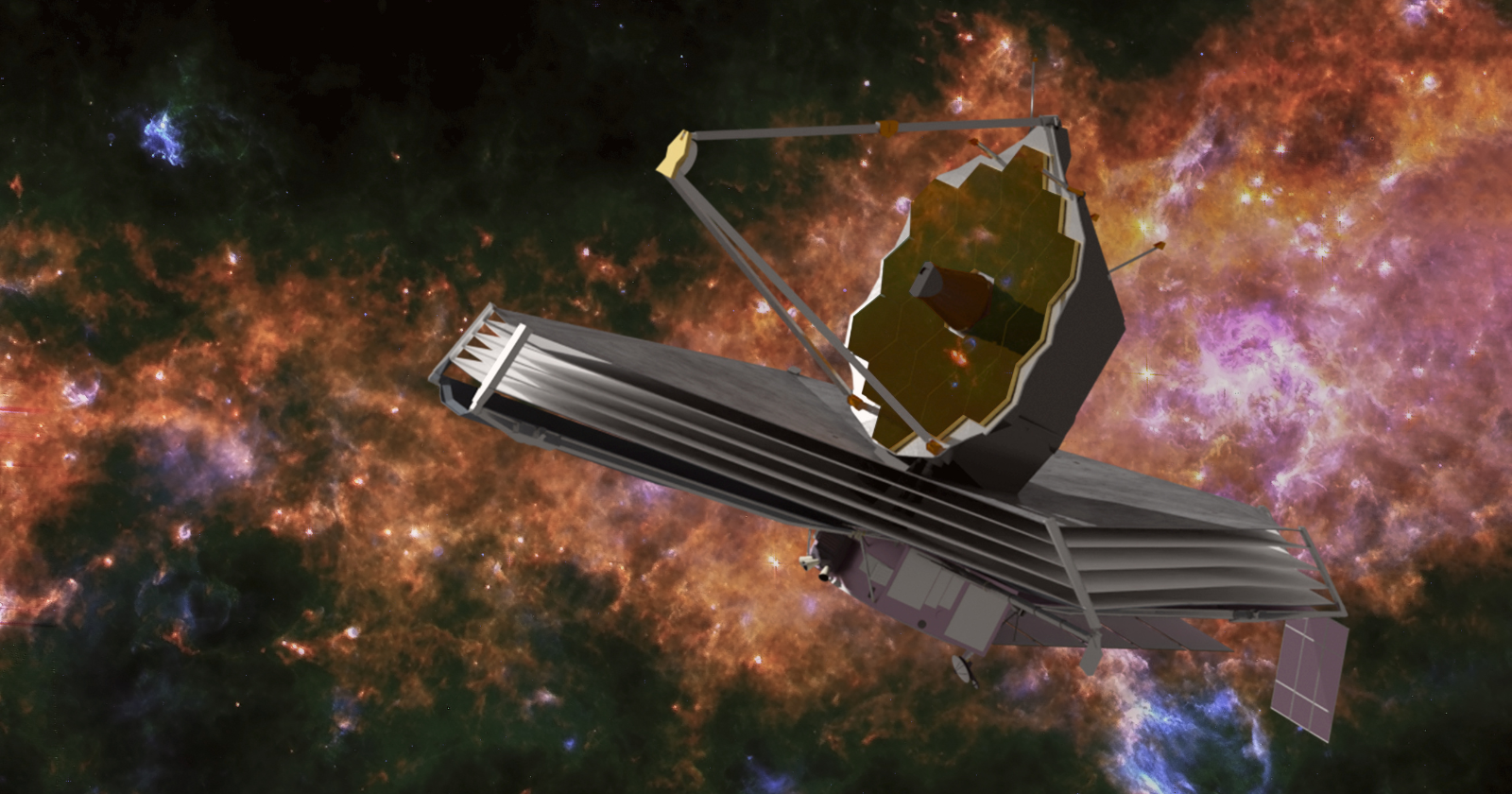
No human being has ever been as far from Earth as the James Webb Space Telescope is right now. The farthest any crew has travelled is about 406,800 kilometres, a record set by Artemis II in April 2026 when it passed the mark Apollo 13 had held since 1970. Webb sits at almost four times that distance. Its predecessor, the Hubble Space Telescope, has spent its entire operational life in low Earth orbit at approximately 547 kilometres altitude — a distance close enough to Earth that the Space Shuttle made five separate servicing missions to Hubble between 1993 and 2009, replacing instruments, repairing failed gyroscopes, installing new solar panels, and ultimately extending the telescope’s lifespan from its originally planned 15 years to what is now 35 years and counting. Webb sits approximately 2,750 times farther from Earth than Hubble does. No crewed spacecraft currently planned by any space agency is designed to reach L2. The closest any rescue mission could come, even in principle, would require approximately 30 days of one-way travel time with no atmosphere, no refueling, no recovery option if anything went wrong. Webb is, in the strict engineering sense, on its own.
According to NASA’s official documentation of Webb’s sunshield system and the thermal architecture of the telescope, the central engineering problem the sunshield solves is that Webb is an infrared telescope. It observes the heat signatures of distant galaxies, of star-forming regions enshrouded in dust, of exoplanet atmospheres, of the universe at redshifts corresponding to the first few hundred million years after the Big Bang. For any of these observations to work, the telescope itself must be colder than its targets — otherwise, the infrared radiation emitted by Webb’s own structure would drown out the faint heat signatures it is attempting to detect. The threshold below which the instruments can function is approximately 50 kelvin, or -223 degrees Celsius. The Mid-Infrared Instrument (MIRI), the most temperature-sensitive of Webb’s four science instruments, requires an even colder environment of approximately 7 kelvin (-266 degrees Celsius), achieved through a dedicated cryocooler — the only active cooling system on the entire spacecraft. Every other component of Webb’s cold-side cooling is passive. The sunshield handles it. Sitting in the deep shade behind five layers of Kapton polyimide film, the telescope simply radiates its own heat into the surrounding vacuum of space and cools to operational temperature by itself.
How five sheets of plastic block the Sun
The sunshield, in cross-section, is a remarkable object. Each of its five layers is made of Kapton — a polyimide film originally developed by DuPont in the 1960s — that is approximately 0.05 millimetres thick for the outermost (sun-facing) layer and 0.025 millimetres thick for the other four layers. Each layer is coated with aluminum, and the outermost two layers are additionally coated with doped silicon to reflect away as much incoming solar radiation as possible. The layers are separated by a vacuum gap, so that what little infrared heat manages to penetrate the first layer radiates outward into the space between layers and re-emits before reaching the next layer. As described in Scientific American’s coverage of the sunshield deployment that completed on 4 January 2022, the temperature drops by approximately 55 degrees Celsius across each successive layer. Layer 1 (sun-facing) sits at approximately +85°C. Layer 5 (telescope-facing) sits at approximately -233°C. The cumulative gradient of approximately 318 degrees Celsius is achieved across a stack approximately 4.8 metres in total height — five layers of plastic film, vacuum gaps, and aluminum coatings, doing the work that on Earth would require a refrigerator the size of a small building.
The size of the sunshield is dictated by the geometry of L2. To work as designed, the shield has to simultaneously block direct sunlight, reflected light from Earth, reflected light from the Moon, and (at certain orbital configurations) reflected light from the Earth-Moon system as a combined source. All three bodies remain approximately in line with the Sun from Webb’s vantage point at L2 — which is the point of placing the telescope there in the first place — but each subtends a slightly different angle. The shield has to be large enough that all three remain in shadow simultaneously, regardless of small variations in Webb’s halo orbit around the L2 point. The resulting dimensions are 21.2 metres by 14.2 metres — approximately the length and width of a singles tennis court. The shield could not be launched in its deployed configuration; no rocket fairing is large enough. It had to be folded into a launch-ready configuration and unfolded after the spacecraft had separated from the Ariane 5 launch vehicle. The unfolding sequence, which took 10 days and involved 178 separate release mechanisms operating in a specific choreographed order, was completed on 4 January 2022. Any one of the 178 mechanisms failing to release on command would have left the shield improperly deployed and the telescope unable to reach operational temperature.
What unreachability actually means
The combination of distance and complexity produces an engineering problem that is qualitatively different from any previous space telescope. As detailed in the comprehensive NASA mission paper describing Webb’s commissioning sequence and its operational performance in the first year at L2, the design philosophy that governed Webb’s construction was that essentially every system had to work the first time, in space, with no possibility of subsequent intervention. The 18 hexagonal segments of the primary mirror had to align themselves to within tens of nanometres of optical precision using onboard actuators, with the alignment process taking approximately 90 days and proceeding through a series of carefully choreographed phases that no human operator could intervene to correct. The mid-infrared cryocooler had to reach its operational temperature of approximately 7 kelvin and remain there, indefinitely, with no possibility of refilling or replacing its working fluid. The propellant tanks had to be filled with enough hydrazine to maintain the spacecraft’s halo orbit around L2 for the entire planned mission duration — initially estimated at five to ten years but, due to the unusually precise trajectory delivered by the Ariane 5 at launch, now expected to last approximately twenty years before station-keeping fuel runs out and the spacecraft drifts permanently away from L2.
The unreachability has, in retrospect, also produced some of the engineering compromises that defined Webb’s three decades of development. As discussed in a 2025 arxiv paper by the Webb design team describing the genesis of the spacecraft’s architecture and the reasoning behind its key engineering choices, the decision to place the telescope at L2 rather than in a serviceable Earth orbit was made early in the design process — primarily because L2 provides the stable thermal environment that the sunshield design requires, and because it offers continuous unobstructed observation of essentially the entire celestial sphere without the day-night cycle that constrains low-Earth-orbit telescopes. The cost of that decision was that every single component had to be qualified for indefinite operation without maintenance. The result, four years into operation, is a telescope that has detected galaxies as they existed approximately 13.4 billion years ago, identified water vapour and carbon dioxide in the atmospheres of exoplanets dozens of light-years from Earth, and resolved the structures of star-forming regions in detail no previous instrument has approached. It sits, at this writing, approximately 1.5 million kilometres from any possibility of repair. It is expected to continue doing what it does until approximately 2042, at which point its hydrazine reserves will be exhausted, its station-keeping ability will end, and the telescope will drift away from L2 into a long, slow heliocentric orbit — silent, unrecoverable, permanently beyond the reach of any plausible follow-up mission, a 6,500-kilogram artefact of early-21st-century human engineering left orbiting the Sun for what will, in practice, be the indefinite future of the species that built it.
