
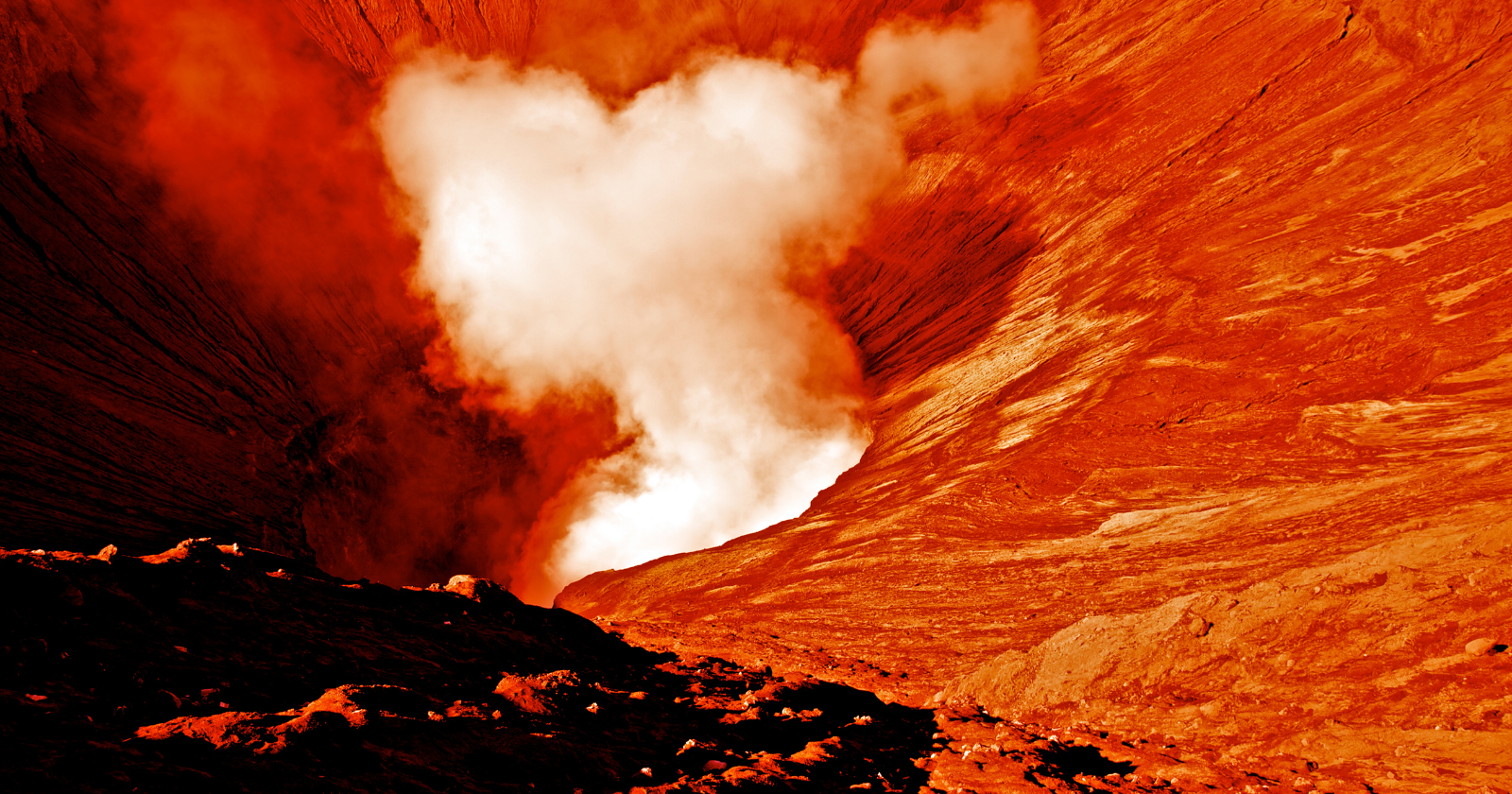
Olympus Mons sits in the western hemisphere of Mars, in a region called Tharsis that is itself a vast volcanic plateau. The mountain rises approximately 21 to 22 kilometres above the surrounding plains, making it the tallest known volcano anywhere in the solar system. Its base is roughly 600 kilometres across and covers an area of approximately 300,000 square kilometres — about the size of the US state of Arizona, or roughly equivalent to the entire country of Italy. The volume of the mountain itself is on the order of 4 million cubic kilometres, approximately 100 times the volume of Mauna Loa, the largest volcano on Earth. Olympus Mons is, by every meaningful measure of scale, an object that no terrestrial reference point quite prepares the imagination to accept.
The volcano was first observed from Earth in the 19th century, when the Italian astronomer Giovanni Schiaparelli noted a persistently bright patch in the Tharsis region during his 1879 mapping of Mars and named it Nix Olympica, the “Olympic Snow,” suspecting (correctly) that it was a high feature catching sunlight at angles other parts of the Martian surface could not reach. The patch’s true nature became visible only in 1971, when NASA’s Mariner 9 spacecraft entered orbit around Mars during a planet-wide dust storm. As the dust settled, the spacecraft’s cameras began returning images of an enormous mountain rising above the clearing atmosphere. According to BBC Sky at Night Magazine’s profile of Olympus Mons, the discovery transformed planetary science’s understanding of what kinds of structures were geologically possible.
Why Olympus Mons is so large
The combination of features that produces a 22-kilometre-high volcano does not exist on Earth. According to Space.com’s reference on Olympus Mons, two factors specific to Mars allowed the mountain to grow to its current dimensions. The first is the absence of plate tectonics. On Earth, the Pacific Plate moves continuously over the Hawaiian hotspot, with each volcano on the island chain forming only while it sits directly above the upwelling magma plume, then drifting off as the plate moves and being replaced by a new volcano further along. Mauna Loa is large because of how much magma the Hawaiian hotspot has produced, but no single Hawaiian volcano sits over the hotspot long enough to grow to the scale of Olympus Mons. Mars, by contrast, has no significant plate tectonics. Its crust does not move. A volcanic hotspot remains beneath the same location for billions of years, and every drop of magma the hotspot produces stacks up on the same volcano. Olympus Mons formed over an estimated 3.5 billion years, with each successive eruption adding a layer of lava on top of the previous ones.
The second factor is gravity. Mars has approximately 38 percent of Earth’s surface gravity. A mountain on Earth that rises high enough to exceed the structural limit of its base rock will eventually slump or collapse under its own weight, with the rock at the base flowing slowly outward to relieve the pressure. The Hawaiian volcanoes, for example, have approximate height limits set by this balance between rock strength and gravitational load. The same volcano on Mars, with gravity less than half as strong, can grow to nearly three times the height before reaching the equivalent structural limit. Olympus Mons sits comfortably within Mars’s structural capacity. There is no obvious reason it could not have grown larger still, given more time.
The shape of a shield
The reason Olympus Mons is gentle enough to walk up without noticing is that it is a shield volcano — a category of volcano formed by repeated low-viscosity lava flows that spread out widely from the vent rather than building up steeply around it. According to Astronomy magazine’s profile of the volcano, Olympus Mons is approximately 20 times wider than it is high. A typical traverse from base to summit would mean walking 300 kilometres horizontally while rising 22 kilometres vertically, an average slope of about 5 degrees. By comparison, Mount Everest’s slope from base camp to summit averages closer to 35 degrees. A climber who walked Olympus Mons at an unhurried 4 kilometres per hour would need approximately 75 hours to reach the summit from the base — roughly three days of continuous walking — without ever experiencing a slope steep enough to require climbing equipment of any kind.
The shield-volcano structure also produces a particular visual peculiarity. The horizon on Mars sits closer than on Earth, because Mars is smaller and its surface curves away faster. The horizon distance for a 1.8-metre-tall observer standing on the Martian surface is approximately 3.4 kilometres. From the summit of Olympus Mons, the base of the mountain is approximately 300 kilometres away in every direction — far beyond the horizon. An astronaut standing on the summit would see, in every direction, what appeared to be a flat plateau extending to the curvature of the planet. The “mountain” would be invisible because it is too large to fit within visual range. An astronaut walking up the flanks would experience the same problem in reverse. The slope ahead would always look flat. The slope behind would always look flat. The actual structure of the volcano can be perceived only from orbit.
The caldera and the cliff
The summit of Olympus Mons is not a peak but a complex of overlapping calderas — collapsed lava chambers that subsided after their contents had been emptied during past eruptions. The full caldera complex is approximately 80 kilometres by 60 kilometres in extent, formed by six separate collapse events that have left a depression at the summit large enough to contain the entire Greater London urban area. The walls of the caldera drop steeply for several kilometres into the floor of the depression, providing the only place on the volcano where the local terrain has anything resembling steep slope.
The base of Olympus Mons is also unusual. Unlike a typical shield volcano, where the lower slopes simply flatten gradually into the surrounding terrain, Olympus Mons is ringed by a steep escarpment — a continuous cliff that drops anywhere from 6 to nearly 10 kilometres from the volcano’s edge to the surrounding plain. The cliff’s origin is not fully understood. Possibilities include the collapse of a continental-scale landslide, the action of an ancient Martian ocean that once lapped against the volcano’s flanks, or some interaction between the volcano’s mass and the underlying crust. Whatever the cause, the cliff is the only piece of Olympus Mons that visually announces itself as part of an enormous volcanic structure. An astronaut walking up from the surrounding plain would encounter, after hundreds of kilometres of flat terrain, a kilometres-high vertical wall.
Whether it’s still active
The last eruption of Olympus Mons is believed to have occurred approximately 25 million years ago — recent enough, in geological terms, that planetary scientists do not consider the volcano definitively extinct. Most of Mars’s volcanic activity ceased billions of years ago as the planet’s interior cooled. But the Tharsis region, including Olympus Mons, has remained marginally active for far longer than the rest of the planet, and the youngest visible lava flows on the volcano’s flanks are surprisingly young. Whether Olympus Mons might erupt again, on what timescale, and what such an eruption would look like are open questions that future Mars missions are expected to help answer. What is settled is that the largest known volcano in the solar system has been quietly building itself, eruption by eruption, for longer than complex life has existed on Earth, and that the result is a structure so large that the human visual system, evolved for terrestrial mountains, cannot quite see it for what it is.
