

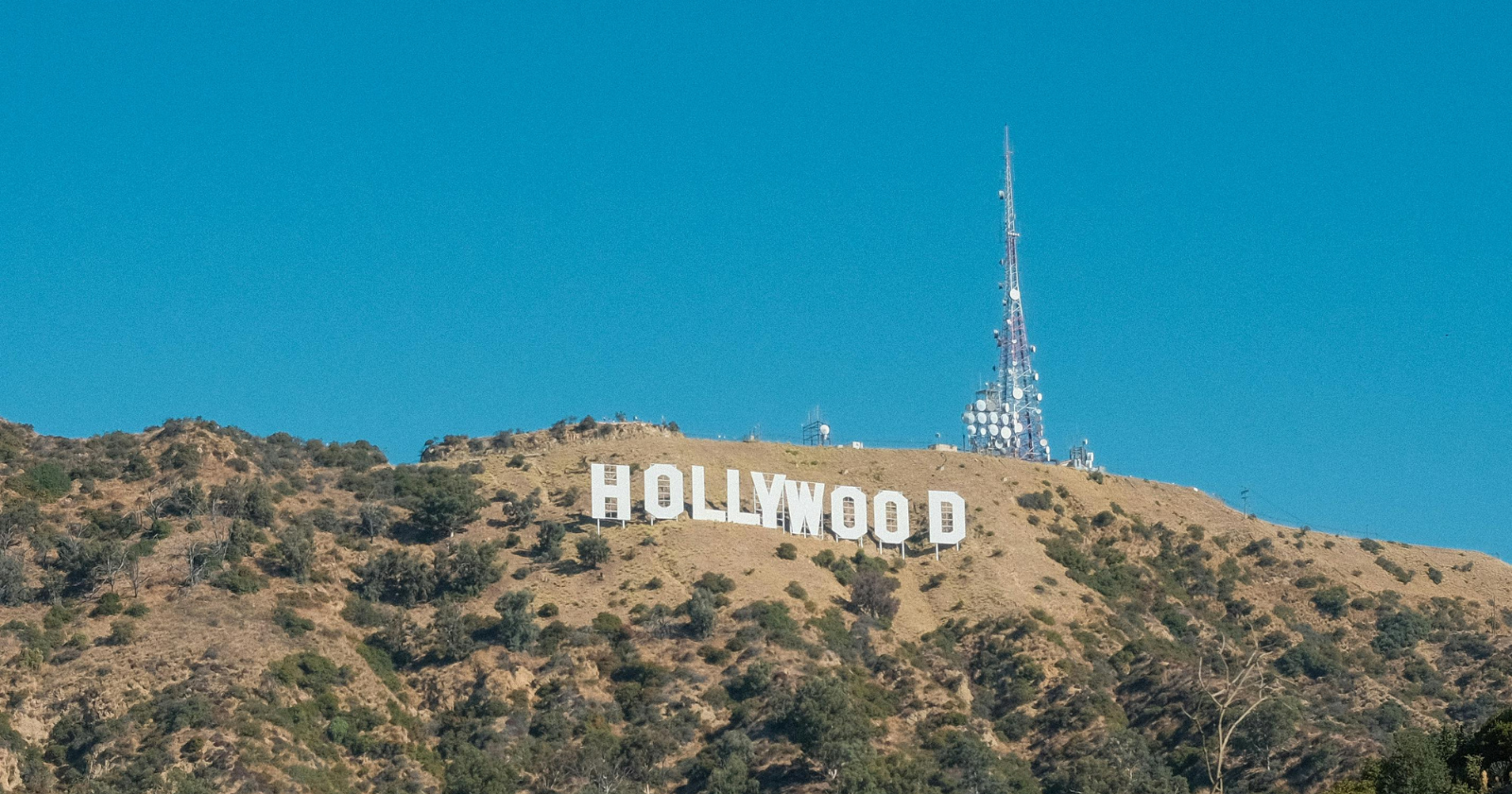
Almost every tourist who flies into Los Angeles, drives up Beachwood Canyon, points a phone at the white letters on the hillside, and posts the resulting photograph to the internet is, technically, photographing the leftover signage from a Roaring Twenties housing subdivision whose homes have all long since been built, sold, and resold many times over. The Hollywoodland tract that the original sign advertised was a hillside residential development promoted by a five-man syndicate consisting of the Los Angeles Times publisher Harry Chandler, the railroad tycoons Eli P. Clark and General Moses Sherman, and the real estate developers Tracy E. Shoults and Sidney H. Woodruff. The syndicate had purchased a large tract of undeveloped land at the upper end of Beachwood Canyon, north of the already-established Hollywood district of Los Angeles, with the intention of subdividing it into lots and marketing it to upper-middle-class buyers as a “superb environment without excessive cost on the Hollywood side of the hills.” The marketing campaign was, in essential respects, a Hollywood production. Mack Sennett, the comedy producer, was brought in to film promotional reels at the site. Press photographers documented the detonation of eight thousand pounds of dynamite to prepare lots for grading. The construction of demonstration homes was filmed in its entirety. The visual centrepiece of the entire campaign, however, was the sign — a 13-letter, 450-foot-long, ridge-mounted electric advertisement, designed to be visible from essentially anywhere in the Los Angeles basin during the day and lit at night by approximately 4,000 light bulbs that flashed the words HOLLY, WOOD, and LAND in sequence, followed by the complete word HOLLYWOODLAND, followed by darkness, followed by the cycle starting again.
According to the Hollywood Sign Trust’s archival history of the sign’s original construction and the disputed date of its dedication, the sign was built by the Crescent Sign Company under the direction of its owner, Thomas Fisk Goff, over approximately 60 days during the summer and autumn of 1923. Each individual letter was constructed of sheet metal panels mounted on wooden scaffolding, with telephone-pole supports anchored into the steep mountainside by means of holes excavated into the hillside and packed with concrete. The materials were transported up the mountain by mule team, since no road existed to the construction site at the elevation the sign required. The total construction cost, in 1923 dollars, was approximately $21,000 — equivalent to approximately $370,000 in 2026 purchasing power. The popular history of the sign frequently dates its official dedication to 13 July 1923, but the Hollywood Sign Trust’s archival research has found no contemporary record of any such dedication ceremony, and the documentary evidence places the actual completion of the sign closer to the end of 1923, with the formal unveiling of the illumination system occurring on the night of 8 December 1923. The first photographs of the completed sign, including the night-time illumination, date from the final weeks of 1923 and the early weeks of 1924.
What was supposed to happen and what happened instead
The Hollywoodland sign was, by the explicit understanding of the syndicate that commissioned it, a temporary advertising structure. The contract with the Crescent Sign Company called for an 18-month operational lifespan. The expectation was that by mid-1925, the available lots in the Hollywoodland tract would either have been sold (in which case the sign would have served its purpose and could be dismantled) or would be in a sufficiently advanced sales process that the cost of maintaining the sign’s illumination would no longer justify itself. The Hollywoodland development was successful enough on its own terms — the syndicate continued to sell lots throughout the 1920s, the development grew steadily into the residential neighbourhood it remains today — but the sign turned out to have a separate and unexpected economic life of its own. As described in Smithsonian Magazine’s account of the hidden history of the Hollywood sign and its evolution from real estate advertisement to global cultural icon, the sign rapidly became associated, in the public imagination of the entire Los Angeles basin and progressively of the broader American filmgoing public, not with the specific real estate tract it had been built to advertise but with the broader Hollywood film industry that was, by the mid-1920s, settling into its identity as the global capital of cinematic production.
The shift from “advertisement for a housing development” to “iconic symbol of the film industry” happened gradually, without any single decisive moment, across the period roughly 1925 to 1935. The syndicate noticed. They allowed the sign to remain. The illumination system was switched off in 1933 (the cost of replacing 4,000 light bulbs at high altitude on a continuous basis had become unsupportable during the Depression), but the physical letters remained. The sign deteriorated slowly through the 1930s and 1940s, periodically damaged by windstorms, occasionally repaired, frequently photographed by tourists, increasingly woven into the visual iconography of Hollywood films set in Hollywood. The most famous incident of the early period was the September 1932 suicide of the 24-year-old British actress Peg Entwistle, who climbed a workman’s ladder up the letter H one night and jumped to her death. The incident attached, retroactively, a darker register to the sign’s symbolic meaning — Hollywood as a place of broken dreams as well as fulfilled ones — that subsequent decades of film and journalism would substantially elaborate.
How the city ended up owning it
The transition from private commercial property to public landmark happened in two stages. As detailed in the Los Angeles Conservancy’s archival summary of the sign’s ownership history and its near-demolition in the late 1940s, the Hollywoodland syndicate, having largely completed the sale of lots in the development, transferred ownership of the sign and the surrounding 425 acres of land to the City of Los Angeles in 1944. The transfer was not a forced one — the developers were not bankrupt and the development had not failed (the Hollywoodland tract remains an active residential neighbourhood, distinct from the broader Hollywood district, and is still referred to by some long-time Angelenos by its original name). The transfer was simply an arrangement under which the city accepted ownership of a sign that no longer served any commercial purpose for its original owners, and the syndicate disposed of an asset that no longer generated any revenue. The city, in 1944, did not have any specific plans for what to do with the sign. It deteriorated further across the second half of the 1940s.
The near-demolition occurred in 1949. The first letter H had collapsed (variously attributed to vandals, to windstorms, or to both). Local residents had begun complaining that the sign was an eyesore. The Los Angeles Recreation and Parks Commission advocated tearing the entire structure down. The Hollywood Chamber of Commerce protested. A compromise was negotiated: the Chamber would fund the repair of the H and the structural refurbishment of the remaining letters; in exchange, the last four letters (LAND) would be removed, and the sign would be reduced from “HOLLYWOODLAND” to the simpler “HOLLYWOOD” — which would reflect the broader Hollywood district rather than the specific Hollywoodland tract. The refurbishment was completed in September 1949. The sign in its current configuration — nine letters, “HOLLYWOOD” only — dates from that 1949 modification. The original 1923 sign in the form it had been built (13 letters, “HOLLYWOODLAND”) existed for approximately 26 years. The replacement structure that now stands on Mount Lee — entirely rebuilt in steel in 1978 after the original wood-and-sheet-metal letters had deteriorated past the point of further repair — has now stood for approximately 47 years, considerably longer than the original. The 1978 replacement was funded by a syndicate of nine donors (Hugh Hefner, Alice Cooper, Gene Autry, Andy Williams among them), each of whom paid $27,778 to sponsor one letter, for a total cost of $250,000. The most photographed piece of typography on Earth, in its current materially permanent form, is a 1978 reconstruction of a 1949 modification of an originally temporary 1923 real estate advertisement for a successfully completed housing development whose remaining residents still live, today, in homes on streets that wind up the hillside directly below the sign that originally advertised those homes to their grandparents’ generation a century ago.