
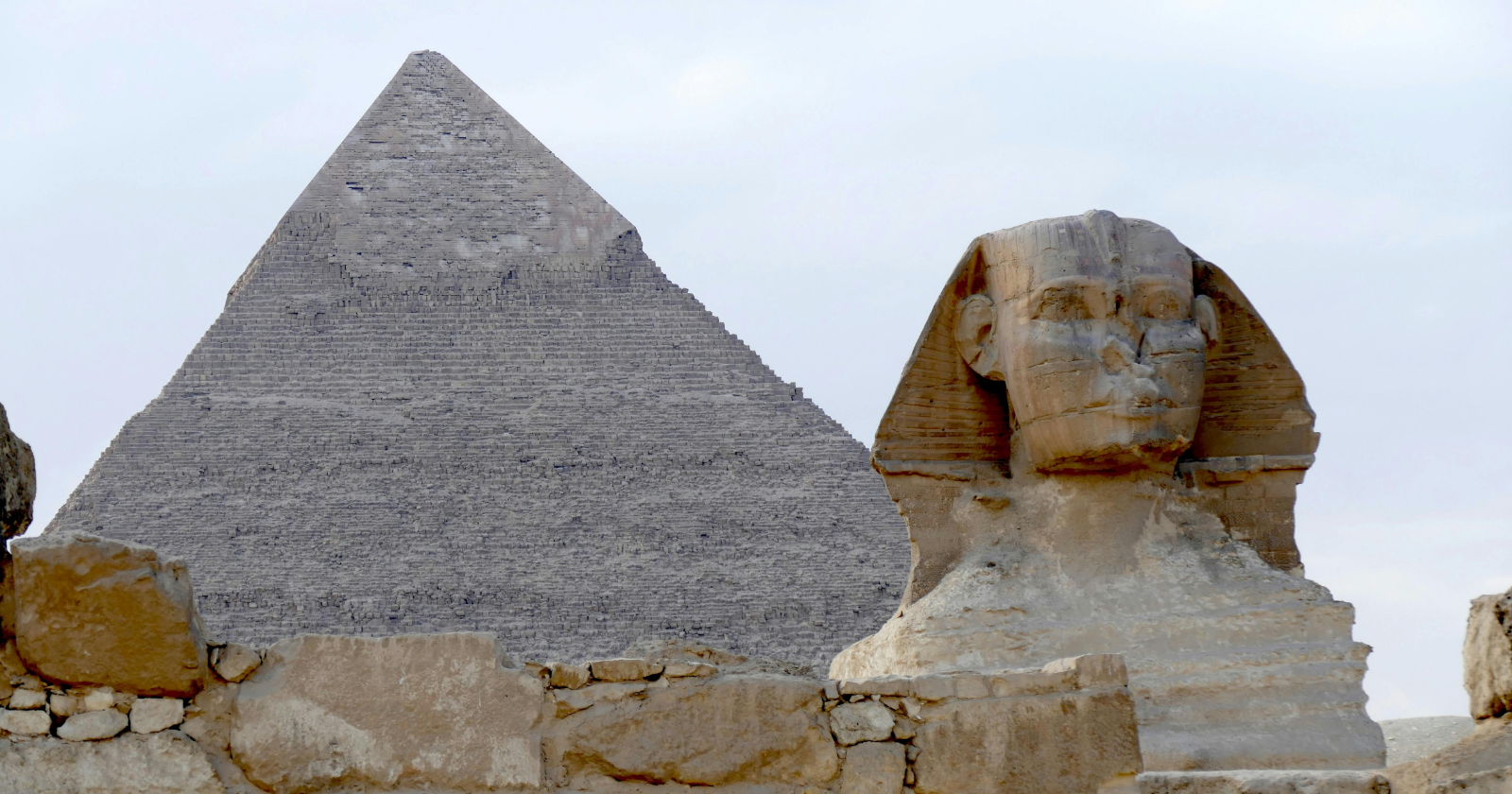
The Great Pyramid of Giza is one of those structures whose age has been repeated so often that the number no longer registers. Sources describe it as around 4,500 years old, which is technically accurate but does not do the work of giving the figure a scale. The Pyramid was constructed around 2560 BCE, during the reign of the Egyptian pharaoh Khufu of the Fourth Dynasty, and stood as the tallest human-made structure on Earth for nearly thirty-eight centuries afterwards. According to History.com’s account, that record only fell in the early 14th century CE, when the central spire of Lincoln Cathedral in England rose to about 525 feet and surpassed it. Until then, every cathedral, every fortress, every observatory, every tower built anywhere in the world, was shorter than something the Egyptians had finished in the third millennium BCE.
Two specific time comparisons illustrate the depth of the Pyramid’s age better than the round figure does. Both are accurate, and both are stranger than they sound.
Stonehenge and the Pyramid
The first comparison involves Stonehenge. In the popular imagination, the two monuments are both “ancient.” In practice, the Great Pyramid was older to the builders of Stonehenge’s final stage than the Renaissance is to anyone alive today.
Stonehenge was built in phases over roughly fifteen hundred years. The earliest works at the site, including the original circular ditch and bank, date to around 3000 BCE, which actually predates the Great Pyramid. The iconic standing stones, the sarsen circle and the bluestones, were erected around 2500 BCE, roughly contemporary with the Pyramid’s construction. But the monument was modified and added to for a thousand years more, and according to Britannica, the site’s last documented construction phase, a ring of pits called the Y and Z holes around the sarsen circle, was completed around 1520 BCE. By the time those final pits were dug, the Great Pyramid was already a thousand and forty years old. Khufu had been dead for forty generations. The Old Kingdom that built the pyramid had collapsed, recovered as the Middle Kingdom, collapsed again, and entered the New Kingdom under entirely different pharaohs.
According to English Heritage’s account of the site, the people working on Stonehenge’s final modifications were Bronze Age Britons. They lived more than a millennium after the height of Old Kingdom Egypt. They had no awareness, as far as is known, that a vastly larger and more sophisticated monument had been standing for a thousand years on a different continent. They were simply finishing their own ancient project.
Cleopatra and the Pyramid
The second comparison is more disorienting still. Cleopatra VII, the last active ruler of Ptolemaic Egypt, was born in 69 BCE and died in 30 BCE. When she walked through Alexandria, the Pyramid of Giza was already more than 2,500 years old. The gap between her lifetime and the Pyramid’s construction was greater than the gap between her lifetime and the present.
The arithmetic is direct. The Pyramid was built around 2560 BCE. Cleopatra died in 30 BCE. The interval is 2,530 years. From Cleopatra’s death to the year 2026 is 2,056 years. The Pyramid was 474 years older to her than she is to us. To put it another way, if a contemporary visitor stands in front of the Pyramid today and tries to imagine Cleopatra looking at the same monument, the visitor has the shorter mental journey. Cleopatra had to look back further to see Khufu than people now have to look back to see her.
This is not a trick of selective dating. Cleopatra is famous partly because she sits at the boundary between antiquity and the period most of European and Mediterranean history is comfortable narrating. She negotiated with Julius Caesar and Mark Antony. The Roman Empire was still expanding when she died, the Greek-speaking world was still recognisable, and the cultural reference points she shared with educated Romans are reference points that descend, with various interruptions, into the modern world. None of those reference points were available to Khufu. The civilisation that built the Pyramid was as remote from Cleopatra as the early medieval period is from us.
Why the perspective matters
The Pyramid is one of those objects whose familiarity has come at the cost of comprehension. Photographs of it are everywhere. Diagrams of its internal chambers appear in elementary school textbooks. The structure has been incorporated into so much popular media that its actual scale on the timeline of human civilisation tends to flatten into “very old, sort of like the other very old things.”
The two comparisons in this piece are not chosen arbitrarily. They are the two most reliable ways to refresh the figure. The Great Pyramid was already an ancient structure when the people of Bronze Age Britain put the finishing touches on Stonehenge. It was older still by the time Cleopatra became pharaoh of Egypt, ruling a country that had absorbed the Pyramid into its national mythology for so long that the original construction was, by then, already deeper in the past than the rise and fall of Rome would later be from the perspective of someone living today.
The structure is still standing. The granite blocks of the King’s Chamber are still arranged in approximately the same configuration that Khufu’s masons left them in around 2560 BCE. Erosion has reduced the original height of about 481 feet to roughly 455 feet, and the polished white Tura limestone casing that once covered the exterior was stripped centuries ago for use in Cairo’s buildings. According to World History Encyclopedia, what remains is the core. The core is enough. It is the only one of the original seven wonders of the ancient world that still exists, and it has been there for so long that the other six, which have not, were already considered extraordinarily old when they were built.
The next time the figure “4,500 years old” appears, the more useful version of it is this: the structure was old by the time the iconic stones at Stonehenge were laid. It was ancient by the time Tutankhamun was born. It was a tourist attraction in the Roman Empire. It outlasted every empire that has ever existed, and it is still outlasting them. The remarkable thing is not that it is old. The remarkable thing is how old it was already, even to the people we ourselves think of as ancient.
