
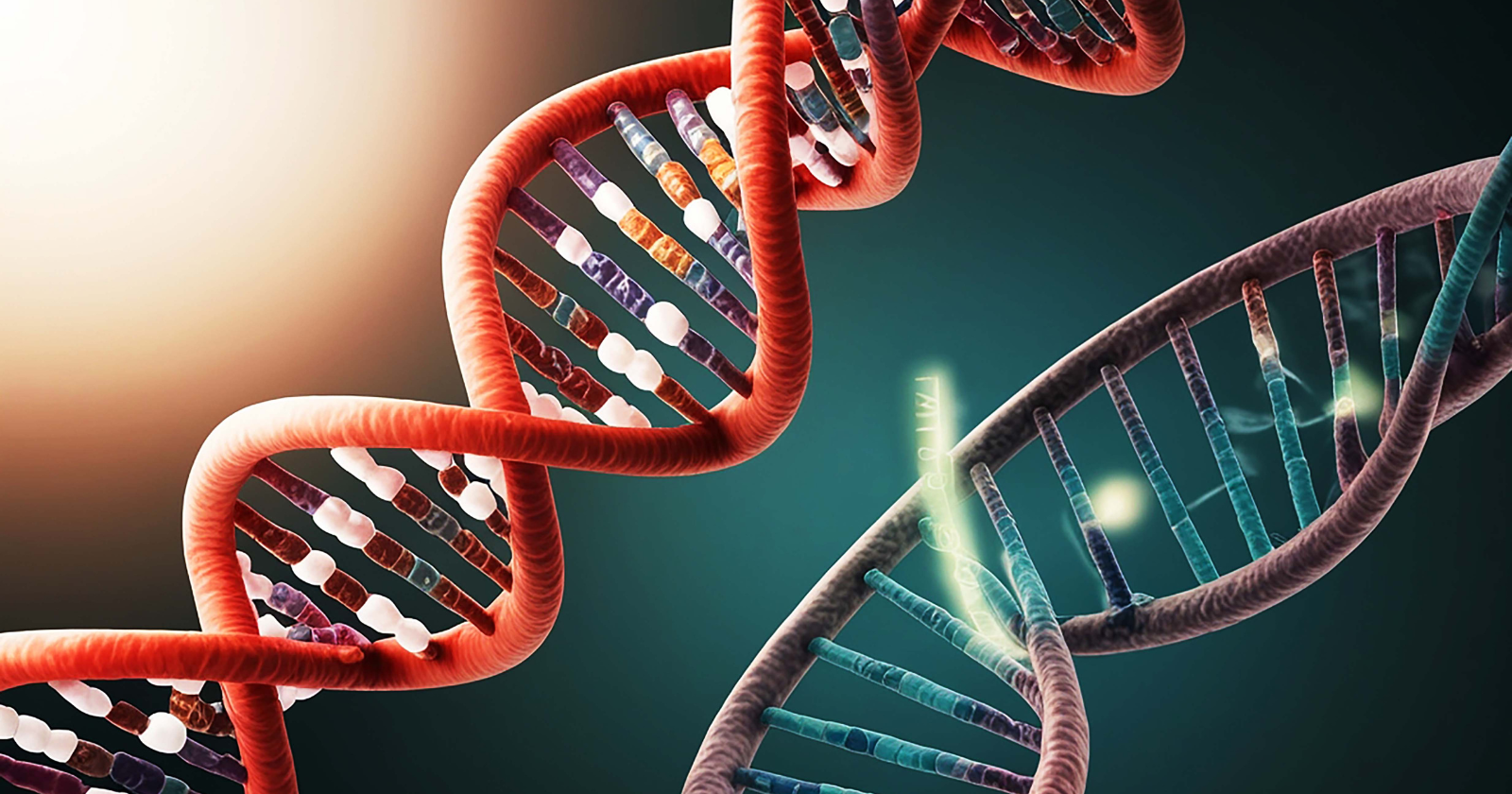
The arithmetic is straightforward and the result is hard to digest. Inside the nucleus of nearly every cell in your body, a length of DNA approximately 2 metres long is folded, coiled, supercoiled, and packaged into a structure about 5 to 10 micrometres across — a thousandth of a millimetre. The cells themselves are about 10 to 30 micrometres in diameter, large enough that perhaps 30,000 to 50,000 of them could fit across the head of a pin if laid flat in a single layer. Each of those cells, with the exception of mature red blood cells and a few other specialised types, contains 2 metres of DNA. The total length of DNA in the average human body, summed across all of its approximately 37 trillion nucleated cells, is approximately 74 billion kilometres. The Earth’s orbit around the Sun has a circumference of about 940 million kilometres, and a single round trip from Earth to Sun and back covers approximately 300 million kilometres. The DNA in your body, if you could somehow unspool it all and connect it end to end, would make this round trip roughly 245 times.
The figures are not a metaphor or an exaggeration. They are the direct mathematical consequence of two well-established biological facts: that a human genome consists of approximately 6 billion base pairs (3 billion in each of the two complementary strands), and that the distance between adjacent base pairs in B-form DNA is 0.34 nanometres. Multiplying gives 6 × 10⁹ × 0.34 × 10⁻⁹ = 2.04 metres per cell. According to the Physics Factbook reference on DNA molecular geometry, this measurement has been confirmed repeatedly since the determination of the double-helix structure by Watson, Crick, Franklin, and Wilkins in 1953, and is one of the more reliably measured quantities in modern molecular biology.
How 2 metres of DNA fit into a microscopic nucleus
The packaging problem the cell must solve is among the more impressive feats of biological engineering. A 2-metre molecule must be compressed by a factor of approximately 10,000 to fit into a nucleus less than 10 micrometres across, while remaining sufficiently accessible that the genes it carries can be read on demand, replicated when the cell divides, and repaired when damaged. The solution involves a hierarchy of folding. The DNA double helix is first wrapped around histone proteins to form nucleosomes — small, beadlike units of roughly 147 base pairs of DNA coiled twice around a histone octamer. The string of nucleosomes is then coiled into a fibre approximately 30 nanometres thick. The 30-nanometre fibre is then organised into loops attached to a protein scaffold, and finally compacted into the dense, sausage-shaped chromosomes that become visible under a light microscope when a cell prepares to divide.
The full hierarchy of folding allows DNA to be selectively unspooled for use. Particular regions of the genome that are needed for active gene expression in a given cell type can be locally unpacked, while other regions remain tightly compacted and inaccessible. The mechanisms by which cells decide which regions to access, and how those decisions change during development or in response to environmental cues, are the central subject of the field of epigenetics. The 2-metre length of DNA is, in this sense, less a static thing than a dynamically managed library, with different sections being checked out and returned over the course of a cell’s lifetime.
What the total adds up to
The number of cells in the human body that contain DNA has been the subject of considerable estimation over the years, complicated by the fact that not every cell is nucleated and that cell sizes vary enormously across tissue types. The most carefully estimated figure, published by Bianconi and colleagues in 2013 in Annals of Human Biology, is approximately 37.2 trillion cells. According to a 2025 ScienceInsights review of DNA-length calculations, even using more conservative estimates of 30 to 35 trillion nucleated cells, the total length of DNA exceeds 60 trillion metres. Multiplying 37 trillion cells by 2 metres of DNA per cell produces approximately 74 trillion metres of DNA, or 74 billion kilometres.
Translated into astronomical distances, the figure becomes vivid. The distance from Earth to the Sun is about 150 million kilometres, and a round trip back to Earth is therefore 300 million kilometres. Dividing 74 billion kilometres of DNA by the 300-million-kilometre round trip gives approximately 247 round trips, which is the figure most carefully done calculations converge on. Other popular framings — that human DNA could reach to Pluto and back several times, that it could stretch beyond Neptune, that it equals roughly twice the diameter of the solar system — are all variations of the same arithmetic. According to a BBC Science Focus reference on DNA length, all the DNA in all your cells combined would extend “about twice the diameter of the Solar System,” a description that converges on a similar order of magnitude.
What this implies about the cell
The numbers carry several biological implications that go beyond their power as scale comparisons. The first is that every time one of your cells divides — and the human body produces roughly 330 billion new cells per day to replace ones that die — the cell must duplicate its entire 2-metre strand of DNA without error, in a process that takes a few hours. The DNA polymerase enzymes that carry out this duplication operate at speeds of about 50 base pairs per second in human cells, with error rates of approximately one mistake per billion base pairs after proofreading and repair. The 2-metre length, in other words, is replicated faithfully roughly every six hours in cells that are actively dividing, with error rates that no human-engineered manufacturing process comes close to matching.
The second implication is the scale of ongoing damage and repair. According to a 2019 Medium piece by chemistry communicator Mark Lorch, the average human cell experiences something on the order of 10,000 to 50,000 DNA damage events per day, from sources including ultraviolet radiation, oxidative metabolism, replication errors, and exposure to mutagenic chemicals. Each of these events would, if uncorrected, alter the sequence of the 2-metre strand in some small way. The cell has elaborate machinery — dozens of distinct DNA repair pathways, each specialised for particular types of damage — that detect and correct these errors on a continuous basis. The total maintenance task across the whole body, scaled to 37 trillion cells, is approximately 10^17 damage events repaired per day. Cancers occur, in significant part, when this repair machinery fails to keep up.
The library and the room
The most striking single image of DNA, perhaps, is the one produced by comparing the genome’s length to the space it occupies. A 2-metre molecule fits inside a 10-micrometre nucleus by being folded with a compression ratio of 200,000 to 1. Translated into more familiar terms, this is roughly equivalent to fitting a 40-kilometre length of fishing line inside a typical living room — and being able to reach in at any moment to read or copy any particular segment of that 40-kilometre line on demand. The reading and copying machinery of the cell does so trillions of times per second across the body, on the same molecules, in the same compact volumes, throughout the entire human lifespan.
The DNA in a single cell, considered as a piece of information storage, holds approximately 1.5 gigabytes of data — enough to store a high-resolution film or several hundred books in compressed form. The DNA in the entire body holds, in aggregate, about 60 trillion gigabytes, although most of that is repeated copies of the same 1.5 gigabyte genome in different cells. The total length, if extended end to end, reaches across the solar system. The volume in which it is actually stored, distributed across the body, is comparable to the volume of a few large fruits. The ratio between these two figures — astronomical length on one side, biological compactness on the other — is one of the cleaner illustrations of what cells, as physical objects, actually are.
