
Egypt has roughly 118 ancient pyramids. Sudan, its southern neighbour, has about 255. The difference is not a recent reclassification or a contested count. It has been established for more than a century in the archaeological literature, repeatedly photographed from the air, and listed in standard reference works. The Nubian pyramids of Sudan outnumber the Egyptian pyramids by more than two to one, and most people who have heard of the pyramids of Giza have not heard of the pyramids of Meroë, Nuri, El-Kurru, or Jebel Barkal. The reasons for the disparity in fame have to do with a combination of geography, politics, and 19th-century European scholarship, none of which has anything to do with the structures themselves.
The pyramids were built by the Kingdom of Kush, an ancient civilisation that ruled Nubia — the upper Nile Valley, in what is now northern Sudan and southern Egypt — for more than a thousand years. According to National Geographic’s account of the Nubian pyramids, Kushite construction began around 900 BC and continued through 400 AD, leaving behind roughly 255 pyramids spread across the desert. Egyptian pyramid construction, by contrast, had largely ceased by the New Kingdom, around 1500 BC, with the last major royal pyramid built by Pharaoh Ahmose I at Abydos. The Kushites kept building pyramids for almost 2,000 years after the Egyptians had stopped.
What the Nubian pyramids look like
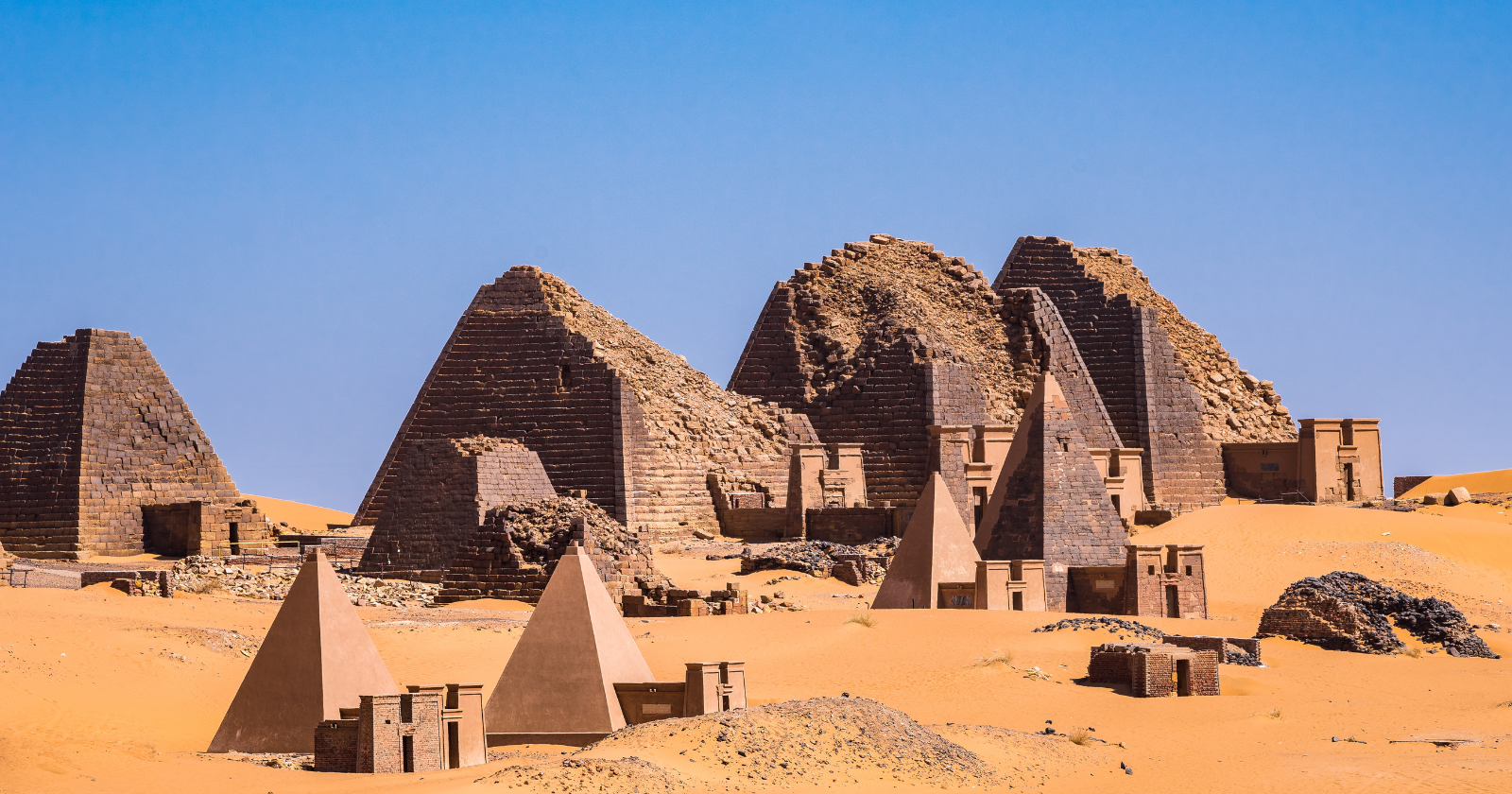
The Nubian pyramids differ in form from their better-known Egyptian counterparts. According to AtlasObscura’s profile of the Meroë complex, the Sudanese structures are typically 20 to 90 feet on a side, compared with the 756-foot base of the Great Pyramid of Giza. The sides slope more steeply, at roughly 70 degrees rather than the 52 degrees of Khufu’s pyramid, giving the Nubian structures their characteristic narrow, almost obelisk-like profile. They are built primarily of red Nubian sandstone rather than the white limestone of Giza, which lends them a darker, warmer colour against the desert.
The largest single Nubian pyramid is at Nuri, the burial site of King Taharqa, who reigned over both Egypt and Kush as the fourth ruler of Egypt’s 25th Dynasty in the 7th century BC. Taharqa was one of the “Black Pharaohs,” a line of Kushite kings who ruled Egypt from approximately 760 to 650 BC, conquering the country from the south during a period of political fragmentation. When the 25th Dynasty fell to Assyrian invasion, the Kushites retreated south to their original capital at Napata, and eventually moved their seat further south to Meroë, where the kingdom thrived for centuries with limited contact with Mediterranean powers.
According to African History Extra’s review of the Nubian pyramid tradition, more than 200 pyramids were built across at least six major sites — El-Kurru, Nuri, Jebel Barkal, Sedeinga, Meroë (north and south cemeteries), and several smaller necropolises. Meroë alone contains roughly 100 pyramids, making it the largest single concentration. The site is a UNESCO World Heritage location, designated in 2011, and is the most-photographed of the Sudanese pyramid fields. The full sequence of construction spans approximately a thousand years, with the El-Kurru site as the oldest (around the 9th century BC) and the latest pyramids at Meroë built into the 4th century AD.
Why almost no one knows about them
The relative obscurity of the Nubian pyramids in the global imagination is not because they are small, badly preserved, or recently discovered. They have been known to European archaeologists since the early 19th century, were extensively mapped by the American Egyptologist George Reisner between 1916 and 1923, and have been the subject of continuous archaeological work ever since. The reason they are not famous is, broadly, that very few people visit them.
According to National Geographic’s overview of the Kushite Kingdom, Sudan’s tourism industry has been chronically constrained by political instability, including two prolonged civil wars (1955-1972 and 1983-2005), the Darfur conflict that began in 2003, and the country’s continued listing on Western travel advisories for much of the 2000s and 2010s. By 2015, Sudan was receiving fewer than 15,000 international tourists per year. Egypt, in the same period, received more than 10 million tourists annually. The Pyramids of Giza, located 12 miles from central Cairo, are accessible by taxi from international hotels. The Pyramids of Meroë, located 125 miles north of Khartoum in the open desert, require a four-wheel-drive vehicle and, for most foreign visitors, a Sudanese visa that has historically been difficult to obtain.
The political dimension intersects with a deeper one. The framing of ancient Egypt as a “Mediterranean civilisation,” consolidated during Napoleon’s Egyptian campaign from 1798 to 1801 and reinforced by 19th-century European scholarship, positioned Egyptian achievements as belonging to a Greco-Roman cultural inheritance rather than to Africa. Nubia, located south of Egypt and inhabited by darker-skinned peoples, was instead classified as African and held to standards that 19th-century European racial theory found culturally inferior. The Italian treasure hunter Giuseppe Ferlini, who in 1834 destroyed the tops of more than 40 Nubian pyramids searching for gold, was acting on assumptions that the Nubian kings could not have produced sophisticated treasures of their own — an assumption his own discoveries proved wrong, but which shaped European framing of the Nubian pyramids for the next century.
What remains there now
The Nubian pyramids, despite Ferlini’s depredations and ongoing erosion from sandstorms and flooding, remain one of the largest concentrations of ancient royal funerary monuments anywhere on Earth. Meroë alone has 41 tombs in its northern cemetery, of which 38 belong to monarchs who ruled between roughly 250 BC and 320 AD. The southern cemetery contains an additional cluster of royal burials. Nuri holds 21 pyramids belonging to kings and 52 belonging to queens. El-Kurru is the oldest site, with the tombs of the earliest Kushite rulers. Jebel Barkal, a sandstone mountain held sacred by both Egyptians and Kushites, sits at the centre of a complex of pyramids and temples dating from the period when Napata was the Kushite capital.
The structures are quietly impressive in person. They sit in open desert, often without fences, signage, or tourist infrastructure of any kind. A visitor in 2026 may have a major UNESCO World Heritage site largely to themselves, walking among 2,000-year-old royal tombs without queueing or jostling for views. The pyramids are smaller than those at Giza, but there are more than twice as many of them, and they were built by a civilisation that continued the pyramid-building tradition for two millennia after the Egyptians had stopped. Whatever the popular image of “the pyramids” looks like, the actual majority of them are in Sudan.
