

The most widely-used tactile writing system in human history was invented by a French teenager working on his own at night with the same kind of leather-punching awl that had blinded him when he was three years old. The educational institution that made Louis Braille’s invention possible was, in essential respects, unique in the world of 1819. The Royal Institute for Blind Youth in Paris — founded in 1785 by the French educator Valentin Haüy on the substantial (and, in the late-18th-century French context, substantially radical) proposition that blind children were capable of formal literary and mathematical education — was the first school for the blind in the recorded history of European education. Its curriculum depended on a raised-letter printing system that Haüy had developed to allow blind students to read the same alphabet that sighted students used, with each Roman letter enlarged and embossed on the page in a form that a blind reader could trace with a fingertip. The system worked, in a limited way. It also produced books that weighed approximately 20 pounds each, that took several minutes per sentence to read, and that could only be read — not written — because the embossing process required substantial printing equipment that no blind student could operate independently. Louis Braille arrived at the Royal Institute in 1819 at the age of 10, on a scholarship arranged by the parish priest of Coupvray and a local aristocrat, and spent the subsequent two years learning to read Haüy’s raised letters — while simultaneously developing an increasingly acute sense that the underlying system was inadequate for the practical needs of blind people.
The catalyst for Braille’s substantive innovation arrived at the Institute in 1821, when Braille was 12 years old. As detailed in National Geographic’s historical reconstruction of Louis Braille’s invention of his tactile alphabet, the new director of the Royal Institute, Dr. Alexandre-René Pignier, invited a retired French army artillery captain named Charles Barbier de la Serre to demonstrate to the students a tactile writing system Barbier had developed across the previous several years. Barbier’s system — which he called écriture ponctuée (point writing), later somewhat misleadingly popularised under the name “night writing” — used sets of 12 embossed dots arranged in a 2×6 grid to encode 36 phonetic sounds of the French language. Barbier had originally developed the system with several possible applications in mind, including as a code for the French army; the specific popular story that his system was designed for soldiers to communicate silently in the dark on Napoleonic battlefields is, per the historical research at the Perkins School for the Blind, a substantially later embellishment that first appeared in 1950s French-language biographies of Braille and that has no direct basis in either Barbier’s or Braille’s contemporary writings. What Barbier actually demonstrated at the 1821 Institute presentation was a general-purpose tactile code that he believed could be adapted for use by blind readers.
The three years of work
The 12-year-old Louis Braille recognised immediately that Barbier’s system had substantial technical problems that made it impractical for actual literary use. As described in the American Foundation for the Blind’s historical account of Braille’s invention of his code, the 12-dot Barbier cell was too large for a single fingertip to encompass — a blind reader had to move the reading finger up and down the cell to identify the specific dot pattern, which substantially slowed reading speed. The phonetic basis of the code meant that words could not be spelled correctly, only sounded out — which precluded any subsequent work involving proper nouns, technical terminology, or foreign words. The code included no punctuation, no numbers, no mathematical symbols, and no musical notation. Braille spent the next three years — between the ages of 12 and 15, working evenings and weekends at the Institute and during his summer holidays back in Coupvray — refining an alternative system that would address each of these limitations while preserving Barbier’s foundational insight that raised dots could function as a tactile alphabet.
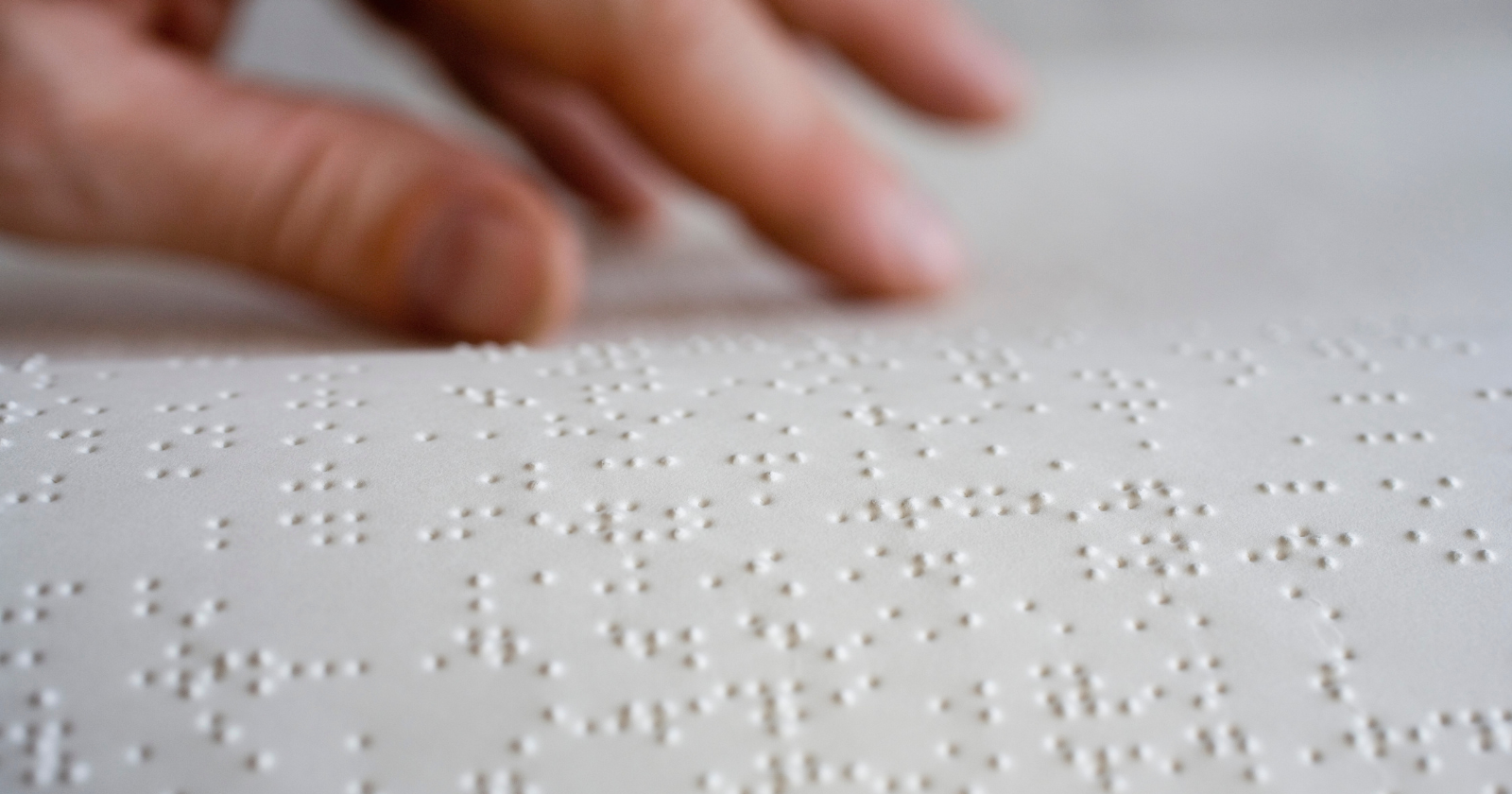
The final Braille system, presented to Dr. Pignier in the summer of 1824, used a 6-dot cell arranged in a 2×3 grid — small enough to be encompassed by a single fingertip and read in a single tactile impression, producing 64 possible dot combinations (including the “no dots” combination as a word separator) sufficient to encode every letter of the French alphabet, every punctuation mark, every numeric digit, and (in Braille’s subsequent extensions) both mathematical and musical notation. Per Sight Scotland’s biographical summary of Louis Braille’s life and work, Braille used the same style of leather-punching awl that had blinded him at three to punch the raised dots into paper across the entire three-year development period — an irony that essentially every subsequent biographical treatment of Braille has noted but that Braille himself never appears to have publicly commented on. The final system was published by Braille in a formal treatise in 1829, when he was 20 years old and had by then become a teacher at the same Royal Institute where he had originally been a student.
The forty years to acceptance
The substantive institutional resistance to Braille’s system across the subsequent four decades is, on the historical evidence, one of the more instructive episodes in the modern history of educational innovation. As reported in the Perkins School for the Blind’s detailed historical reconstruction of Braille’s invention and the subsequent institutional politics surrounding its adoption, blind students at the Royal Institute embraced the Braille system immediately, teaching it to each other, using it for their private correspondence, and progressively adopting it for their formal coursework across the 1830s and 1840s. Sighted teachers and administrators, however, resisted. The specific objection was that Braille’s system was, in essential respects, a separate writing system rather than a tactile version of the standard French alphabet — meaning that blind students who learned Braille would be reading and writing in a script that sighted people could not read, producing a specific form of educational separatism that some sighted educators considered undesirable. In 1840, a new director of the Royal Institute formally banned Braille from the curriculum and ordered existing Braille books at the Institute burned. Students smuggled copies and continued using the system unofficially. Braille himself, who continued teaching at the Institute across this period despite the increasingly worsening tuberculosis that would eventually kill him, refused to abandon the system. It was formally reinstated at the Institute in 1850, two years before Braille died of tuberculosis at the age of 43. The World Congress of Blind Educators formally adopted Braille as the international standard for blind literacy in 1878. Louis Braille’s body was disinterred from the family grave in Coupvray in 1952, on the 100th anniversary of his death, and reburied in the Panthéon in Paris — the burial place reserved for the most distinguished French citizens — where it currently rests alongside those of Voltaire, Victor Hugo, Marie Curie, and the other figures the French state has posthumously recognised as substantially foundational contributors to French civilisation.