
Some time around 240 BCE, a librarian in Alexandria worked out the size of the planet from the length of a single shadow. His only equipment was an upright stick, a clear day, and a figure for the distance between two Egyptian cities.
Eratosthenes of Cyrene ran the Library of Alexandria and had a habit of appearing in several fields at once. His reckoning of the Earth’s circumference is the one everybody remembers. What he did was real and ingenious, and slightly less certain than the retellings suggest.
What he actually measured
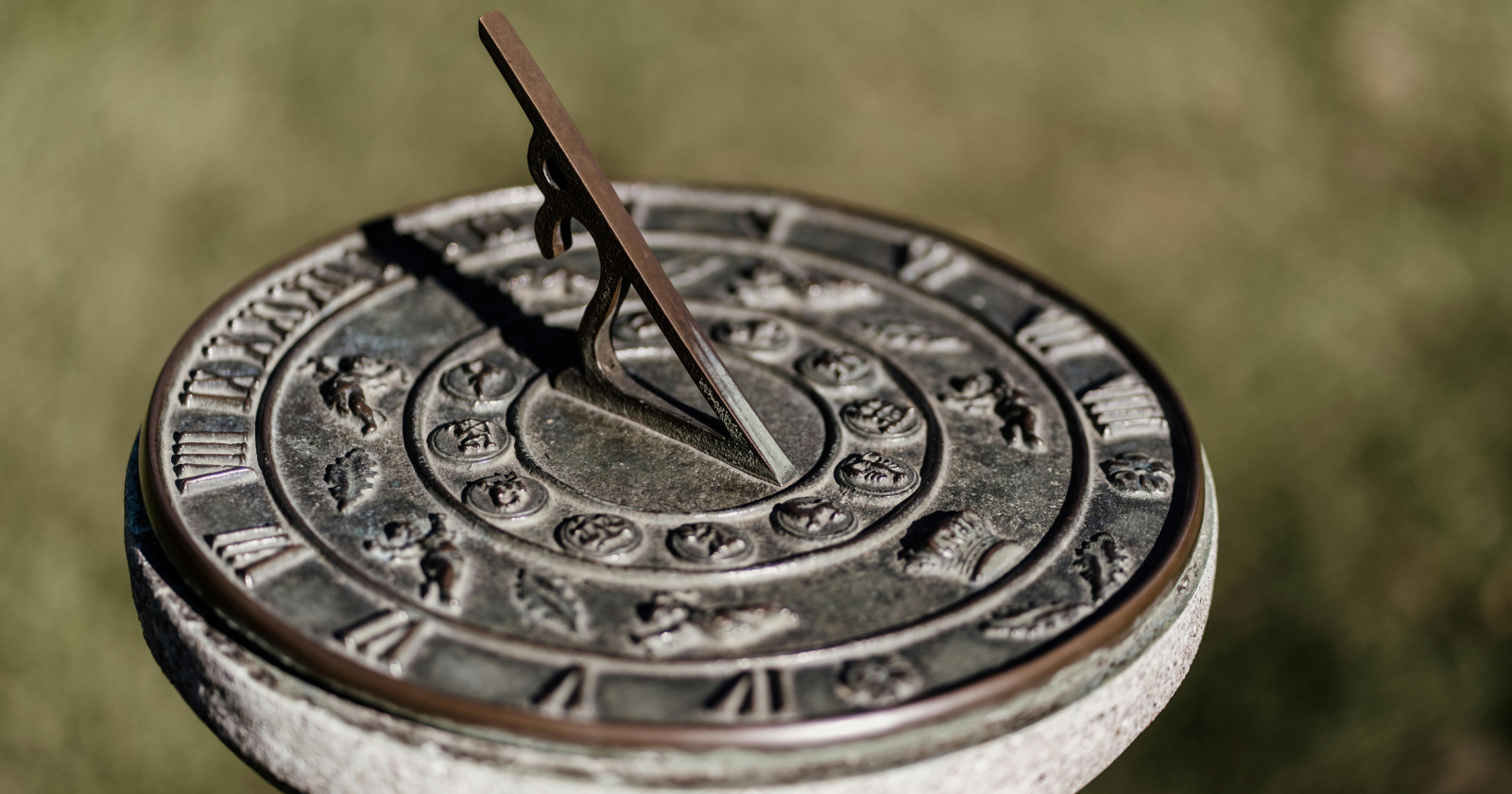
The method is simple, which is much of its appeal. Eratosthenes knew that at noon on the summer solstice the Sun stood directly overhead at Syene, near modern Aswan, far enough south that a vertical rod cast no shadow. On the same day in Alexandria, a rod did cast one. He measured the angle of that shadow and found it to be about a fiftieth of a full circle, roughly 7 degrees and 12 minutes of arc.
The rest was geometry. If the two cities lay 5,000 stadia apart, and that gap covered a fiftieth of the way around the Earth, the whole circumference came to 250,000 stadia. Later writers, Strabo and Pliny among them, give 252,000, probably a small adjustment to make the figure divide more neatly.
That is the whole of it.
The well that probably had nothing to do with it
The popular telling adds a well at Syene, into which the solstice Sun shone straight to the bottom, and sometimes a second stick planted by Eratosthenes himself. Carl Sagan’s 1980 series Cosmos fixed that image in most people’s memories. It makes a clean story, and it is partly legend.
The classicist Peter Gainsford has traced the well through the ancient sources and argues it had little to do with the calculation. A well of the kind did exist at Syene, described by Pliny, but it worked as a vivid sign that the town sat on the Tropic of Cancer, not as the instrument behind the number. Eratosthenes very likely never travelled south to take the readings. He appears to have drawn on distances gathered by professional surveyors and on shadow measurements already published by others.
The unit nobody can pin down
Eratosthenes gave his answer in stadia, and the length of a stadion in modern terms is not known. Estimates run from about 157 metres up to about 185, a spread wide enough that translating his result into today’s units becomes a choice about which ancient measure to trust.
A study of the disputed “itinerary stade” argues that the very short units may be a modern reconstruction rather than a real ancient one, and that the better attested stadion is the longer of the two. A 1943 note in Nature had already set out how far this single uncertainty muddies any modern verdict on his work. So we know what Eratosthenes calculated without being able to say cleanly how it stands against the planet he was measuring.
Errors that happened to cancel
This grows more tangled once you notice how many of his inputs were slightly wrong. Syene is not quite on the Tropic of Cancer. It is not due south of Alexandria either, sitting some 3 degrees of longitude to the east. That gap between the cities was an estimate, and probably a rounded one. Each of these fed a small error into the working.
The result was rescued by luck. In his 1942 study Egypt in the Classical Geographers, the geographer John Ball showed that the errors pushed in opposite directions and largely offset one another. Historians sometimes call this fortuitous error cancellation. However well the answer holds up, on this reading it owes a debt to mistakes that happened to balance.
What the achievement was
What he did holds up regardless of where the arithmetic finally lands. The point was never the number. It was the reasoning: the recognition that a shadow in one city and no shadow in another, on the same day, was enough to size a planet, provided the Earth was round and the Sun far enough away for its rays to arrive parallel. Both assumptions held, and both were open to argument in his century.
The method endures because it asks for so little. A stick in the ground, a clear solstice noon, a distance you already know, and the patience to reason from them. It is still repeated in classrooms, where students reach for the same logic with equipment no better than his.
What stays genuinely open is the smaller question hiding behind the famous one: how long his stadion really was. Answer that, and the last uncertainty in the most quoted calculation in the history of geography would finally close.