Somewhere in Tokyo in the mid-1980s, a Norwegian marketing strategist stood in front of a room of Japanese seafood executives, served them raw salmon, and watched the room politely fall apart. The colour was wrong, they told him. Its smell, they said, had a river-like quality. Someone objected to the shape of the fish’s head.
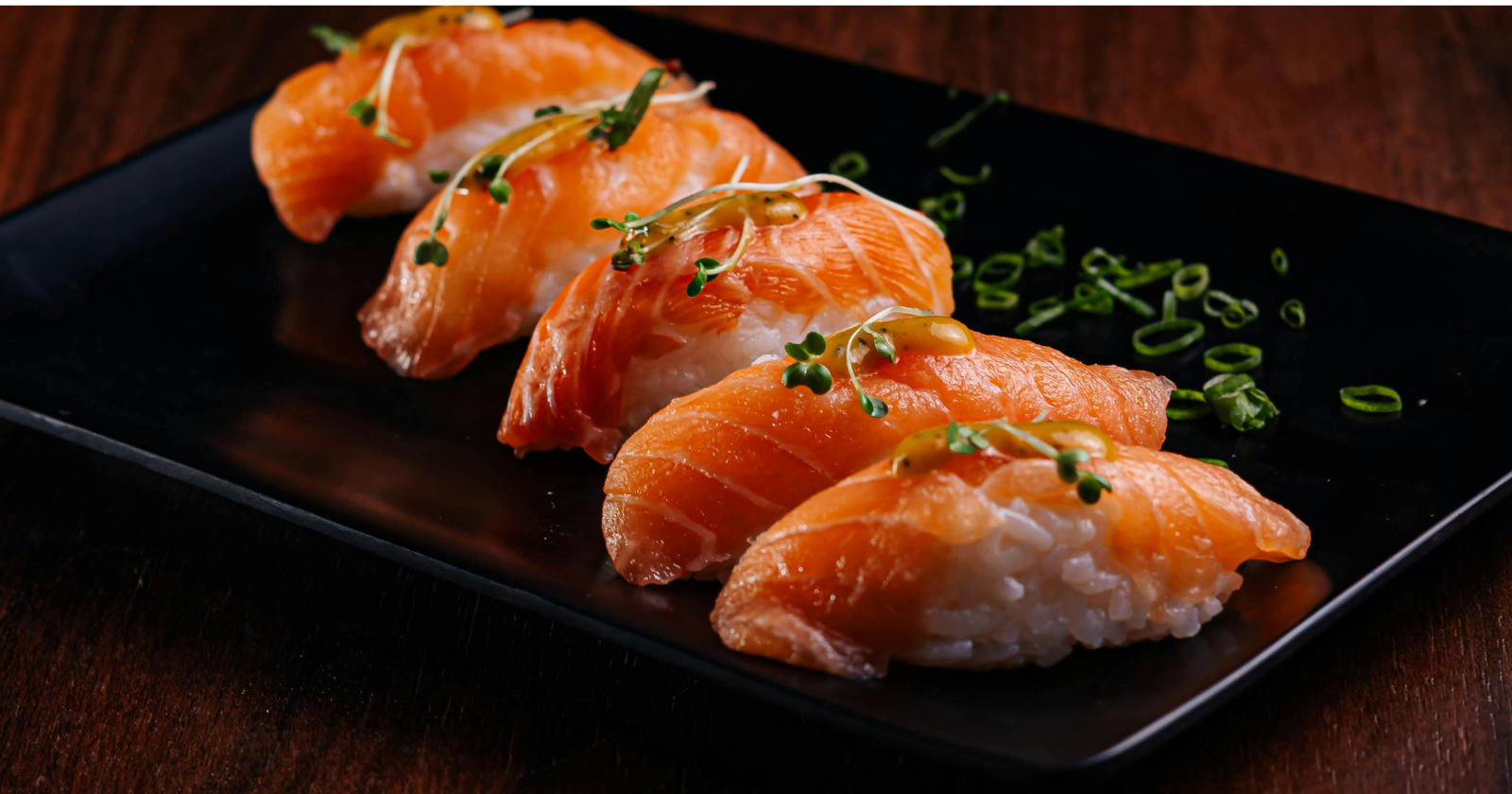
I think about that meeting every time I sit at a conveyor belt and watch the orange slabs go past. Salmon nigiri has the settled look of something that was always there, parked next to the tuna and looking as venerable as a prawn tempura. It has been on Japanese menus for about thirty years.
What Japan actually ate before
Japanese cooks have used salmon for centuries. They grilled it, salted it, flaked it into rice balls and packed it into lunchboxes. Nippon.com describes grilled salmon and salmon flakes as fixtures of home cooking, with a hard line drawn between that cooked fare and anything sliced raw. The domestic workhorse was chum salmon: lean, firm, nobody’s idea of sashimi.
So the fish was there. The appetite for raw fish was very obviously there. Those two facts never met.
The parasite question, answered properly
There was a real reason for the line, and fussiness was not it.
Wild Pacific salmon carry Anisakis simplex, a nematode larva that causes a thoroughly miserable illness called anisakiasis if you swallow it alive. Heat kills it. Deep freezing kills it. Slicing the fish fresh and eating it does not, which is why generations of Japanese cooks treated raw salmon as a hazard to be cooked out.
Farmed Atlantic salmon raised on heat-treated pellets is a different animal. The Norwegian Food Safety Authority exempts farmed salmon and rainbow trout from the freezing rule that otherwise applies to fish destined to be eaten raw, on the grounds that the fish eat nothing but dry feed containing no viable parasites and barely graze on wild organisms in the pen. That exemption tracks a 2010 European Food Safety Authority opinion and its 2024 re-evaluation.
A survey published in the Italian Journal of Food Safety put numbers on it: 270 slices of smoked farmed Atlantic salmon examined, zero anisakids found, against ten positives out of thirteen slices of wild sockeye. One paper on one processed product, not a settled literature, but it points the same way the regulators do.
Norway had too much fish
Norway started farming salmon commercially in the 1970s, then watched its own population drift towards chicken and red meat.
Freezers filled up.
The Norwegian Seafood Council, which has every commercial reason to tell this story well, dates the campaign to 1985, when a delegation led by former fisheries minister Thor Listau flew to Tokyo. Their figures: two tonnes of Norwegian salmon went to Japan in 1980, and twenty years later the annual number was above 45,000 tonnes.
Underneath all of it sat one piece of arithmetic. Fish sold for the grill competes on price with every other cheap protein, while fish accepted for sashimi could fetch up to ten times more, as Bjørn Eirik Olsen, who ran market research for the project, later told The Japan Times.
A name change, then a decade of nothing
“We couldn’t just say that our fish doesn’t have parasites,” Olsen said in that interview. Walking into a foreign industry and announcing that its national fish is wormy tends to close doors rather than open them.
So he went after the word instead. The Japanese for salmon is sake, and sake carried every association he was trying to escape: grilled, salted, cheap, the thing in the lunchbox. Olsen borrowed the English word and pushed the katakana sāmon, the term still stamped on essentially every sushi menu in the country. Same animal, different shelf.
Then came the advertising, all clean fjords and clear arctic water, and it achieved almost nothing for years. Olsen told NPR that pressure from home to abandon the sushi idea and dump the stock into the grill market was relentless.
The deal that broke it open
In 1992, Olsen offered the frozen food giant Nichirei 5,000 tonnes of salmon at close to giveaway prices, with one condition written into it: the fish could only be sold as sushi. Nichirei said yes.
That was the crack in the wall. Through the 1990s, Iron Chef and celebrity chefs including Yutaka Ishinabe put Norwegian salmon onto national television, and appetite did the rest. Olsen has said he knew the campaign had landed when he started noticing plastic salmon nigiri in restaurant window displays.
Where salmon sits now
Salmon has topped Japan’s biggest conveyor-belt sushi survey for fifteen consecutive years. In the 2026 round, run by Umios (the company known as Maruha Nichiro until March), 47.7 per cent of respondents named it as the topping they eat most often, more than eleven points clear of lean tuna in second place. The split runs along age lines: older diners tend to open with lean white fish and work up to tuna, while younger ones go straight for the orange.
Norway built something very large on the back of it. The seafood council reckons roughly 30 per cent of all Norwegian salmon now ends up raw in sushi, and that Norway supplies a little over half the global salmon market across 113 countries.
The high end went too. That’s the part I still find slightly hard to credit. Iwasa-zushi in Toyosu used to turn away customers who asked for salmon back when the market was at Tsukiji, and now has it on the board. Yamagata Tadashi, whose family has run a Nihonbashi sushi restaurant since 1887 and who chairs the Japan Sushi Environmental Health Federation, expects salmon to become a staple of Edomae sushi, arguing that clinging to wild domestic fish alone will empty the sea.
What a tradition is made of
The reasoning that lost for a decade turned out to be correct. Cold water, controlled feed, negligible parasite risk, safe raw. Olsen simply had no way to prove it to a room that had already decided, and no vocabulary that did not sound like an insult.
The argument never won anyone over. A discount and a shipping container did.
What gets me is how completely the seam has vanished. A teenager ordering sāmon at a kaiten place in Osaka is not participating in a trade negotiation or performing globalisation, any more than an Indian cook reaching for a chilli is. Thirty years is apparently long enough for a foreign product, sold under an English name at a loss by a government agency with a warehouse problem, to become simply what people like. Every cuisine anybody calls ancient is carrying a few of these, quietly, with the receipts thrown out.