
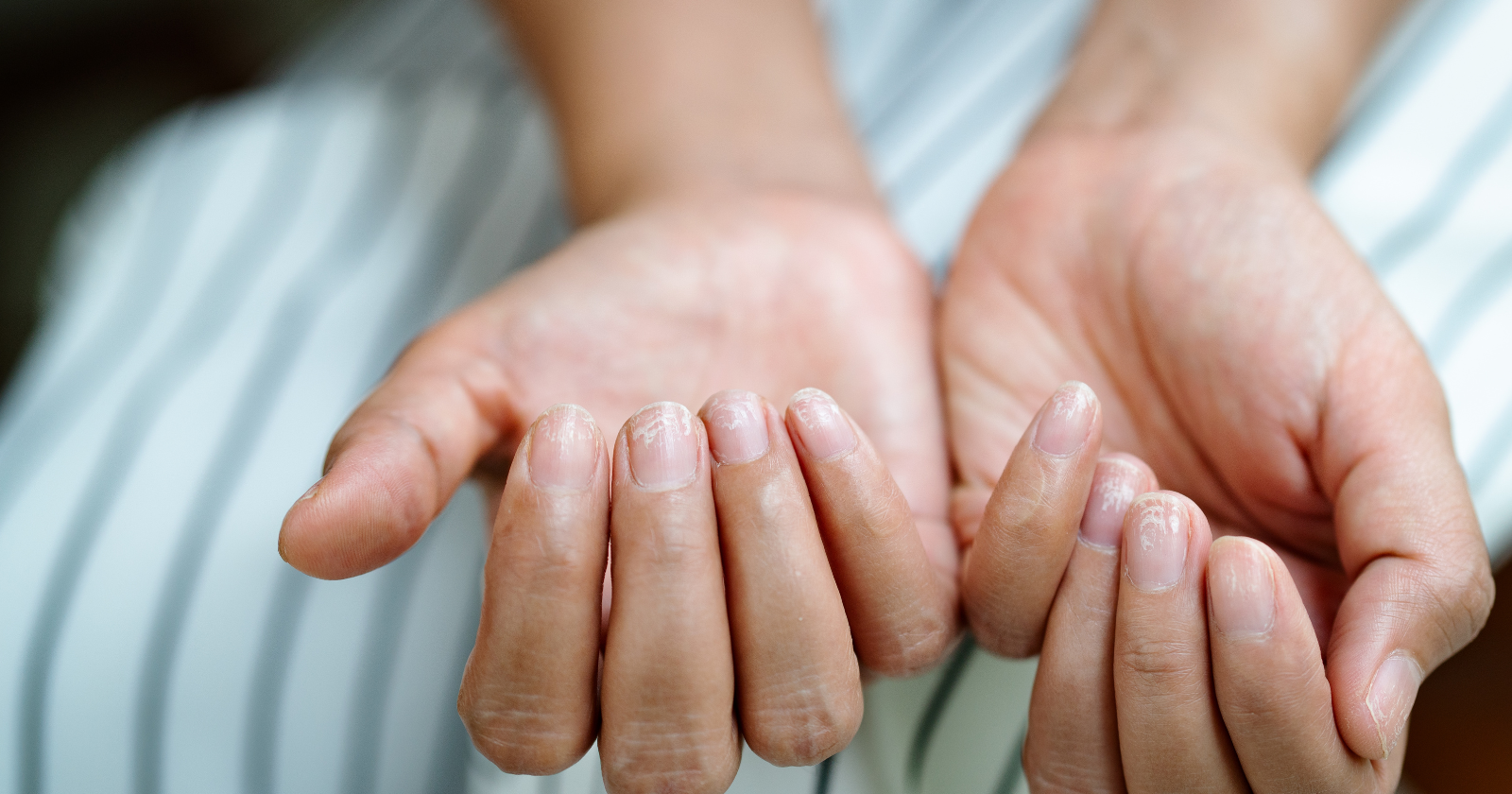
Twenty-two American astronauts have had a fingernail peel away from the nail bed on the job. Most of them managed it without leaving Houston.
Doctors call this onycholysis, and it is a common enough complaint on Earth. Cleaners get it. So do nurses, dishwashers and anyone whose hands spend long days sealed inside damp gloves. What sets the astronaut version apart is the paperwork. NASA has been quietly logging these cases for four decades, which turns a minor gross-out into one of the best-documented occupational hazards in human spaceflight.
What the medical files showed
A NASA team led by epidemiologist Jacqueline Charvat went digging through crew medical records covering 1981 to 2010, spanning the Space Shuttle years and the early International Space Station era. Their data-mining study settled on 179 US crew members who had trained in a suit under pressure, flown a spacewalk, or both.
Between them, 31 nail injuries.
Four of those happened in orbit. The other 27 happened underwater, in suited training runs, per the team’s breakdown of the crew records. Two Houston facilities are involved across those thirty years, the cramped old Weightless Environment Training Facility and the much larger pool that replaced it.
That split is less surprising once you see the exposure behind it: all 179 trained, only 96 ever flew a spacewalk, and between them they clocked 322 of those against 11,704 training runs.
Six hours in a glove that fights back
Today’s pool is the Neutral Buoyancy Laboratory at Johnson Space Center: 202 feet long, 40 feet deep, 6.2 million gallons of chlorinated fresh water. Full-size mock-ups of the space station sit on the bottom. Floating is about the closest you can get to weightlessness without buying a rocket.
Crew go in for runs of roughly six hours at a stretch, gloves inflated the whole time. A pressurised glove behaves like a stiff balloon wrapped around the hand, so every finger bend has to work against that pressure, and the fingertip gets driven into the end of the glove. Two suspects have occupied the researchers, and both may be guilty. One is mechanical: sustained squeezing that chokes the blood supply to the fingertip. Gripping tests run at MIT for NASA measured skin blood flow falling by 40 to 50 per cent under pressure. The other suspect is plain damp, since sweat pools inside a sealed glove for hours, and wet nails give up their grip more easily.
Do that over and over, across a career.
Nails let go.
Glove fit beats hand size
That same MIT lab had already pointed somewhere else entirely. Roedolph Opperman and colleagues pulled 232 crew injury records from NASA’s medical logs in Houston and tested them against more than 20 hand measurements. Their results, published in Aviation, Space, and Environmental Medicine, landed on hand circumference. Men whose hands measured more than nine inches around ran a 19.6 per cent chance of fingernail injury, against 5.6 per cent for smaller hands.
Charvat’s team could not reproduce that. When they ran hand circumference through their own models, it came out nowhere near statistically significant.
What did survive the analysis was fit. Christopher Reid and colleagues, publishing the modelling work in the journal Human Factors, kept coming back to the gap between the glove’s middle finger and the wearer’s actual middle finger. Every extra tenth of an inch of mismatch was associated with roughly 23 per cent higher odds of a nail injury. Longer sessions tracked the same way, adding about 57 per cent per extra hour. Women came out more than twice as likely as men to report the problem, and of the two glove models studied, the newer Phase VI carried 8.5 times the odds of the older 4000 Series.
Reasons to hold the numbers loosely
Handle those figures gently, because the authors do. This was exploratory work with a small pile of injuries in it, so the team deliberately loosened the usual statistical bar, keeping any variable that cleared p = 0.15 rather than the conventional 0.05. Several of the resulting confidence intervals are enormous. The one around that 8.5 figure stretches from just below 1 to nearly 76, which is another way of saying the real effect could be negligible or could be far bigger.
The glove comparison has a second problem on top of that.
NASA ran a drive to improve injury reporting between 2002 and 2004, which happens to be exactly when the Phase VI glove came to dominate. Sixty-nine per cent of all training injuries in the dataset were recorded in that three-year window. Only two predate it entirely. So the glove may be worse, or the record-keeping may have simply got better, and the analysis cannot pull the two apart.
Same caution applies to the rest of it. A single retrospective trawl through thirty years of medical records, kept by different flight surgeons with no severity scale and no agreed vocabulary, is one study rather than a settled scientific position. A crew surgeon in 1994 and a crew surgeon in 2008 might have written up the same damaged finger in completely different words.
Where the next fix gets tested
None of this is a mystery NASA has abandoned. Gloves now come with nail hardener, dressings and firm advice to keep nails trimmed short, and an earlier fix ran a longer ventilation tube down the arm to dry the glove out.
Meanwhile the replacement suit for the Moon, Axiom Space’s AxEMU, has been through its own test campaign, including crewed runs in that same pool in Houston.
Which is a neat bit of circular logic for anyone about to climb into the new suit. To find out whether its gloves will take your fingernails off, you first have to spend a few hundred hours in the water that has been taking them off all along.