
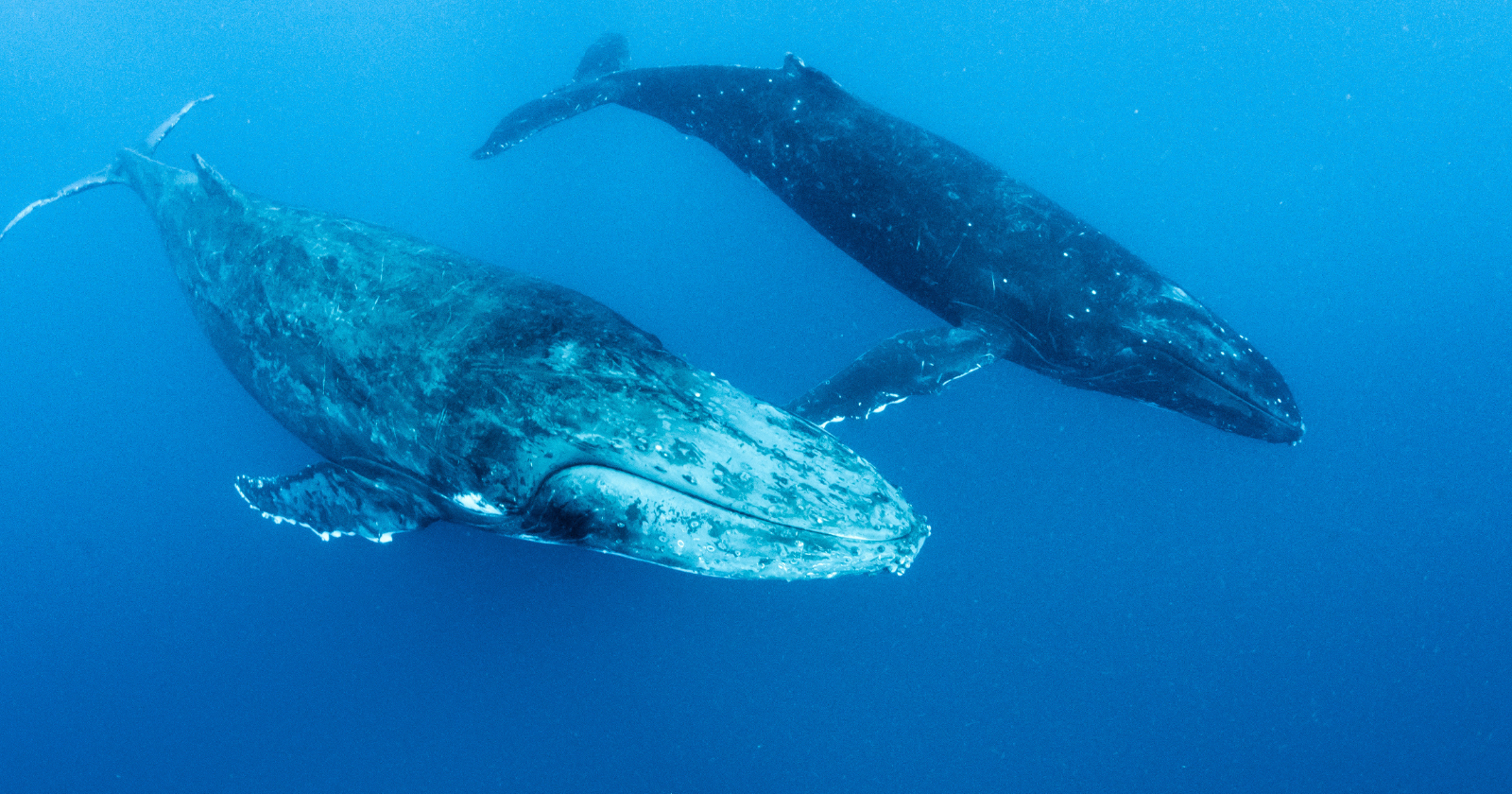
Sound in air travels at about 343 metres per second, the figure that fighter pilots cross when they break the sound barrier. Sound in seawater travels at about 1,500 metres per second. The ratio is roughly 4.3 to 1. The reason is straightforward physics: sound waves propagate through a medium by transferring vibrational energy between adjacent molecules, and the denser and stiffer the medium, the faster that transfer happens. Water is roughly 800 times denser than air, with much smaller intermolecular distances, and it transmits acoustic energy with much less loss per metre than air does. The same whale call that would fade to nothing within a kilometre in air can carry for hundreds of kilometres through the deep ocean.
According to NOAA’s Ocean Service reference on underwater sound, the speed of sound in seawater varies between roughly 1,450 and 1,540 metres per second depending on temperature, salinity and pressure. The first reasonably accurate measurement was made in 1826 on Lake Geneva by the Swiss physicist Jean-Daniel Colladon and the French mathematician Charles-François Sturm, who used an underwater bell, a flash of gunpowder for synchronisation, and two boats positioned ten miles apart. Their figure was within a few percent of the modern measurement, despite the relatively crude instruments available.
Why whale songs cross oceans
The speed of sound in water is only part of what makes long-distance whale communication possible. The other part is the way sound bends in the ocean. Sound speed in seawater depends on temperature and pressure, and these vary with depth. Near the surface, the water is warm and the sound speed is high. Below the warm surface layer, the temperature drops sharply through the thermocline, and the sound speed drops with it. Below the thermocline, the temperature is nearly constant but pressure continues to rise, and the sound speed begins to climb again.
The result is a minimum in the sound speed at roughly 1,000 metres depth in mid-latitudes, with faster speeds both above and below. According to the Discovery of Sound in the Sea reference, an academic resource maintained by oceanographers at the University of Rhode Island and elsewhere, this minimum creates a natural waveguide. A sound wave emitted at or near 1,000 metres depth that strays upward into faster water gets bent back down. A sound wave that strays downward into faster water gets bent back up. The wave is trapped, channelled by the gradients of temperature and pressure, and propagates horizontally with almost no energy loss to absorption.
This is the SOFAR channel — Sound Fixing and Ranging — discovered toward the end of the Second World War by Maurice Ewing and Joseph Worzel at the Woods Hole Oceanographic Institution. A low-frequency sound emitted into the SOFAR channel can travel thousands of kilometres before its energy dissipates. Blue whales, fin whales and other large baleen whales produce calls below 20 hertz, on the edge of human hearing or below it, and these low-frequency calls couple efficiently into the SOFAR channel. Researchers led by Christopher Clark at Cornell University have tracked individual whales across entire ocean basins using the long-distance propagation that the SOFAR channel makes possible.
The “Jezebel Monster”
The Cold War history of underwater sound is where the popular framing of “sonar operators filtering out whale noise” comes from. Beginning in 1950, the US Navy developed a global underwater listening network called the Sound Surveillance System, or SOSUS, designed to detect Soviet submarines by their low-frequency acoustic signatures travelling through the SOFAR channel. According to the Discovery of Sound in the Sea account of SOSUS history, the system was very successful at detecting noisy diesel and nuclear Soviet submarines. It was also picking up sounds that no one initially knew how to classify.
One particularly persistent unknown source was labelled the “Jezebel Monster” by SOSUS analysts. The sounds were low-frequency, came from no known submarine, and could be heard from enormous distances. They turned out to be the calls of blue and fin whales, propagating through the SOFAR channel exactly as Soviet submarines would have been, and detected by SOSUS arrays exactly as Soviet submarines would have been. The whales were not being filtered out in the everyday sense of being a routine nuisance. They were being identified as a category of acoustic source that the Navy had not previously known to look for. Once identified, the calls became valuable rather than confusing: they confirmed that the SOFAR channel was working as predicted, and they later became the basis of the most comprehensive long-distance whale-tracking research ever conducted.
At the end of the Cold War, the Navy declassified the technical operation of SOSUS sufficiently to allow civilian researchers with security clearances to use the system. The result has been a generation of marine biology research that would have been impossible without the Cold War infrastructure. Whales communicating across thousands of kilometres of ocean are now routinely tracked by hydrophone arrays that were originally listening for Soviet ballistic-missile submarines. The same physics, the same channel, the same long-distance propagation.
How loud is loud, under the ocean
Whale calls below 20 hertz are produced at source levels of up to 188 decibels relative to one microPascal at one metre — a figure that does not directly map onto the decibel scale used for air-based sound, because the reference pressures are different, but that corresponds to one of the loudest sustained biological sounds on Earth. A blue whale’s call at source can be heard at a level above background ocean noise for hundreds of kilometres in unmodified ocean conditions. The 2012 paper by Denise Risch and colleagues in PLOS One documented the inverse case: humpback whales in the Stellwagen Bank National Marine Sanctuary off Cape Cod measurably reduced their singing during an Ocean Acoustic Waveguide Remote Sensing experiment 200 kilometres away. The whales could detect the experiment, and modify their behaviour in response, from a distance comparable to the route between London and Paris.
The modern problem is anthropogenic noise. Shipping traffic, oil-and-gas exploration, military sonar, and underwater construction now produce so much low-frequency noise that the effective range over which whales can communicate with each other has shrunk substantially. Christopher Clark has estimated that the acoustic environment in which whales operate has been reduced to a small fraction of what it was a century ago, because human noise occupies the same frequency band as whale calls. The physics of underwater sound has not changed. What has changed is the level of competing noise sharing the channel. The whales are still singing. The ocean is just no longer quiet enough for the songs to travel as far as they once did.
