
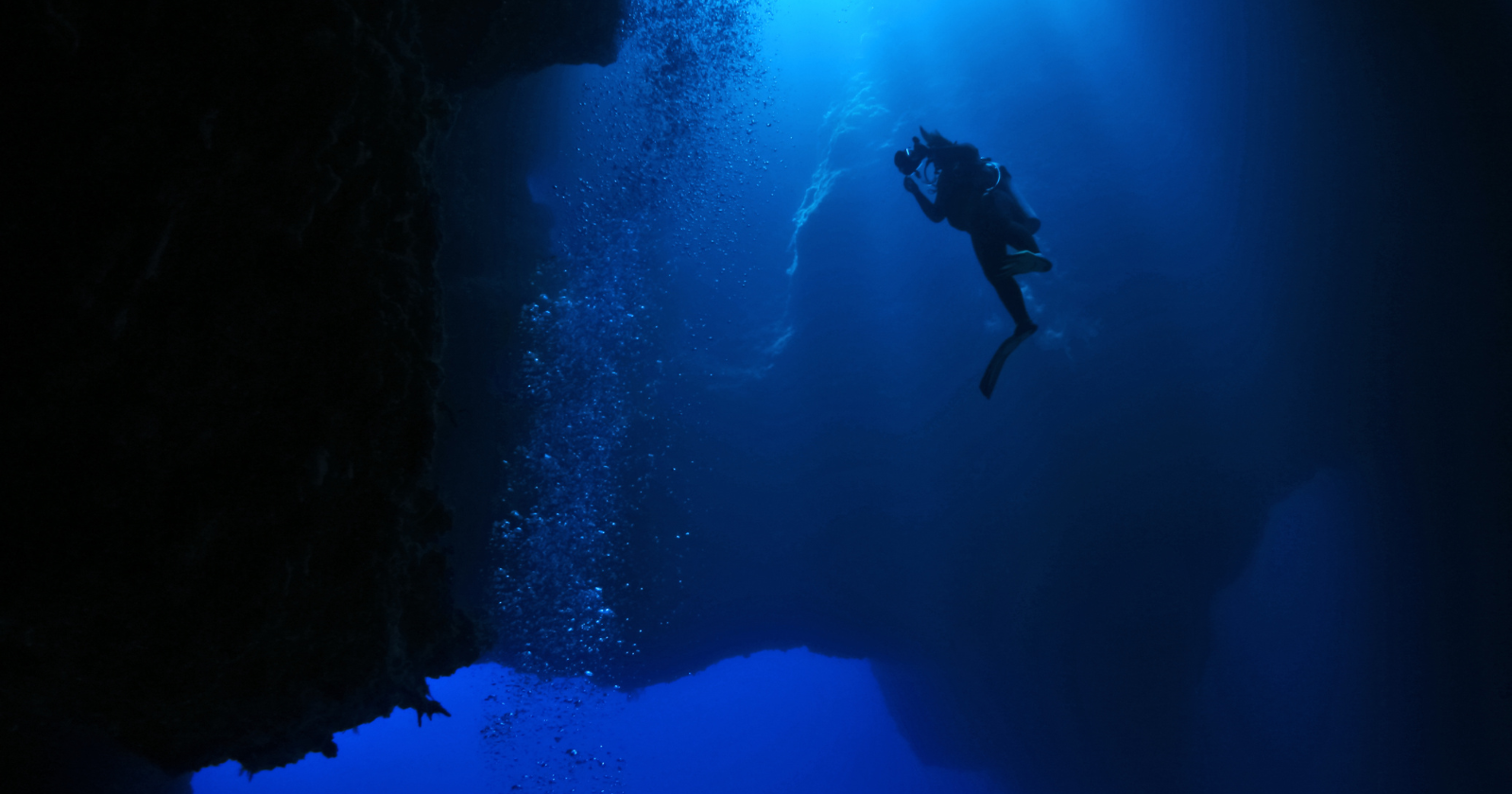
The deepest place on Earth, it turns out, is littered. The dive began at the surface of the western Pacific Ocean, approximately 200 miles southwest of Guam, on the morning of 28 April 2019. Victor Vescovo, a 53-year-old retired Navy officer and Dallas-based private-equity investor, climbed into a two-person titanium pressure sphere mounted inside a 12-tonne submersible called Limiting Factor. He sealed himself in alone. The support crew on the surface ship released the submersible into the water. Vescovo began a vertical descent through the ocean — past the sunlit surface waters, past the dim twilight zone at 200 metres, past the cold blackness below 1,000 metres where natural light no longer reaches, and on downward through the deep ocean basins toward the bottom of the Mariana Trench. The descent took approximately four hours. By the time Vescovo’s submersible came to rest on the seabed, he was approximately 10,928 metres below the surface — almost seven miles down — in the deepest known point on the entire planet.
According to CNN Travel’s coverage of the dive, Vescovo’s depth of 10,928 metres exceeded the previous deepest manned descent — Don Walsh and Jacques Piccard’s 1960 trip in the bathyscaphe Trieste — by approximately 16 metres, or 52 feet. The film director James Cameron’s 2012 solo dive in the Deepsea Challenger had reached approximately 35,787 feet, slightly less deep than the 1960 record. Vescovo therefore became, at the moment his submersible touched bottom on 28 April 2019, the deepest-diving human in history, and the fourth person ever to have visited Challenger Deep, after Walsh and Piccard in 1960 and Cameron in 2012. He would, over the following two weeks, return to the bottom three more times, making him the most experienced visitor to the deepest place on Earth by a considerable margin.
What it takes to go there
The technical challenge of reaching Challenger Deep is substantial, and the engineering required to keep a human being alive at that depth is unlike any other application in modern engineering. The pressure at 10,928 metres is approximately 1,086 bar, or 16,000 pounds per square inch — roughly 1,071 times the atmospheric pressure at sea level. Several common metaphors are used to convey the magnitude of this pressure in human terms. One is the weight of approximately 50 fully loaded Boeing 747 jumbo jets stacked on top of one another. Another is the weight of the Empire State Building bearing down on an area the size of a single human foot. A third is simply that any ordinary unprotected object lowered to Challenger Deep will be crushed essentially instantaneously into a small dense pellet of whatever material it was made from.
The Limiting Factor was designed specifically to survive these conditions. The submersible’s pressure hull is a titanium sphere with walls 90 millimetres thick, manufactured by Triton Submarines in Florida and certified by classification societies for unlimited depth — meaning the design is engineered to tolerate the maximum pressure that exists anywhere on the Earth’s seafloor. The interior of the sphere is approximately 1.5 metres in diameter, just large enough for two people to sit upright in cramped positions. The submersible’s life support, viewports, communications, propulsion, and ballast systems all had to be designed to operate at the extreme conditions of the trench bottom. The total cost of the Limiting Factor and its supporting expedition, called the Five Deeps Expedition, was approximately $48 million — Vescovo’s own money, derived from his career in private equity.
What he found
The bottom of the Mariana Trench is not, despite popular imagination, a featureless plain. According to NBC News Mach’s coverage of the dive, Vescovo described the seafloor at Challenger Deep as “a flat, beige basin covered with a thick layer of silt,” but with occasional rocky outcrops, varied geological features, and a surprisingly active biological community. He observed shrimp-like amphipods with long legs and antennae moving across the silt, translucent “sea pigs” (a type of sea cucumber adapted to extreme depths), spoon worms, snailfish, and other deep-sea organisms. Four of the species the expedition collected during the multiple Challenger Deep dives turned out to be previously unknown to science. The biological collection alone, taxonomically speaking, justified the entire expedition.
The submersible’s external lights illuminated patches of the seafloor as Vescovo manoeuvred the Limiting Factor across the basin. He criss-crossed back and forth for approximately four hours, the longest single time any human being has ever spent at Challenger Deep, looking for unique geological features, biological specimens, and any evidence that some location nearby might be even deeper than the 1960 Trieste position. He also looked, as a secondary mission objective, for any signs of human contamination. In the popular imagination, the deepest point on Earth would presumably be the one place least likely to contain evidence of human activity. The 1960 Trieste dive, which had been brief and visually limited, had not reported any obvious human debris. Cameron’s 2012 dive had likewise focused on biological and geological observations and had not specifically catalogued plastic pollution.
The plastic on the seabed
Vescovo’s longer dive time and more powerful illumination produced different results. According to TIME magazine’s coverage of the discovery, Vescovo observed a plastic bag and several candy wrappers resting on the seafloor at the bottom of Challenger Deep. The objects were photographed by the submersible’s external cameras and later confirmed by his expedition team. The plastic objects had presumably arrived at the deepest point on Earth through some combination of overboard dumping from ships, river runoff carried by ocean currents, and the gradual sinking of plastic debris through the water column from the floating Pacific garbage patches that have accumulated over the past several decades. Vescovo’s reaction, conveyed in interviews shortly after the dive, was direct: “It was very disappointing to see obvious human contamination of the deepest point in the ocean. It’s not a big garbage collection pool, even though it’s treated as such.”
According to CBS News’s coverage of the Five Deeps Expedition findings, Vescovo also observed “angular metal or plastic objects, one with writing on it” on the seafloor — suggesting that the visible debris at the bottom of the trench includes more than just the bag and wrappers, and that the cumulative presence of human-made objects at Challenger Deep is more substantial than any single piece would suggest. The expedition team collected biological samples and confirmed in subsequent analysis that the amphipods Vescovo had observed during the dive contained microplastics in their digestive systems — meaning that the visible plastic on the seafloor was the structurally largest component of a far more pervasive contamination that extended into the bodies of the animals living there.
What the dive established
The Five Deeps Expedition continued through the rest of 2019, with Vescovo completing dives to the deepest point in each of the world’s five oceans. The Mariana Trench dive remains the deepest of the five. The mission’s biological collection contributed several dozen new species to the scientific literature. The detailed sonar maps the expedition produced of the deepest points in the Atlantic, Indian, Pacific, Southern, and Arctic Oceans substantially improved the global bathymetric record of the planet’s deepest features. The Limiting Factor submersible has since been used for further deep-ocean research expeditions, including the first manned dives to the bottoms of several other ocean trenches that had not previously been visited by people.
What the dive established, beyond its various scientific contributions, was something simpler and harder to absorb. The deepest place on Earth, the most physically remote point on the planet’s surface, the location that took 59 years from the first manned descent in 1960 to be visited for a fourth time by the spring of 2019 — that place contains plastic. The 50 jumbo jets of pressure overhead, the seven miles of seawater above, the total darkness, the four-degree water, the thousand-fold isolation from the activities of the human surface world have not been enough to keep the bag and the candy wrappers from arriving on the seafloor. Vescovo’s 2019 dive was the first time anyone had stayed at the bottom long enough, and looked carefully enough, to confirm what was already true: that the planet’s deepest point, like every other point on the planet, now contains visible evidence of the species that has spent the past century industrially manufacturing single-use plastic and disposing of it in ways that allow it, eventually, to settle to the bottom of every body of water on Earth. The deepest place on the planet, as of April 2019, is no longer pristine. Whether it ever was is a more philosophical question. It is certainly not pristine now.
