
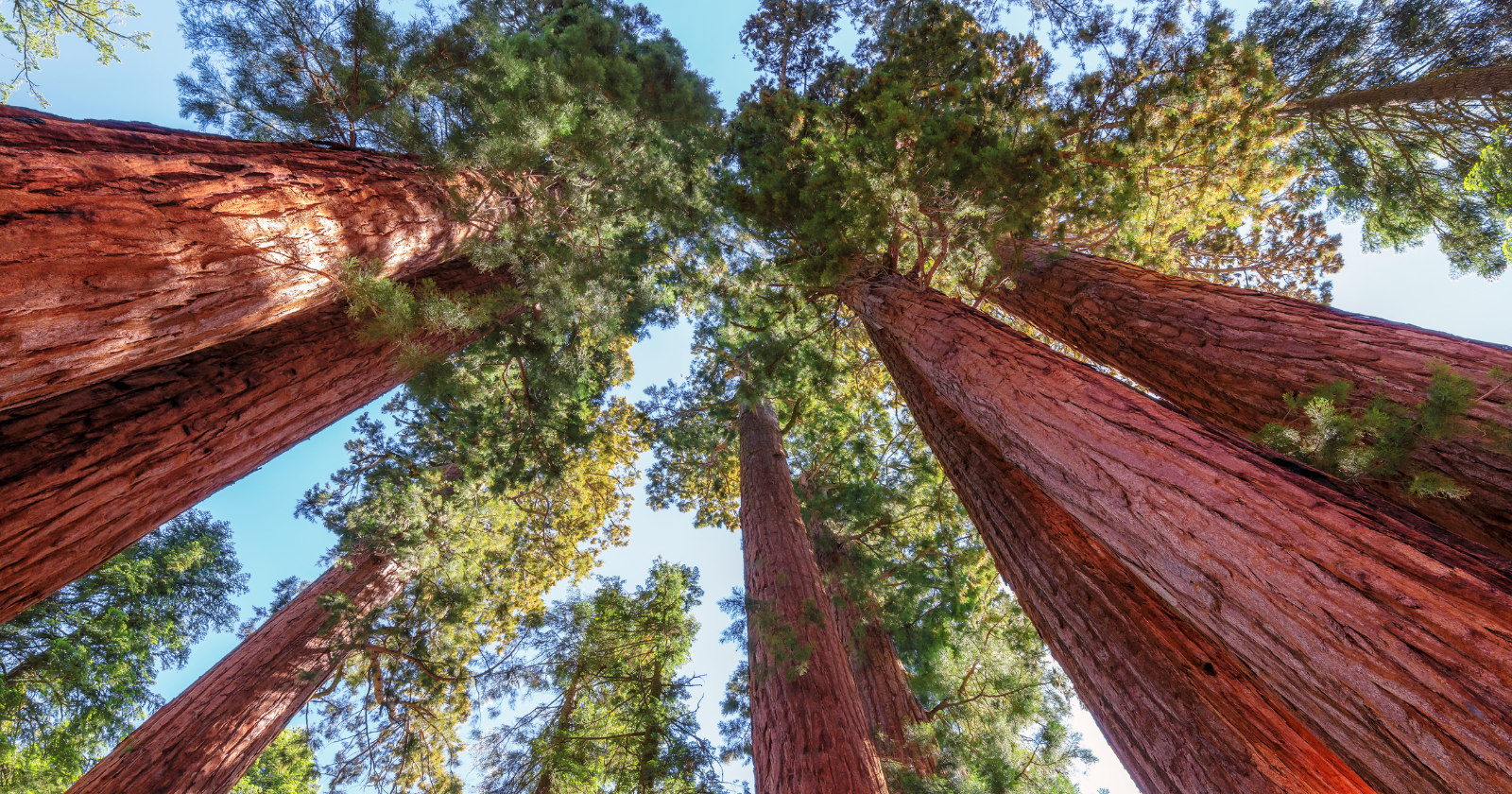
In Sequoia National Park in California, a giant sequoia named the President stands 247 feet tall, carries roughly 2 billion leaves, and has been alive for about 3,200 years. It germinated as a small seed in the late twelfth century BC. At the time, the New Kingdom of Egypt was building additions to the temples at Karnak. The Trojan War, if it actually happened, was still within living memory. The first Olympic Games would not be held for another four centuries. The founding of Rome, in the traditional reckoning, would not occur for another 425 years. The Parthenon would not be built for another seven centuries. Most of recorded human history is younger than the President tree.
The President is not even the oldest known giant sequoia. According to a National Park Service history of sequoia age estimates, the Grizzly Giant in Yosemite’s Mariposa Grove was estimated at 3,800 years of age by early 20th-century researchers, and was considered by many to be the oldest of all living giant sequoias. Other historic estimates pushed individual trees as old as 4,000 years. The most carefully verified figures, based on ring counts of stumps in the early 20th century, identified a small number of giant sequoias more than 3,000 years old, with the oldest at about 3,200 years.
Why sequoias live so long
The biological mechanism behind sequoia longevity is a combination of features that together produce an organism unusually resistant to the ordinary causes of tree death. The bark of a mature giant sequoia is up to three feet thick, fibrous, and rich in tannins that deter insects and fungi. The wood itself contains compounds that resist decay, so even fallen sequoia logs remain intact for centuries. The trees are notably fire-adapted: their thick bark insulates the living cambium beneath, and surface fires that would kill most species sweep through a sequoia grove without ending the trees’ lives. In fact, periodic fires are required for sequoia reproduction. Sequoia cones release their seeds in response to the heat of a passing fire, exposing the freshly cleared mineral soil that seedlings need.
The biggest threat to a mature giant sequoia is not age but mechanical failure. The trees grow so large that root systems eventually become unable to anchor them against high winds, particularly in saturated soil after heavy storms. Most sequoias that die in old age do so by falling over rather than by senescence in any biological sense. There is no indication that giant sequoias have a maximum natural lifespan in the way most species do. They simply continue to grow, slowly, for as long as they remain upright. According to Atlas Obscura’s profile of the General Sherman tree, the largest sequoia by volume is “adding volume faster than ever, overturning previous theories that trees grow more slowly as they get bigger.”
Two species, often confused
The popular phrase “sequoia and redwood” conflates two distinct species. The giant sequoia (Sequoiadendron giganteum), confined to about 75 groves on the western slope of the Sierra Nevada in California, is the species producing the famous 3,000-year-old specimens. The coast redwood (Sequoia sempervirens), found along the Pacific coast from southern Oregon to central California, is a closely related but separate species. Coast redwoods are the tallest trees on Earth, with the current record-holder, Hyperion, measuring 380 feet, but they typically do not live as long as giant sequoias. The oldest documented coast redwoods are around 2,200 years old. The world’s oldest individual tree of any kind is neither a sequoia nor a redwood, but a bristlecone pine (Pinus longaeva) named Methuselah, growing in California’s White Mountains, with a verified age of approximately 4,855 years.
What makes the giant sequoias famous is the combination of their longevity with their sheer mass. The General Sherman tree, the largest single-stem tree in the world by volume, contains roughly 1,487 cubic metres of wood and weighs over 2,000 tons. The National Park Service’s current age estimate places it at about 2,200 years, with other published figures ranging from 2,200 to 2,700 years depending on the dating method. Earlier 20th-century estimates were considerably higher, reaching 3,500 years or more, but successive scientific revisions have brought the figure down. The uncertainty reflects the practical difficulty of dating a living tree without coring it deeply enough to count its innermost rings, which for the oldest sequoias would require boring through metres of dense, often partially-rotten heartwood.
What 3,200 years actually looks like
The historical context becomes more striking the more carefully you spell it out. A tree that germinated in 1,175 BC was already a sapling when the Phoenician alphabet was being developed. It was approximately 425 years old when Rome was founded in 753 BC by the traditional reckoning. It was approximately 728 years old when work began on the Parthenon in 447 BC. It was approximately 1,075 years old when Julius Caesar was born in 100 BC. It was approximately 1,200 years old when the Roman Empire was founded under Augustus in 27 BC. It was approximately 1,290 years old when the Roman Empire reached its territorial peak under Trajan around 117 AD.
The tree was already ancient by every meaningful measure when the Western Roman Empire fell in 476 AD. It had been alive for 2,460 years when the Norman Conquest of England occurred in 1066. It had been alive for 2,975 years when the United States declared independence in 1776. It has now lived through the entire span of recorded human history of California’s indigenous Yokuts, Tubatulabal, and Mono peoples, who lived in proximity to the giant sequoia groves for the last several thousand years and who, by oral tradition, regarded the trees with religious significance. The first widely-documented European sighting of a giant sequoia, by Augustus T. Dowd, occurred only in 1852. From the tree’s perspective, that encounter happened less than 6 percent of its life ago.
The General Sherman, the President, the Grizzly Giant, and the other named individuals of the giant sequoia groves are quietly older than nearly every cultural reference humans use to anchor the deep past. They were there when those reference points happened. They are still there now.
