
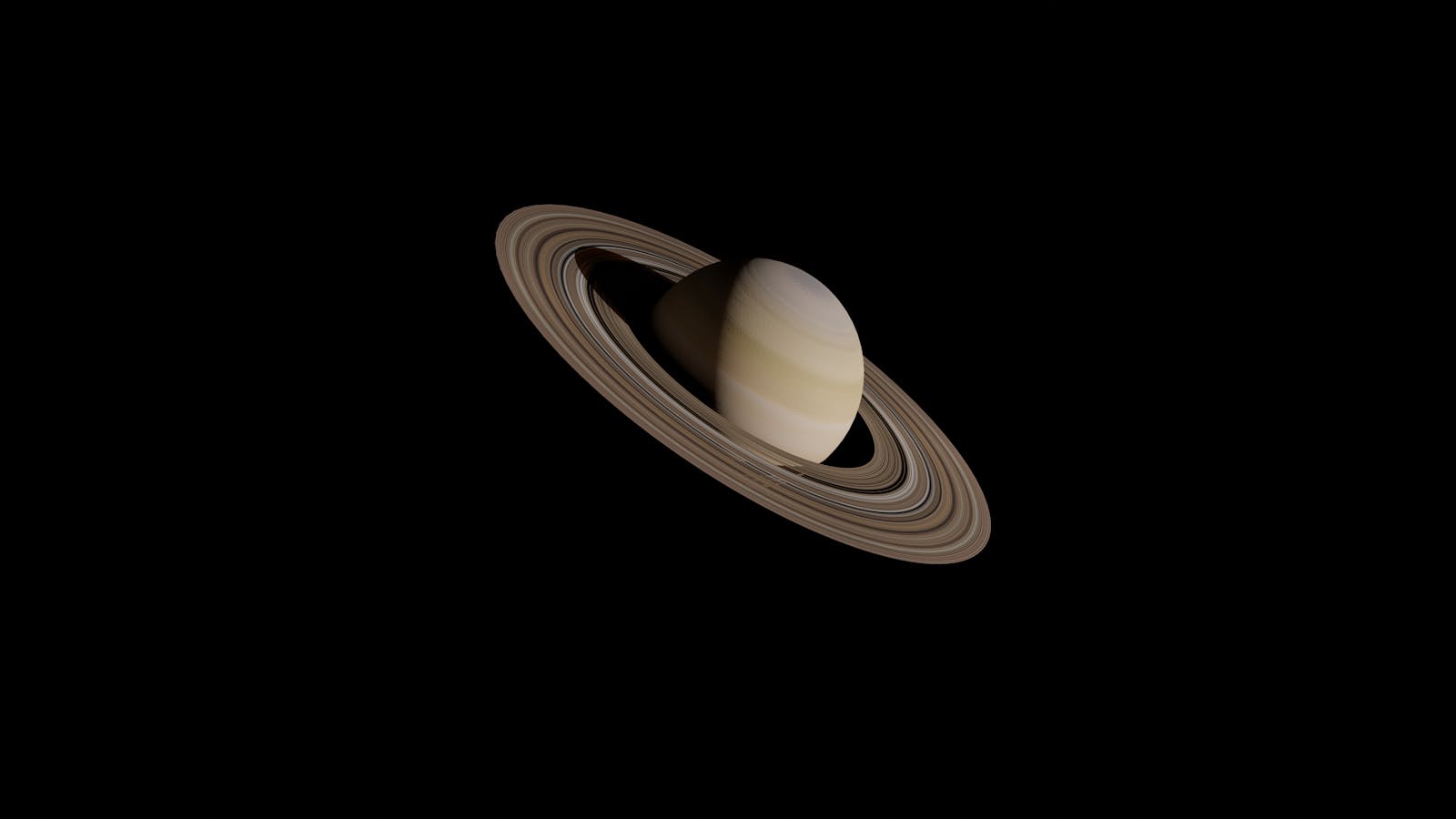
Saturn’s rings are, by every available physical measurement, made mostly of water ice. NASA’s research on the composition places the rings at over 95 percent water ice, with the remaining few percent consisting of dust and other contaminants. The rings range in particle size from microscopic grains to chunks of ice the size of houses. The whole system is, by every available astronomical measure, one of the more visually striking features of the solar system, and it has been for as long as humans have had telescopes capable of resolving it.
What has only become clear in the last decade, on the basis of Cassini spacecraft data and ground-based observations from the Keck telescope, is that the rings are not a permanent feature of Saturn. The rings are, more accurately, raining down into the planet at a measurable rate, and the rate is high enough that the rings have a finite remaining lifespan that astronomers can now calculate with some precision.
The figure that has, by various combinations of accuracy and dramatic framing, become the most commonly cited is approximately 100 million years. The figure is on the lower end of the range of estimates, and it depends on some assumptions about whether the current rate of infall will remain stable. The wider estimate, accounting for various sources of uncertainty, places the rings’ remaining lifespan somewhere between 100 million and 1.1 billion years. Most working planetary scientists currently place the most likely figure somewhere in the lower hundreds of millions of years.
The structural implication of this, on close examination, is what this article is about.
What “ring rain” actually involves
The mechanism by which the rings are disappearing was first proposed in the 1980s and has, in the last decade, been confirmed by direct measurement. The NASA research describes the process as “ring rain,” in which electrically charged ice particles from the rings are pulled along Saturn’s magnetic field lines into the planet’s upper atmosphere, where they vaporize and react with the ionosphere.
The rate is, by every available measurement, considerable. The water draining from the rings into Saturn’s atmosphere amounts to enough to fill an Olympic-sized swimming pool every thirty minutes. The Cassini spacecraft, in its final orbits in 2017, also detected additional ring material falling directly onto Saturn’s equator at a rate of between 4,800 and 44,000 kilograms per second. The combined rate is what produces the lower-end estimate of less than 100 million years until the rings are gone.
None of this is, on the available physics, controversial. The mechanism is understood. The rate is measured. The conclusion is what the conclusion has to be, given the inputs. The rings, on the current evidence, are not going to be there indefinitely.
What the timeline actually means
The figure of 100 million years sounds, in human terms, vast. The figure is vast in human terms. The figure is, however, less vast in the terms that the solar system itself operates on.
The solar system is approximately 4.5 billion years old. The rings, by current estimates from the Cassini mass measurements, are somewhere between 10 and 100 million years old. The combined figure of approximately 200 million years of total ring existence, against 4.5 billion years of solar system history, gives the rings a duration of roughly 4 percent of the solar system’s life so far. The figure is small. The figure is, in some real way, considerably smaller than the wider cultural register has absorbed.
What this means, in structural terms, is that the rings are a temporary feature of Saturn rather than a permanent one. The rings were not there for the first roughly 4.4 billion years of the planet’s existence. The rings will not be there for whatever portion of the planet’s future life follows the next 100 million years. The rings are, in some real way, occupying a specific window of the planet’s existence that, on the cosmic timeline, is relatively brief.
The window is the part the cultural register has not, on the available evidence, fully absorbed. The wider cultural register tends to treat Saturn’s rings as a fixed feature of the solar system, in the way it treats most of the visible features of the night sky. The treatment makes a certain amount of intuitive sense, because nothing in the visible night sky changes meaningfully on human timescales, and the human tendency is accordingly to treat all visible features as permanent. The treatment is, on the available evidence, not accurate to Saturn’s rings. The rings are not permanent. The rings are, more accurately, transient features in a particular phase of Saturn’s existence.
What the math implies about when we happen to exist
The structural implication of the rings’ transience, on close examination, is something the wider register has not yet developed a clean way of describing. The implication is that almost any other moment in Saturn’s history that one might have been born into would have seen Saturn without rings. The pre-ring era covered roughly 4.4 billion years. The post-ring era will cover, on the available physics, however many billions of years Saturn has remaining before the eventual death of the sun renders the question moot. The ring era, against either of these, is brief.
What this means, for any particular observer, is that the existence of Saturn’s rings during one’s lifetime is, in some real way, not a default feature of being alive in the solar system. The existence is, more accurately, a feature of being alive during one specific window of Saturn’s existence that the cosmic dice happened to roll in our favor. Most of the windows the dice could have rolled would have produced a Saturn without rings. The window we happen to be in produced a Saturn with them.
The framing is not, on close examination, sentimental. The framing is structural. The probability that any given conscious observer in the solar system would be alive during the ring era is, on the available timeline, somewhere around 4 to 5 percent, if one assumes the distribution of conscious observers across cosmic time is uniform. The distribution is, of course, not uniform, since the conditions for conscious observers required certain prior conditions to be met first. But the rough probability stands. We are, in some real way, alive during a specific moment that, on the cosmic timeline, is brief enough to be remarkable.
What this is, structurally, an example of
The Saturn ring case is, on close examination, one example of a wider pattern that the cosmic timeline produces. The pattern is that many of the features of the universe that strike us as fixed, permanent, and definitional are, in fact, transient features of particular phases that we happen to be observing during specific windows.
The moon, similarly, is slowly receding from Earth at a rate of approximately 3.8 centimeters per year. The total solar eclipses we currently get to observe, in which the moon precisely covers the disc of the sun, are a feature of the moon being currently at exactly the right distance for its apparent size to match the sun’s. In a few hundred million years, the moon will be far enough away that total eclipses will no longer occur. The eclipses we get to see are, accordingly, also a feature of a specific window of the moon’s orbital history.
The visible galaxies in the night sky are similarly transient on cosmic timescales. The expansion of the universe is, in the long run, going to carry most of the currently observable galaxies beyond the cosmological horizon, at which point future observers will be unable to detect any galaxies outside their own local group. The view of the universe we currently have, with its hundred billion visible galaxies, is a feature of the specific cosmic moment we are observing from. Future observers, hundreds of billions of years from now, will look up and see a much emptier sky.
The pattern, on close examination, is that the universe contains many features that are temporary on cosmic timescales but that present themselves to short-lived observers like ourselves as permanent. The shortness of our individual lives, against the cosmic timeline, is what produces the illusion of permanence. The features are not permanent. The features are, more accurately, the particular configuration the universe happens to be in during the brief window we are alive to observe it.
The acknowledgment this article wants to leave
Saturn’s rings are one of the more beautiful features of the solar system. The rings are also, on the available evidence, not going to be a permanent feature. The rings are raining down into the planet at a measurable rate, and they will, by the lower end of current estimates, be gone in roughly 100 million years. The rings have been there, on the available evidence from Cassini mass measurements, for somewhere between 10 and 100 million years. The total window of their existence, against the 4.5-billion-year history of the solar system, is brief.
We happen to be alive during this brief window. The happening-to-be-alive is not, in any deep sense, our personal achievement. The happening-to-be-alive is, more accurately, what the cosmic dice rolled, in our particular case, to produce the conditions under which we get to look up and see something that almost any other moment of cosmic history would not have shown us. The seeing is the privilege. The privilege is, in some real way, temporary. The temporary nature of it is what makes it, on close examination, worth taking seriously rather than treating it as a fixed feature of the universe we happen to live in. The fixed-feature framing is the default human assumption. The fixed-feature framing is, in this case, simply not accurate. The rings will be gone. We are seeing them now. The seeing is, in some real way, what we are alive in this specific window to do.
