
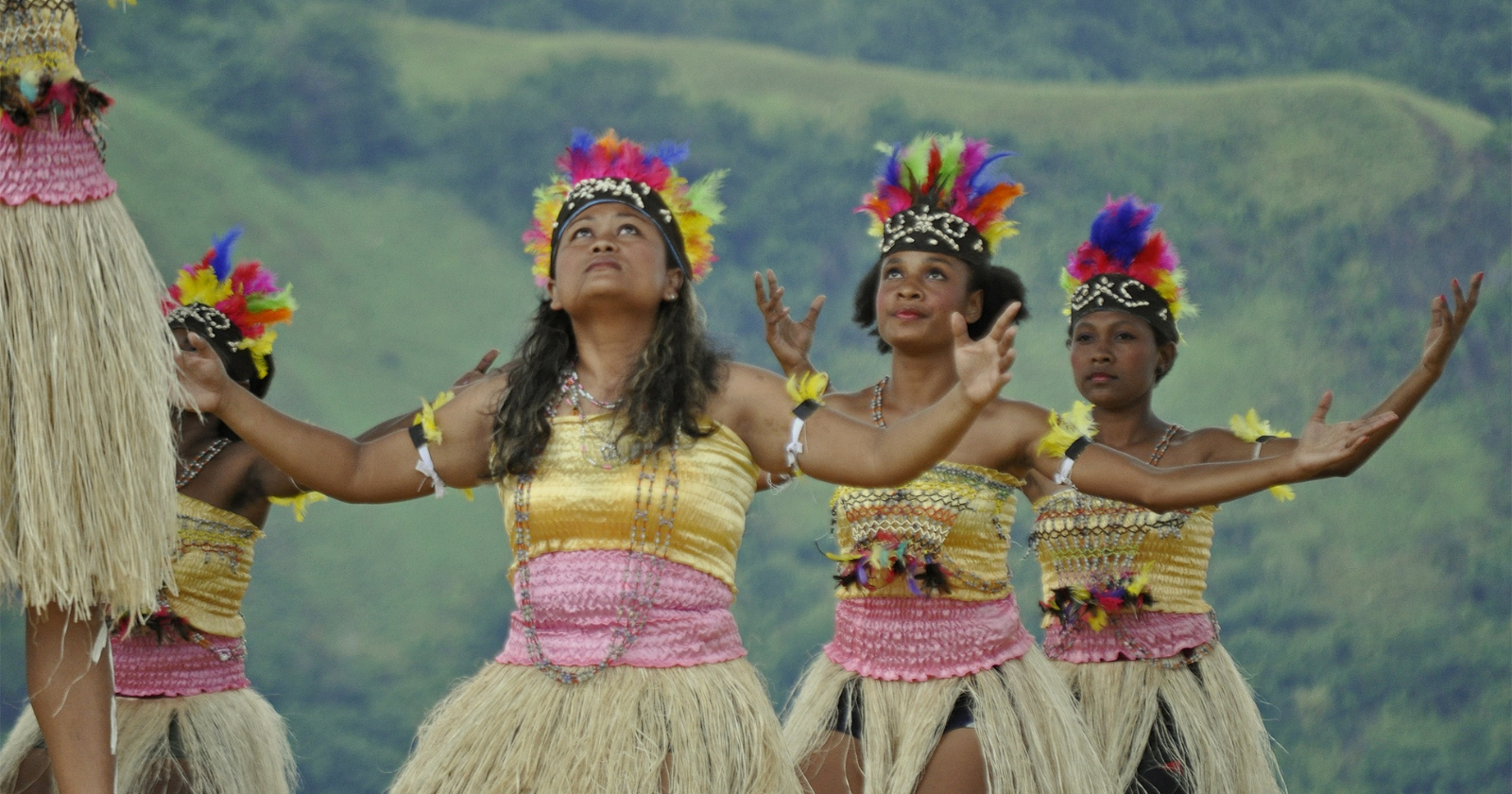
In parts of the Papua New Guinea highlands, two villages within a day’s walk of each other can speak languages as far apart as English and Japanese. Cross a ridge, and the words change entirely. This is not folklore. It is the ordinary texture of a country that holds more living languages than any other place on Earth.
The figure most often cited is 840, drawn from Ethnologue, the language database maintained by SIL International. That sits against roughly 7,170 living languages worldwide, which means a nation of about 10.5 million people accounts for more than one in ten of all the languages currently spoken. Indonesia comes second, with around 721, and Nigeria third with 538. No other country is close.
What the number actually counts
The 840 figure should be handled with some care, because counting languages is not like counting rivers or mountains. The line between a language and a dialect is a judgement, not a measurement, and reasonable people draw it in different places.
The numbers wander accordingly. Ethnologue’s own totals have sat at 839, 840, and 841 across recent editions. In 2006, then Prime Minister Sir Michael Somare put it at 832, and was careful to specify languages, not dialects. The spread is not a sign of sloppiness. It reflects a genuine problem in linguistics, where mutual intelligibility, shared vocabulary, and speaker self-identification do not always point the same way.
What is not in dispute is the order of magnitude. Whether the true count is 832 or 843, Papua New Guinea sits far ahead of anywhere else.
More languages than all of Europe
The comparison that tends to stop people is with Europe. Depending on how migrant and minority languages are counted, the whole continent is home to somewhere between about 250 and 300 languages, according to the survey in Wikipedia’s overview of the languages of Europe. Even on the most generous count, that is roughly a third of Papua New Guinea’s total. One country, slightly larger than the state of California, speaks more than twice as many languages as every nation from Portugal to the Urals put together.
The reasons come down to time and terrain. People have lived on the island of New Guinea for around 50,000 years, a long stretch for languages to form, split, and drift apart. Roughly 3,500 years ago, Austronesian-speaking arrivals added a second, unrelated layer. Steep mountains, dense forest, and river valleys then kept communities separate for millennia, and, as Our World in Data notes, the region never went through the kind of early political centralisation that elsewhere pushed one language to dominance over its neighbours.
Isolation, in short, did the work that unification did across much of Europe, only in reverse.
Many of these languages are fragile
Sheer number should not be mistaken for security. A large share of these languages have very small speaker populations, some in the hundreds or low thousands, and the pressures that erode small ones elsewhere apply here too. Urban migration, schooling in English, and the practical pull of a shared tongue all work against the smallest of them.
Tok Pisin, an English-based creole, has become the country’s main lingua franca and now has native speakers of its own. That is a gain and a loss at once. A common language makes a fractured country navigable, while quietly thinning the diversity that made it remarkable in the first place.
The wantok system
The count is not just a curiosity of the map. In Papua New Guinea, the language you speak sorts you into a social network with obligations attached. The Tok Pisin word for it is wantok, literally “one talk”: the people who share your tongue are the people you are expected to help, and who will help you in turn.
Where the formal welfare state is thin, that network does a great deal of the work. Someone who moves from the highlands to Port Moresby for a job may arrive knowing no one except a wantok, a person from the same language group, who is bound by custom to find him somewhere to stay and a way in. Researchers describe it as an informal system of reciprocity, and it reaches into business and government as readily as into village life.
That reach is also its difficulty. The obligation that shelters a stranger can shade into favouritism when the person doing the hiring, or awarding a contract, has wantoks to look after. Work published by the U4 Anti-Corruption Resource Centre treats it as precisely this double thing, a safety net and a channel for patronage at the same time.
The category is also loosening as people move. Jonathan Ritchie, a research fellow at Deakin University, has observed that Papua New Guineans studying or working in Australian cities will treat one another as wantoks even though, at home and speaking different tongues, they would not. What counts as sharing a language widens to fit the new distance.