
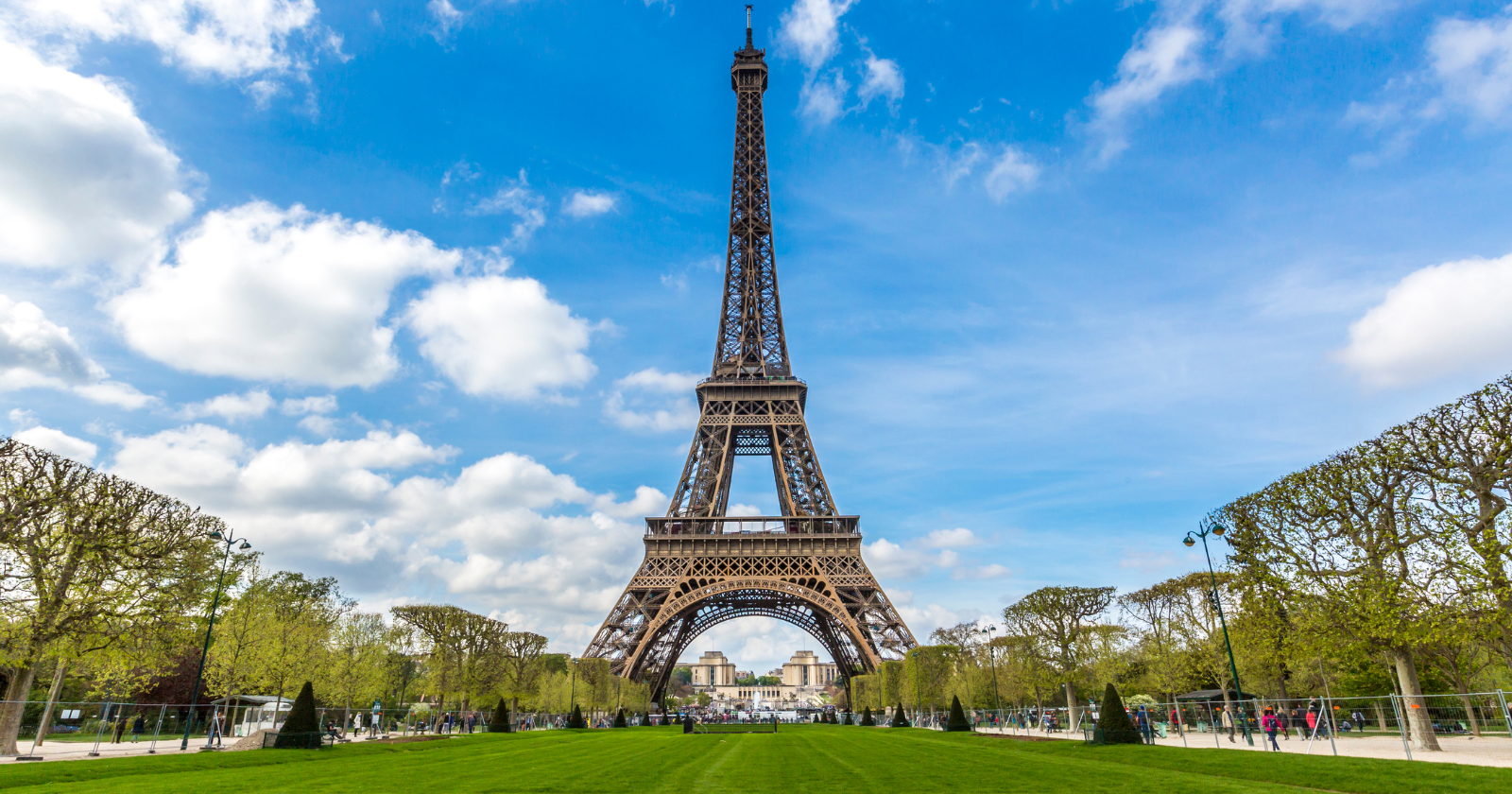
On a clear afternoon in Paris, the very top of the Eiffel Tower, 330 metres above the ground, is not exactly where it was at sunrise. It has moved a few centimetres to the west. By midday it has moved a few more centimetres to the south. By late afternoon it is several centimetres east of where it began. By the time the sun sets and the iron cools back to the surrounding air temperature, the top of the tower returns to its starting position. Over the course of a sunny day, the summit traces a slow, irregular curve roughly 15 centimetres in diameter, or just under six inches. The cause is not wind. Wind makes the tower sway and shudder on its own faster timescale. The cause of the slow daily circle is the sun.
According to the official Eiffel Tower website maintained by the Société d’Exploitation de la Tour Eiffel, “the sun only hits one of the 4 sides of the Tower creating an imbalance with the other 3 sides, that remain stable, thus causing the Eiffel Tower to lean. In this way, the sun’s movement over the course of a clear day can cause the top of the Tower to move in a more or less circular curve measuring approximately 15 centimetres in diameter.”
The physics, in three lines of arithmetic
The mechanism is the simplest thermal physics there is. Solids expand when they get warmer, because the atoms in them vibrate more vigorously and on average sit slightly further apart. The amount of expansion is described by the material’s coefficient of linear thermal expansion. According to a 2025 explainer in The Conversation by architecture professor Federico de Isidro Gordejuela, the puddled iron and steel components used in the Eiffel Tower have a coefficient of approximately 12 × 10⁻⁶ per degree Celsius. That figure means a one-metre iron bar grows by 12 micrometres for each degree Celsius of warming, which is roughly the width of a human hair.
The Eiffel Tower is not a one-metre bar. It is 330 metres tall after the installation of a new digital radio antenna in March 2022, which added 6 metres to the previous 324-metre height. The top of the original 1889 iron lattice structure, before any antennas, sits at 300 metres. Multiply 300 metres by 12 micrometres per metre per degree, and you get 3.6 millimetres of expansion per degree Celsius along the tower’s vertical axis. A 40-degree temperature change between a cold Paris winter and a sun-heated summer surface gives 14 centimetres of vertical expansion. The Eiffel Tower’s seasonal height range, as monitored by engineers with continuous strain-gauge readings, is between 12 and 15 centimetres, comfortably within what the simple calculation predicts.
Why the tower leans
The seasonal vertical expansion is uniform across the whole tower, because cold winters and hot summers heat all four faces about equally. The daily circular drift at the top is different. On a sunny day, the sun is in the east in the morning, the south at noon, the west in the afternoon. Each of these positions illuminates a different face of the tower’s four-sided lattice, while the other three faces remain in shade. The illuminated face heats up several degrees above the shaded faces, and that face expands more than the others. The result is that the tower bends, a few millimetres per metre of height, away from the sun.
Because the sun moves across the sky over the course of the day, the warmest face changes. The lean changes with it. In the morning, when the east face is illuminated, the top of the tower leans west. By noon, with the south face illuminated, the top leans north. In the afternoon, with the west face illuminated, the top leans east. After sunset, with no differential heating, the top returns to its starting position above the centre of the base. The trace of the top’s position over a full day is a roughly circular curve, with the irregularities reflecting variations in cloud cover and wind. The amplitude of the daily drift is about 7 centimetres in each horizontal direction, for a circle approximately 15 centimetres in diameter.
What Gustave Eiffel knew
The behaviour is not a surprise to the engineers who built the tower. Gustave Eiffel and his team, including the chief engineers Maurice Koechlin and Émile Nouguier, were well aware of thermal expansion when they designed the structure for the 1889 Exposition Universelle. Late-nineteenth-century iron-and-steel construction was already routine for railway viaducts and large bridges, and any competent engineer of the period understood that 300-metre iron structures would change shape with temperature. The tower’s design includes the lattice geometry and riveted joints that allow thermal movement to be distributed across thousands of small connections rather than concentrated in a few stressed points. The seasonal 15-centimetre rise and the daily lean are deliberately accommodated by the structure, not problems to be solved.
The same physics governs nearly every large engineered structure on Earth. The Garabit Viaduct, also designed by Eiffel and completed in 1884, is 565 metres long; the Forth Bridge in Scotland is 2.5 kilometres long; modern long-span bridges and tall buildings are all engineered with expansion joints, sliding bearings, or flexible connections to accommodate thermal movement. Railway tracks have expansion gaps welded into them at calculated intervals. The Eiffel Tower is the most visible of these examples because it is tall, slender, and isolated against the Paris sky, with its movement directly observable to anyone with a precise enough measurement system.
What you would see if you could see it
The drift is too slow to perceive in real time. A 15-centimetre circle traced over the course of a 10-hour day means the top is moving at an average speed of about half a centimetre per hour, far below the threshold of human visual detection. The Eiffel Tower has been continuously instrumented for structural monitoring since 2021, with GPS sensors, accelerometers, inclinometers, and strain gauges tracking the spire’s inclination, the deformations of its four pillars, and ambient temperature and humidity across the structure. The data shows the tower’s response to temperature, sunlight, wind, and the cycle of seasons with millimetre precision.
From the perspective of a tourist standing at the base, the tower looks as still as any building. From the perspective of the iron itself, the tower is in continuous quiet motion. The sun warms one face, that face stretches, the tower leans. The sun moves, the next face warms, the lean shifts. The structure that has dominated the Paris skyline since 1889 is, on any clear day, also a 7,300-tonne sundial, with the position of its summit telling you, within a few centimetres, where the sun is.
