
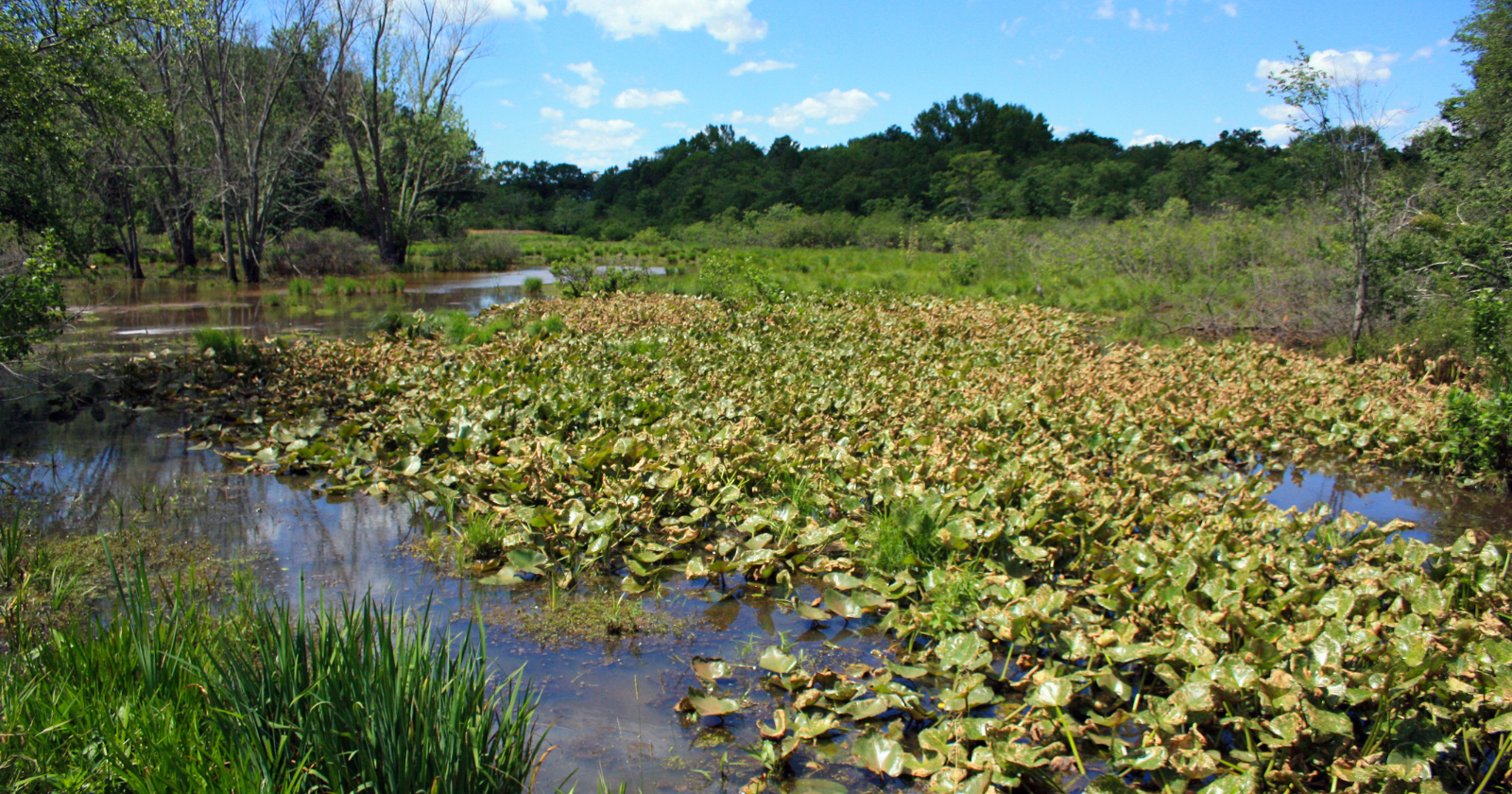
Wood ducks now nest on ground that was once pencilled in for four 10,000-foot runways.
In December 1959, the Port of New York Authority announced it had found the site for the region’s next great airport: ten thousand acres of wet, sedgy, mosquito-farming ground in Morris County, New Jersey, about 26 miles west of Times Square. Word broke in the Newark Evening News on 3 December, and by the standards of mid-century American infrastructure the thing was already settled. One side had money, lawyers and the moral authority of progress. The other side had station wagons and a slide projector.
What the plan actually involved
Four runways, each 10,000 feet long. Hills would have been bulldozed flat, the wetland filled in, and around 700 homes and other structures demolished, per the Great Swamp Watershed Association, which keeps the fullest public account of the proposal. Chatham Township and several of its neighbours would have gone under the concrete entirely, a detail spelled out on the historical marker the Chatham Township Historical Society erected in 2019.
Nobody in 1959 thought a swamp was worth much. That was rather the point. Wetlands were that era’s default answer to where an enormous ugly thing should go: cheap, easy to overlook, and nobody’s postcard. Draining them counted as tidying up.
A kitchen table in Green Village
Helen Fenske was a housewife in Green Village when the news landed. Local meetings filled the high school to standing room. A committee formed, and Fenske was made its secretary, as documented by the US Fish and Wildlife Service in its account of her role. Much of the early organising happened at her kitchen table.
Her weapon was an old slide projector. She hauled it to any room that would have her, showed people photographs of the place they were about to lose, and explained why a soggy 55-square-mile basin mattered to anyone who drank water downstream. She and a fellow committee member, Grace Hand, then talked a reluctant regional director into the idea that this unglamorous patch of New Jersey ought to be a national wildlife refuge.
Which is how one slide projector and a lot of stubbornness ended up owning land.
The awkward business of buying a swamp
Talk alone was not going to save the swamp. The committee started buying land instead. Over several years it raised a million dollars and bought nearly 3,000 acres, which it handed to the federal government, as the refuge’s own history records show. Congress established the refuge by act on 3 November 1960. Contributions arrived from more than 6,100 people and 462 organisations across 29 states, as set out in a research summary of the campaign. New Jersey’s incoming governor, Richard Hughes, signed a bill blocking jetport construction before the end of 1962. Roughly 6,000 volunteers turned out at the grassroots end.
A million dollars in 1960 money was not pocket change for a handful of Morris County towns. In blunt terms, they bought their own landscape back.
Why refuge status was not enough
Winning did not stick. Feel-good retellings tend to skip that. The Port Authority kept pushing for the airport for years after the refuge existed, because a refuge is only a designation, and a sufficiently motivated agency can always undo one.
So Fenske went after something harder to reverse. The Wilderness Act had passed in 1964, and she taught herself congressional procedure to get the Great Swamp included under it. In 1968 Congress designated 3,660 acres as wilderness, the first such area within the Department of the Interior, as recorded by Wilderness.net. That designation, and not the refuge paperwork, is what finally killed the jetport.
Nearly nine years, start to finish. The fight is the subject of a 2017 documentary, Saving the Great Swamp, for anyone who wants the full political knife-work.
What is actually out there
More than 244 bird species have been identified using the site, along with 39 mammal species including river otters, foxes and the endangered Indiana bat. It covers twelve square miles in what is now a mostly suburban landscape. Bog turtles and blue-spotted salamanders live there too, which is the sort of company that tends to vanish first when anyone pours concrete.
Roughly eight and a half miles of trail cut through the wilderness section. No bikes, no vehicles, no permanent structures. Old roads and dumps were pulled out and drained wetlands were put back, so a decent chunk of what visitors walk through today has been rebuilt by hand.
The visitor centre is named after Fenske.
The threat that came next
Nobody bulldozed the place. And yet by 1989, the Wilderness Society was listing it among the ten most endangered refuges in the national system, as reported at the time by the Christian Science Monitor. Chemical runoff and development were pressing in at the boundaries. Wetland that size also works as a flood sponge, holding heavy rain that would otherwise end up in somebody’s basement downstream. Airports arrive with public hearings and scale models. Subdivisions and fertiliser arrive quietly, one approval at a time, and there is no single villain to raise a million dollars against.
That’s presumably why the people who saved it in the sixties went back to work in the eighties, and why a 55-square-mile watershed still has a full-time organisation watching what flows into it.
