

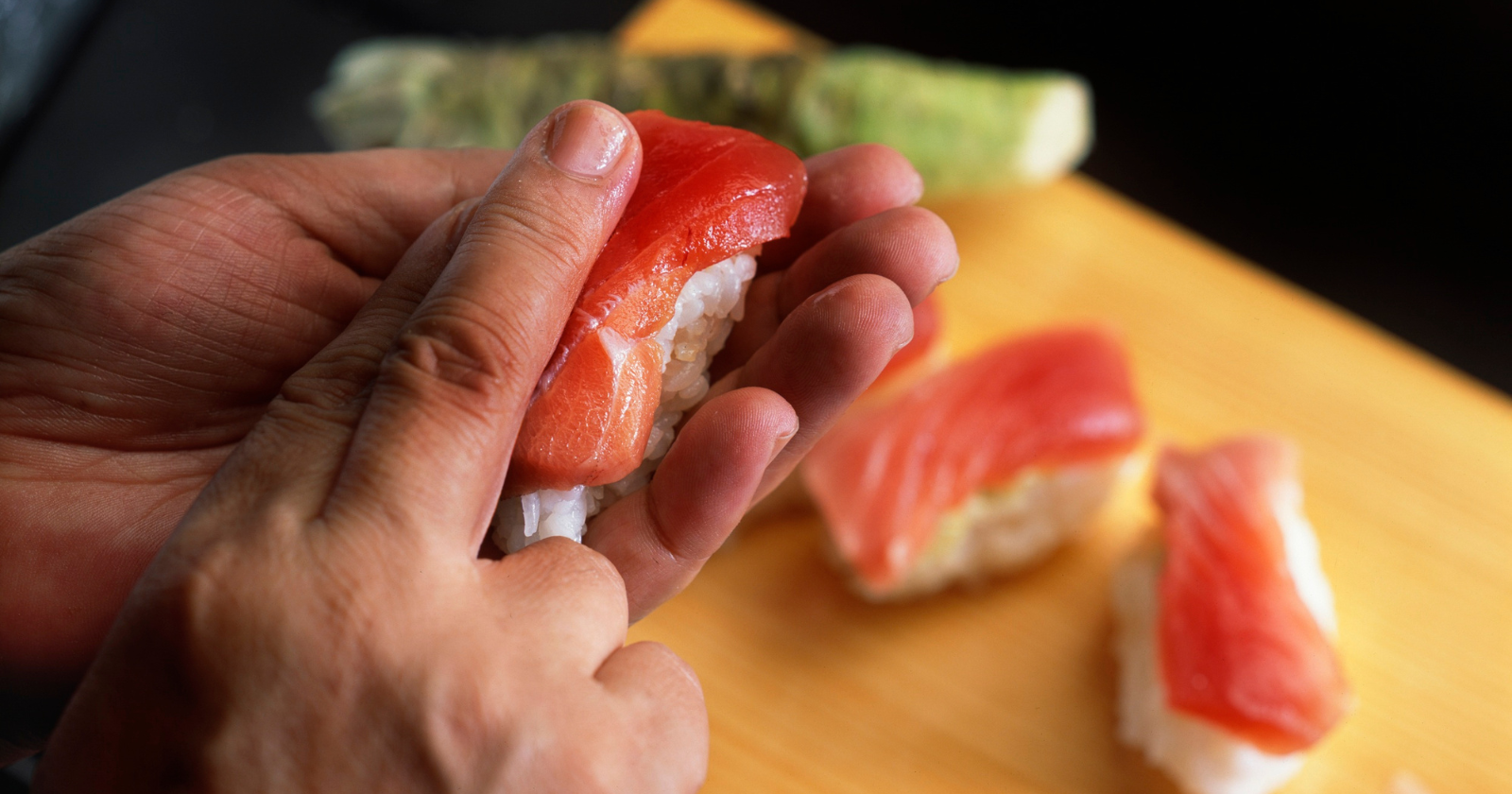
There is a certain kind of worker who has spent forty years doing one thing. Not forty years in a field, or a company, or a broad profession, but forty years on a single craft: the same fish, the same joint, the same glaze, refined past the point most people would call finished and then refined again. Japanese has a word for this person. The word is shokunin.
It gets translated as craftsman or artisan, and the translation is accurate enough to be useless. Its two kanji are plain: shoku, occupation or craft, and nin, person. A person of a craft. What the dictionary cannot carry is the weight the word has picked up over centuries of use, which is less a matter of skill than of a particular relationship to the craft, one that treats a lifetime spent on one narrow thing as a form of respect rather than a failure of ambition.
That is the version of shokunin that travels well. A person gives everything to a craft, the culture honours the giving, and the devotion reads as dignity rather than obsession. It is an appealing idea, especially somewhere that measures a working life in titles and moves. We think it broadly true, and think the tidy version leaves out the parts worth understanding.
What the word carries
The clearest English-language account is still Toshio Odate’s, in his 1984 book Japanese Woodworking Tools: Their Tradition, Spirit and Use. Odate trained as a tategu-shi, a maker of sliding doors, before moving to the United States, and wrote partly to explain what the word meant to the people who used it of themselves. His definition gets quoted everywhere, usually without attribution: the shokunin has technical skill, but also a social obligation to work at his best for the general welfare of the people.
That second half is the part most Western readers skate over. That obligation points outward. The devotion is not, at root, self-expression or personal excellence for its own sake. It runs toward the people it serves, and the long line of makers who came before. Sachiko Matsuyama, writing in the Kyoto Journal, describes taking visitors to meet shokunin and being asked how long a piece takes to make. The answer she reports is a lifetime. She calls the binding quality an altruistic, non-individualistic attitude, in which the work exists beyond the person doing it.
That is the register that travels least well.
Shokunin has old roots. Craftspeople were a recognised social layer by the Edo period, from the early seventeenth century to the late nineteenth. Even in Japan the word is loosely bounded: Matsuyama notes that who counts as a shokunin is debated among shokunin themselves. The concept is a spirit more than a job title, which is part of why it resists a clean definition, and why it is so easily borrowed.
The part the tidy version leaves out
Odate’s book is also a record of how harsh the traditional apprenticeship could be. He describes saving for a year to buy a good hand plane, only for his master to take it away: an apprentice was not thought worthy of a fine tool, and he never saw it again. He describes leaving sharpening stones out on a winter night, letting them freeze and crack, and being beaten for it. There was no formal instruction. You learned by watching the master while doing your own work, and looking away from your work was itself an offence.
Hold that next to the phrase deep respect for the work and the picture gets more honest. The respect was real. So was the cost, and the cost was usually paid by the young and the junior.
The most watched modern portrait carries the same double edge. Jiro Dreams of Sushi, the 2011 documentary by David Gelb about the Tokyo sushi chef Jiro Ono, is usually recommended as an inspiring film about mastery. It is also a film about a man whose sons arranged their adult lives around his standards, and about the quiet arithmetic of a household built on one person’s craft. Jiro’s own advice is to choose your work, immerse yourself, and fall in love with it. Gelb’s film shows what that immersion asked of the people near him.
What the West tends to do with it
Search the word in English and most of what comes back is aspirational. Design blogs, productivity writers, and marketing pages have adopted shokunin as a philosophy of personal excellence, a way to feel serious about your own output. Some of this is harmless. Some of it borrows the authority of the concept while reversing it.
The common Western frame is self-optimisation: master one thing and become the fullest version of yourself. Shokunin, as Odate and Matsuyama describe it, runs closer to the opposite.
The self recedes.
The maker becomes one link in a chain, humble before the material and the tradition, and the satisfaction comes from vanishing into competent work instead of standing out through it. That is a harder sell as a personal brand.
Shokunin gets folded, too, into the familiar story of ten thousand hours of practice, as though it were an early draft of a productivity rule. That figure, popularised by Malcolm Gladwell, was contested almost as soon as it appeared, including by Anders Ericsson, whose research it drew on. It also measures the wrong thing. Shokunin was never a claim about how many hours produce mastery. It asks what a working life is for.
Where the love actually comes from
One detail in Jiro’s advice is easy to miss. He tells people to fall in love with their work, but places it after the decision to commit, not before. The affection is downstream of the years, not the reason for starting them. That reverses the advice most young people now receive, which is to find what you already love and then chase it.
What the shokunin idea suggests, in our reading, is that devotion of this kind is built more often than found. Love arrives, if it arrives, through repetition, through getting slightly better across a long run of ordinary days, through the narrowing that most career advice treats as a trap. Kaizen, small continuous improvement, and kodawari, an uncompromising attention to detail, name the texture of that narrowing from inside.
None of this makes the shokunin life right for everyone, and it would be a mistake to sentimentalise a system that also produced confiscated planes and beaten apprentices. The concept works better as a corrective than a template: a reminder that a life spent going deep on one thing has been treated, in at least one culture and for a very long time, as an honourable way to spend it rather than a smallness to apologise for.
The word survives partly because it still describes real people. Somewhere in Japan a plasterer or a knife maker or a lacquer specialist is being asked how long the work takes, and giving the same answer Matsuyama recorded, and meaning it plainly.