
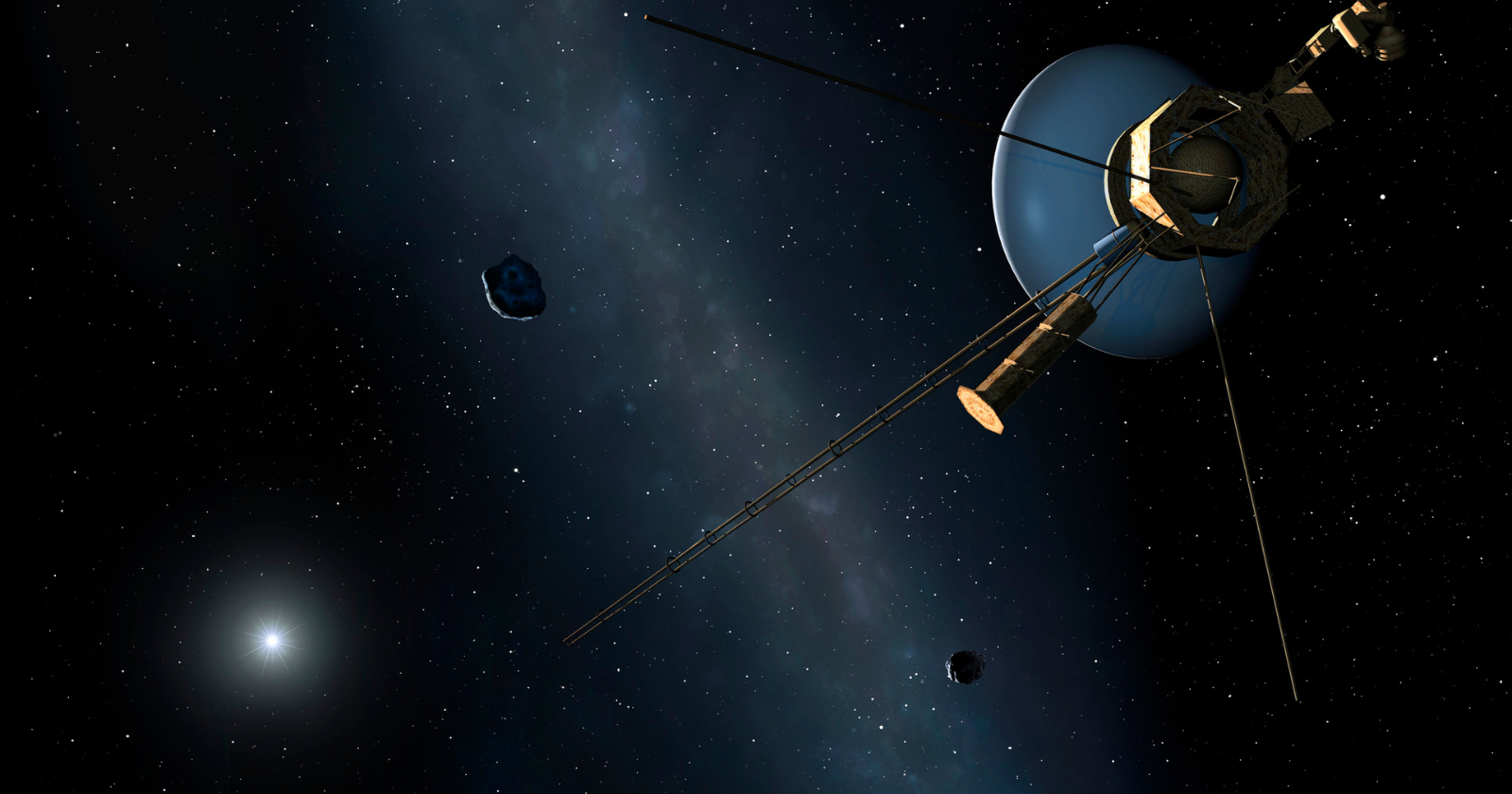
Voyager 1 is, by every available measure, the longest-running and most successful piece of deep-space hardware in the history of the species. It launched at 8:56 AM Eastern Daylight Time on 5 September 1977, atop a Titan IIIE-Centaur rocket from Launch Complex 41 at Cape Canaveral Air Force Station, on what was originally planned as a four-year mission to study Jupiter and Saturn. That four-year mission was completed in November 1980 when Voyager 1 finished its Saturn flyby. The spacecraft has been continuously operating, transmitting data, and receiving commands from Earth for the 46 years since then — an unplanned bonus mission that has, by accident of engineering durability, turned into the longest-distance human technological project ever attempted. The Voyager 1 that will cross the one-light-day threshold in November 2026 is, in essential respects, the same spacecraft that left the launch pad in 1977, with the same instruments, the same power source, the same antenna, the same onboard computers, and a slowly accumulating list of small mechanical failures that the JPL ground team has, so far, managed to work around.
According to CNN’s coverage of the upcoming light-day milestone, the threshold will be reached when Voyager 1 is approximately 16.1 billion miles (25.9 billion kilometres) from Earth, which on its current trajectory will happen on 15 November 2026. Suzy Dodd, the Voyager project manager at NASA’s Jet Propulsion Laboratory, described the operational reality in concrete terms: “If I send a command and say, ‘good morning, Voyager 1,’ at 8 a.m. on a Monday morning, I’m going to get Voyager 1’s response back to me on Wednesday morning at approximately 8 a.m.” The 24-hour one-way signal time means that all communication with the spacecraft now operates on a 48-hour command-and-acknowledgement cycle. The JPL ground team can no longer have anything resembling a conversation with the probe. Each command must be sent into the dark, with the team waiting two days to find out what happened.
Why distance becomes time
For most of Voyager 1’s mission, JPL has reported the spacecraft’s distance in kilometres, then in billions of kilometres, then in astronomical units. As the numbers grew larger, they became progressively harder to interpret. At 16 billion miles, distance loses any intuitive meaning. As reported by Popular Science’s coverage of the approaching milestone, the mission team has accordingly shifted to measuring distance in terms of how long light itself takes to cross the gap. Light-hours have been the standard unit for the past several years. Light-days are now beginning. By the time Voyager 1’s mission ends, its distance will be measured in fractions of a light-week. The progression matters because radio signals travel at the speed of light, and the time light takes to reach the spacecraft is the same as the time radio signals take. The two-day command cycle that the team is now operating within is, in effect, what running a spacecraft at one light-day’s distance looks like in practice.
The spacecraft itself is travelling at approximately 38,000 miles per hour, or roughly 11 miles per second — a substantial velocity by human technological standards, but glacial compared to light. Voyager 1 covers approximately 3.5 astronomical units (the Earth-Sun distance) per year. At its current speed and trajectory, it would take Voyager 1 approximately 73,000 years to reach the nearest star to the Sun, Proxima Centauri. The spacecraft is not, in fact, heading toward Proxima Centauri. It is heading in the general direction of the constellation Ophiuchus, and will pass approximately 1.6 light-years from a faint red dwarf called Gliese 445 in roughly 40,000 years. Voyager 1 will, by every projection, be the longest-surviving artefact of human civilisation in the universe — long after the Earth itself is no longer hospitable to the species that built it.
What is still working
Per Tom’s Hardware’s analysis of the engineering challenges facing the aging spacecraft, the Voyager 1 that will cross the light-day milestone in November 2026 is a substantially diminished version of the spacecraft that left Earth in 1977. The probe was launched with eleven scientific instruments; four are still operating. The power supply, three Radioisotope Thermoelectric Generators fuelled by plutonium-238, produced approximately 470 watts at launch and now produces roughly 250 watts, declining by about 4 watts per year. The ground team has been progressively turning off non-essential instruments and heaters since the late 1990s to extend the spacecraft’s operational life. Each shutdown decision involves a trade-off: turning off a heater saves power but risks a critical component freezing in the -270°C ambient temperature of interstellar space. Turning off an instrument loses scientific data but extends the spacecraft’s communication capability with Earth.
The recent years have been mechanically eventful. In May 2022, Voyager 1’s attitude control system began sending garbled data, and the JPL team spent months diagnosing the problem from 22 light-hours away — sending commands, waiting nearly two days for responses, interpreting the results, sending revised commands. In November 2023, the spacecraft stopped sending readable science data entirely; the team spent approximately five months working out that one of the onboard computers had a faulty memory chip, and then re-routing operations around the failed component. Both problems were eventually fixed. The 49-year-old spacecraft continues to function, but each successive year produces new failures that the ground team must work around with progressively less margin for error.
The end of the mission
The Voyager 1 mission will, by most current JPL estimates, continue functioning into the early 2030s before its power supply drops below the minimum threshold required to operate any of its remaining instruments. The spacecraft will not stop existing at that point. It will continue traveling outward at 38,000 miles per hour for an effectively unbounded duration. The Golden Record bolted to its side — the gold-plated copper disc designed by a team led by Carl Sagan, containing greetings in 55 languages, music from across human cultures, scientific diagrams, and a map showing Earth’s location relative to nearby pulsars — will continue traveling outward with it, indefinitely, until some chance encounter with a star, a planet, or another civilisation many millions or billions of years from now. The light-day milestone in November 2026 is a substantially smaller event than the eventual silence of the spacecraft, but it is a real one. For 24 hours of one-way travel time, light itself becomes a unit of measurement at the scale of a thing humans have built. Voyager 2, on a different trajectory and slightly behind its twin, is currently at 19.5 light-hours and continues outward as well. By the time the second Voyager crosses its own light-day threshold, sometime in the next decade, the first will have travelled substantially beyond.
