

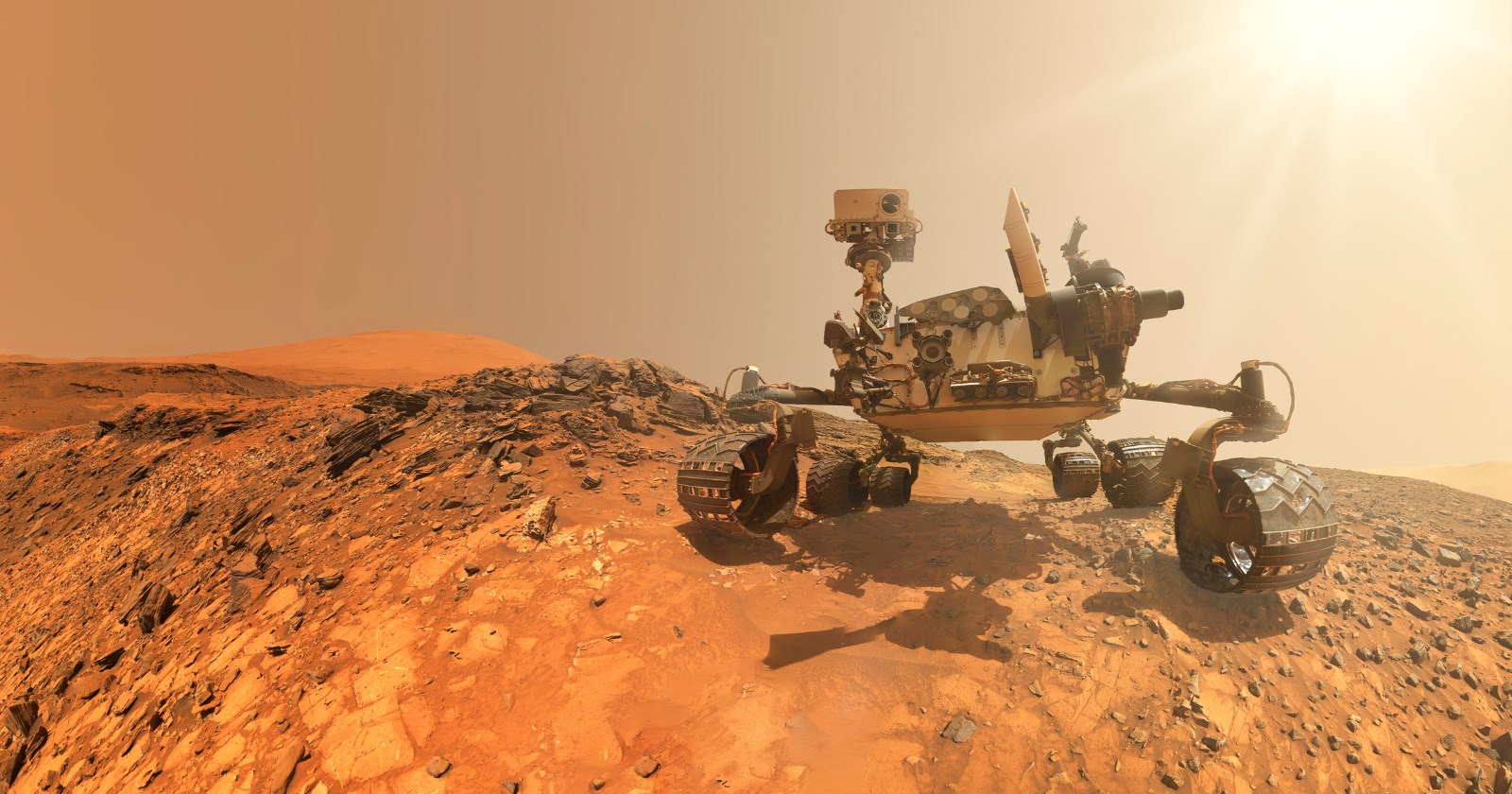
The Curiosity rover was given its name by a 12-year-old girl from Kansas named Clara Ma, who in 2009 won a NASA-sponsored essay contest with a submission that included the line: “Curiosity is the passion that drives us through our everyday lives. We have become explorers and scientists with our need to ask questions and to wonder.” Her autograph, etched onto a metal plate, was attached to the rover before launch. The rover itself was, in essentially every measurable specification, the most ambitious robotic exploration vehicle that had ever been sent to another planet. It was substantially larger than every previous Mars rover combined — the small Sojourner rover of 1997 had weighed approximately 10 kilograms; the twin Spirit and Opportunity rovers of 2004 had each weighed approximately 185 kilograms; Curiosity weighed 900 kilograms and carried 17 cameras, a chemistry laboratory occupying nearly half its payload, a rock-vaporising laser capable of striking targets up to seven metres away, a hand-lens imager, an X-ray diffraction mineralogy unit, a weather station, a radiation detector, and a powered drill capable of extracting samples from up to five centimetres below the Martian surface. The total cost of the mission to launch was approximately $2.5 billion.
According to NASA Jet Propulsion Laboratory’s mission summary for the Curiosity rover and the Mars Science Laboratory programme, the central engineering challenge of the mission was getting a 900-kilogram object safely onto the surface of a planet whose thin atmosphere makes parachute-only landings impractical and whose distance from Earth makes real-time control impossible. The solution, developed by JPL engineers over approximately six years of design work, was the “sky crane” — a rocket-powered descent stage that would hover several metres above the Martian surface while lowering the rover beneath it on cables, set the rover gently down on its wheels, sever the cables, and fly away to a controlled crash. The technique had never been attempted before. Mission planners called the seven minutes between atmospheric entry and surface contact “the seven minutes of terror.” The landing was executed entirely by onboard automation, with mission control in Pasadena receiving telemetry confirmation approximately 14 minutes after each event due to the speed-of-light delay between Mars and Earth. The landing worked. Curiosity touched down within 2.4 kilometres of its intended target in Gale Crater. Mission control in Pasadena erupted in celebration that was broadcast live on NASA TV and watched by approximately a thousand people gathered in New York’s Times Square.
What the rover was sent to find
The scientific objective of the Curiosity mission was, in its original 2011 framing, comparatively narrow. As described in NASA Science’s mission overview of the Mars Science Laboratory’s primary scientific goals, the question Curiosity was designed to answer was whether Mars had ever possessed the environmental conditions necessary to support microbial life — not whether life had actually existed there (which would require evidence of fossilised or extant biological material), but whether the planet had ever, at any point in its 4.5-billion-year history, been habitable in the strict biological sense. The choice of Gale Crater was driven by orbital observations that had identified the 154-kilometre-wide impact basin as a site containing layered sedimentary rocks visible from orbit — rocks that, if the geological interpretation was correct, would have been deposited in a body of standing water billions of years ago. The 5.5-kilometre-high central peak of the crater, named Mount Sharp by NASA in honour of the geologist Robert P. Sharp (and officially designated Aeolis Mons), would offer Curiosity, as it climbed the mountain’s slopes, a continuous geological record of approximately two billion years of Martian environmental history, recorded in successive layers of stratified rock visible to the rover’s instruments as it ascended.
The mission’s first major scientific finding, announced approximately seven months after landing, was that ancient Gale Crater had indeed contained a freshwater lake — chemically habitable, neither too acidic nor too saline, with the kind of mild conditions that could in principle have supported microbial life — approximately 3.5 billion years ago. Subsequent drilling campaigns have produced a sustained sequence of progressively more specific discoveries about Martian chemistry and the planet’s past habitability. In 2018, Curiosity’s instruments identified benzene and propane in three-billion-year-old rock samples. In March 2024, the same instruments identified long-chain alkanes with up to twelve consecutive carbon atoms — molecules whose origin (whether biological or geological) remains unclear. In April 2026, NASA announced the detection of benzothiophene and amine-bearing benzene rings — including what the agency described as DNA precursors — in a sample collected in 2020. The methane concentration in the immediate vicinity of the rover has been documented to vary with the Martian day-night cycle, a pattern that current atmospheric models cannot fully explain.
What 14 years of operation actually looks like
The duration of Curiosity’s continued operation has, by every available measure, substantially exceeded what NASA’s original mission planners considered realistic. As detailed in Space.com’s reference guide to the Curiosity rover and its operational history, the rover’s primary mission was scheduled for one full Martian year — approximately 687 Earth days, or roughly two Earth years. In December 2012, just four months after landing, NASA extended the mission indefinitely. The rover is now in its fifth extended mission. The cumulative distance it has driven is 36.86 kilometres (22.90 miles) from its landing site. The total elevation it has climbed up the slopes of Mount Sharp is approximately 740 metres (2,430 feet). The number of rock samples it has drilled is 47, the most recent of which was a sample called “Campo Marte” extracted in May 2026 from the boxwork region of the mountain’s mid-flank. The number of laser shots fired by its ChemCam spectrometer at Martian rocks is over 900,000.
The fundamental reason Curiosity is still operating after 14 years, when its solar-powered predecessors Spirit and Opportunity each ended their missions partly as a consequence of dust accumulation on their solar panels, is the radioisotope thermoelectric generator that powers it. As described in NASA’s ongoing Curiosity blog updates from mission scientists throughout 2025 and into 2026, the rover’s plutonium-238 power supply generates approximately 110 watts of continuous electrical power regardless of weather, dust, season, or time of day. The output decays slowly — plutonium-238 has a half-life of approximately 87.7 years, so the rover loses electrical capacity at a predictable rate of approximately 0.8 percent per year — but the rate of decline is gentle enough that Curiosity is expected to remain operational well beyond 2030, by which point the rover will be approximately 20 years into a mission originally planned for two. The combination of nuclear-powered endurance, redundant scientific instrumentation, and an Earth-side mission team that has now spent more time operating the rover than the original engineering team spent designing it has produced an exploration vehicle whose continued daily operation has become, in the broader context of crewed and robotic space exploration, one of the more unremarkable miracles of the early 21st century. Curiosity is still there. It is still drilling. The data continues to come back.