
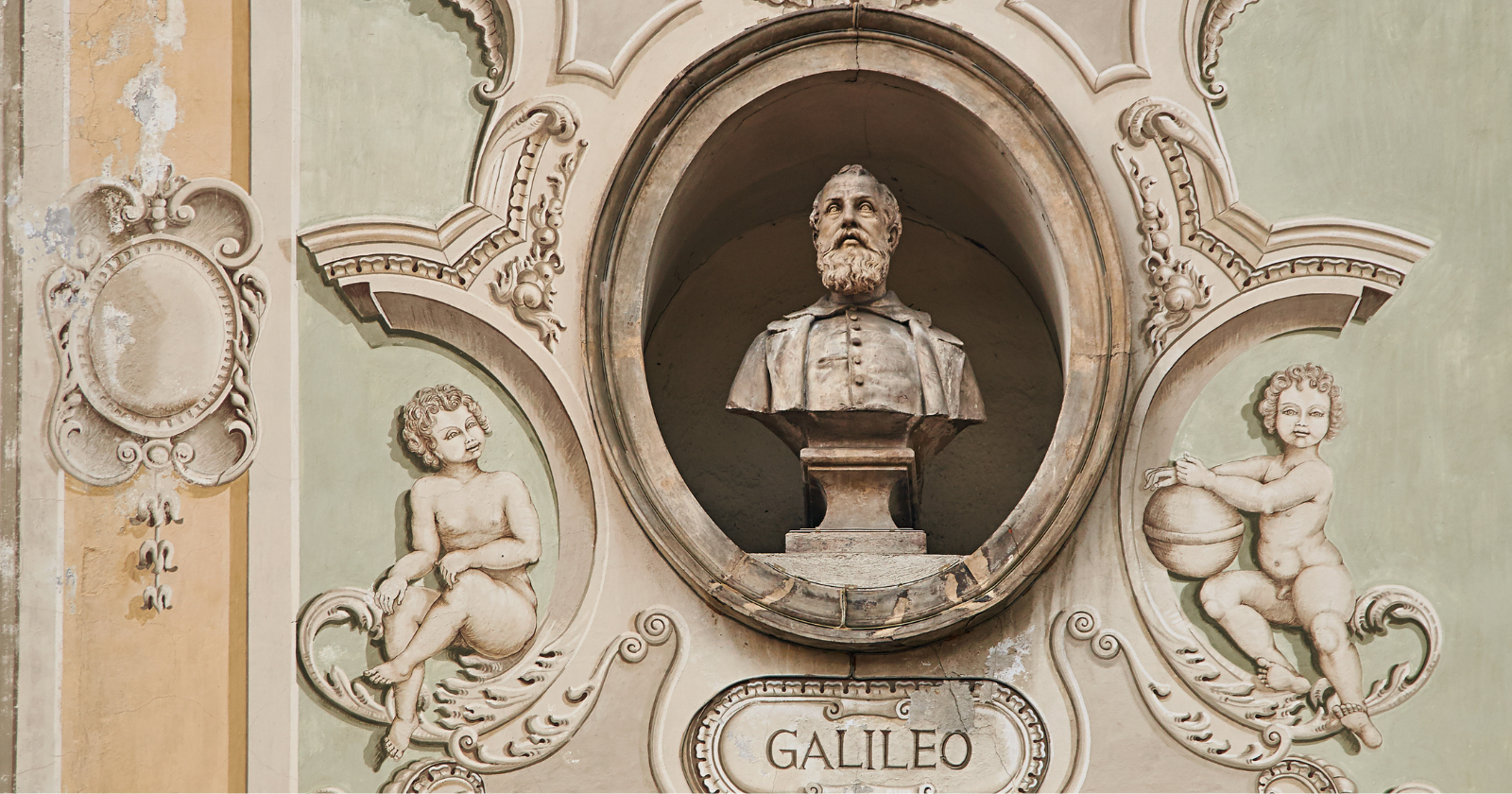
On the first night, 7 January 1610, Galileo recorded what he was seeing in his observation notebook with the careful, slightly bemused understatement of a researcher who knew he was looking at something interesting but did not yet know what. He wrote that he had seen “three small but very bright” stars arranged along a line parallel to the ecliptic and unusually close to the planet Jupiter. He noted their positions. He did not, that first night, attach any particular significance to them. The stars he had observed were, by every standard 17th-century interpretation of what stars were, fixed background objects against which the planets moved. The arrangement was unusual but not, on the evidence of a single night, structurally important. He closed his notebook. He returned the following night to take a second look — by his own later account, more out of curiosity than out of any specific theoretical expectation.
According to a NASA history-of-spaceflight summary commemorating the 415th anniversary of Galileo’s discovery, what he found on the second night was that the three small bright stars had moved. Not in the direction the background stars should have moved relative to Jupiter, but in the opposite direction — and not as a group, but each independently of the others. By the third night, two were on one side of Jupiter and one was on the other. By 13 January, a fourth small bright object appeared near the planet, behaving in the same way as the original three. By 15 January, after eight nights of patient observation, Galileo had concluded — correctly, against essentially the entire prevailing astronomical orthodoxy of the previous fifteen hundred years — that the four small bright objects were not stars at all but moons, satellites, bodies in orbit around Jupiter itself, the first such objects ever directly observed by any human being from any location anywhere.
What the moons proved
The astronomical orthodoxy that Galileo’s observation contradicted was the Ptolemaic-Aristotelian geocentric cosmology, which had been the dominant intellectual framework for understanding the structure of the universe in Christian Europe since approximately the 2nd century AD. As described in the Library of Congress’s archive on Galileo’s telescopic discoveries and their reception, the model held that the Earth sat motionless at the centre of the universe, surrounded by a series of nested crystalline spheres in which the Sun, Moon, planets, and stars were embedded, all rotating around the Earth in perfect uniform circular motion. The model was endorsed by the Catholic Church. It was the basis of most university astronomy curricula. It was, by the early 17th century, supported by approximately 1,500 years of intellectual inertia and theological consensus. The alternative, heliocentric model — proposed by the Polish astronomer Nicolaus Copernicus in his 1543 book De revolutionibus orbium coelestium, drawing on speculative work by the ancient Greek astronomer Aristarchus of Samos in approximately 270 BC — placed the Sun at the centre of the cosmos and the Earth in orbit around it. The Copernican model had been available in print for 67 years by the time Galileo turned his telescope on Jupiter, but had been treated by most contemporary astronomers as a mathematical convenience rather than a physical description of reality.
What Galileo saw at Jupiter changed this. The four moons orbiting the planet directly contradicted the Aristotelian claim that all celestial motion centred on the Earth. If four objects were demonstrably orbiting Jupiter, then either the Earth was not the unique centre of all celestial motion, or there were multiple centres of motion in the universe — neither of which was compatible with the geocentric model as it had been taught for centuries. The discovery did not, by itself, prove the Copernican heliocentric model. Galileo’s subsequent observation of the phases of Venus, made later in 1610 and through 1611, was substantially more decisive for that question — only a heliocentric model could produce the full cycle of phases that Galileo observed Venus undergoing. But the Jupiter moons were the first physical evidence that the geocentric model was structurally wrong, and they were the first observation that could be repeated and verified by any other astronomer with a sufficiently powerful telescope. The observational quality of the evidence was a substantial part of its impact.
What happened next
Galileo published his findings within weeks. As reported by BBC Sky at Night Magazine’s anniversary coverage of Galileo’s Jupiter observations and their broader scientific significance, the resulting book — Sidereus Nuncius, or “The Starry Messenger” — was published in Venice in March 1610, just over two months after the original observations. It was 60 pages long, printed in an initial run of 550 copies, written in Latin (the standard language of European scholarly publication), and it sold out within a week. The book described not only the Jupiter moons but also Galileo’s other recent telescopic discoveries: the mountainous, cratered surface of the Moon (contradicting the Aristotelian claim that all heavenly bodies were perfect smooth spheres), the resolution of the Milky Way into countless individual stars (contradicting the claim that the cosmos was bounded and finite), and the existence of stars too faint to be seen by the naked eye but visible through the telescope (contradicting the claim that the sky contained a fixed and complete set of celestial objects). Each of these findings, individually, was a substantial challenge to the prevailing cosmology. Taken together, they represented the most concentrated single overturning of established astronomical knowledge that the field had ever experienced.
The Catholic Church’s response was, in the first instance, mixed. Per the High Altitude Observatory’s biographical summary of Galileo’s life and the reception of his discoveries, the initial reaction from Rome was cautious interest rather than immediate condemnation. Galileo demonstrated his telescope to senior Vatican officials in 1611 and was received with substantial honour. The complications came later. The book that ultimately led to Galileo’s conviction by the Roman Inquisition was not Sidereus Nuncius but his 1632 Dialogue Concerning the Two Chief World Systems, which presented an explicit comparison between the Ptolemaic and Copernican cosmologies and which the Inquisition determined had crossed the line from mathematical hypothesising into the assertion of heliocentrism as physical fact. Galileo was tried for heresy in 1633, was forced to formally recant his support for the Copernican model, and was sentenced to indefinite house arrest, which he served at his villa in Arcetri, near Florence, until his death on 8 January 1642 — exactly 32 years and one day after the first night he had looked at Jupiter through his telescope and seen three small bright objects he had assumed were stars. The four moons he discovered have, since 1614, been called by the names given to them by his German contemporary Simon Marius: Io, Europa, Ganymede, and Callisto. Collectively, in honour of their discoverer, they are known as the Galilean satellites — and they continue to orbit Jupiter approximately as Galileo originally described them, four hundred and sixteen years after the night he first saw them, providing the same observational evidence today, available to any amateur astronomer with a small telescope, that the Earth is not the centre of everything in the universe.
