

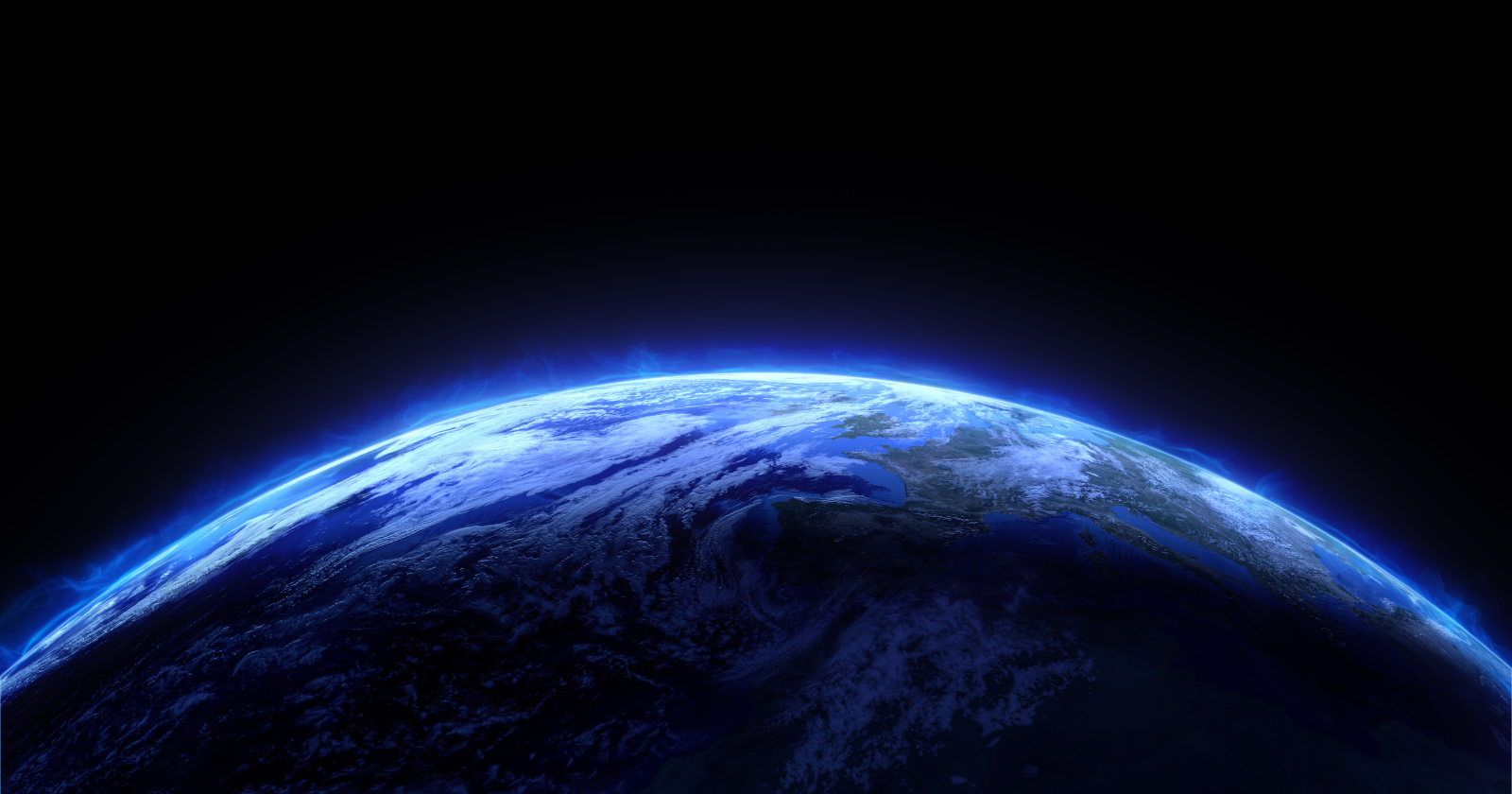
Get in a car. Point it at the sky. Drive at the speed limit. You would reach the official boundary of outer space — the line at which Earth’s atmosphere thins to the point where conventional aircraft can no longer generate enough lift to fly, and at which orbital dynamics take over from aerodynamic ones — in approximately the time it takes to listen to one side of a long-playing record. The distance is 100 kilometres. The drive is shorter than the commute many people make every day. The thinness of the protective layer holding every living creature on Earth’s surface in its breathable, pressurised, temperature-regulated environment is, by every honest measure, alarming once you actually do the arithmetic. The atmosphere is not a vast reservoir of air extending out into space. It is a thin film clinging to the surface of a rocky planet, held in place by gravity that is just strong enough to keep most of it from drifting away, and thin enough that the entire usable portion fits within a layer about 1.5 percent as thick as the planet’s radius.
According to Britannica’s overview of the Kármán line and the historical debate over where exactly the atmosphere ends, the 100-kilometre boundary used internationally to mark the edge of space is, in technical terms, somewhat arbitrary. It was proposed in the mid-20th century by the Hungarian-American aerospace engineer Theodore von Kármán, who was trying to identify the altitude at which a conventional aircraft could no longer rely on aerodynamic lift to stay airborne. His calculations gave approximately 84 kilometres. An associate of his, the lawyer Andrew G. Haley, suggested in 1957 that the number could be used as the legal boundary between atmosphere and outer space, and proposed naming it after Kármán. The World Air Sports Federation formalised the boundary at 100 kilometres in the early 1960s, rounding upward from Kármán’s actual calculation primarily because round numbers are easier to remember and administer. NASA and the US Federal Aviation Administration use a slightly lower figure of 80 kilometres (50 miles) for awarding astronaut wings. The atmosphere, in physical reality, has no sharp boundary — it gradually thins out across hundreds of kilometres until it merges imperceptibly with the solar wind. The 100-kilometre line is a regulatory convention, not a physical one. The thinness of the actual breathable layer is, however, real.
How the air is distributed
The vertical structure of the atmosphere is heavily bottom-weighted. As reported by NASA’s overview of the layered structure of Earth’s atmosphere, the troposphere — the lowest layer, where essentially all weather occurs, where every commercial passenger flight you have ever taken cruises, and where all of the air available for breathing actually sits — extends from the surface to approximately 12 kilometres at the equator and as little as 8 kilometres at the poles. This layer alone contains approximately 80 percent of the atmosphere’s total mass. The next layer up, the stratosphere, extends from approximately 12 to 50 kilometres and contains another 19 percent of the atmosphere’s mass, including the ozone layer that absorbs most of the incoming ultraviolet radiation from the Sun. Above that lies the mesosphere (50 to 85 kilometres), where most meteors burn up before reaching the ground, and the thermosphere (85 to 600 kilometres), where the International Space Station orbits in what is technically still atmosphere but is, by ordinary standards, indistinguishable from vacuum. Approximately 99 percent of the entire atmosphere’s mass sits within the lowest 32 kilometres of altitude. The remaining one percent is spread across the next several hundred kilometres of progressively thinner gas. By the time you reach the Kármán line at 100 kilometres, you are passing through a region whose density is approximately one millionth of sea-level density.
The intuitive impact of the arithmetic is best appreciated by comparison with the size of the planet itself. Earth’s radius is approximately 6,371 kilometres. The breathable troposphere is approximately 12 kilometres thick, or about 0.2 percent of the planet’s radius. The full distance to the Kármán line at 100 kilometres is approximately 1.57 percent of the planet’s radius. If you were to make a scale model of the Earth at the size of a typical apple — about 4 centimetres in radius — the proportional thickness of the entire atmosphere up to the Kármán line would be about 0.6 millimetres. The proportional thickness of the actually-breathable troposphere would be about 0.075 millimetres. The skin on an apple is, depending on the variety, between 0.1 and 0.4 millimetres thick. The apple-skin comparison is approximate — depending on which atmosphere boundary you use and which apple variety you measure, the atmosphere is either slightly thinner than apple skin, comparable to apple skin, or slightly thicker — but the general scale is correct. The atmosphere is a thin film. The breathable part of the atmosphere is an even thinner film.
What the thin film actually does
The function performed by this thin layer of gas is, in every meaningful sense, the entire reason Earth’s surface is habitable. Per NASA’s standard summary of what each atmospheric layer contributes to surface habitability, the troposphere provides the breathable oxygen that essentially every multicellular animal on Earth requires for respiration, along with the nitrogen, carbon dioxide, water vapour, and trace gases that together compose the mixture life on Earth has evolved to use. The stratosphere holds the ozone layer that filters out approximately 97 to 99 percent of the Sun’s medium-frequency ultraviolet radiation, which would otherwise reach the surface in concentrations sufficient to cause severe sunburn, widespread DNA damage, and the rapid extinction of essentially every land-based species not specifically adapted to UV exposure. The mesosphere absorbs and incinerates the approximately 50 to 100 metric tons of meteoroidal material that strikes Earth’s upper atmosphere every day. The thermosphere absorbs the highest-energy ultraviolet and X-ray radiation from the Sun and largely accounts for why the surface receives only the relatively benign visible-light fraction of the solar output.
Without the atmosphere, none of this filtering and processing happens. The surface receives the full solar radiation spectrum. Liquid water boils away at any temperature above freezing because there is no atmospheric pressure to hold it as liquid. The meteoroids reach the ground intact. The temperature swings between scorching daytime and lethal nighttime cold without any atmospheric mass to moderate the change. As detailed in EBSCO’s research summary of the Kármán line and the implications of crossing it, the boundary between habitable surface and lethal space is, in essential respects, a function of how much atmospheric mass sits above any given point. The thin film of gas surrounding Earth — the same thin film a car could drive up through in under an hour, if cars worked vertically and the road continued upward — is the only thing standing between every living creature on the planet and the vacuum of interplanetary space. The Moon, our nearest planetary neighbour, has essentially no atmosphere at all. Mars has an atmosphere approximately one percent the density of Earth’s. Venus has an atmosphere approximately 90 times denser than Earth’s, hot enough to melt lead at the surface, and almost entirely carbon dioxide. None of the other rocky bodies in the solar system has anything resembling Earth’s specific configuration. The thin film holding the air in place around this particular planet, against gravity that is just barely strong enough to keep it from drifting away, is one of the more improbable and load-bearing features of human existence. It is also, by every available proportional measure, approximately as substantial as the skin of an apple.