
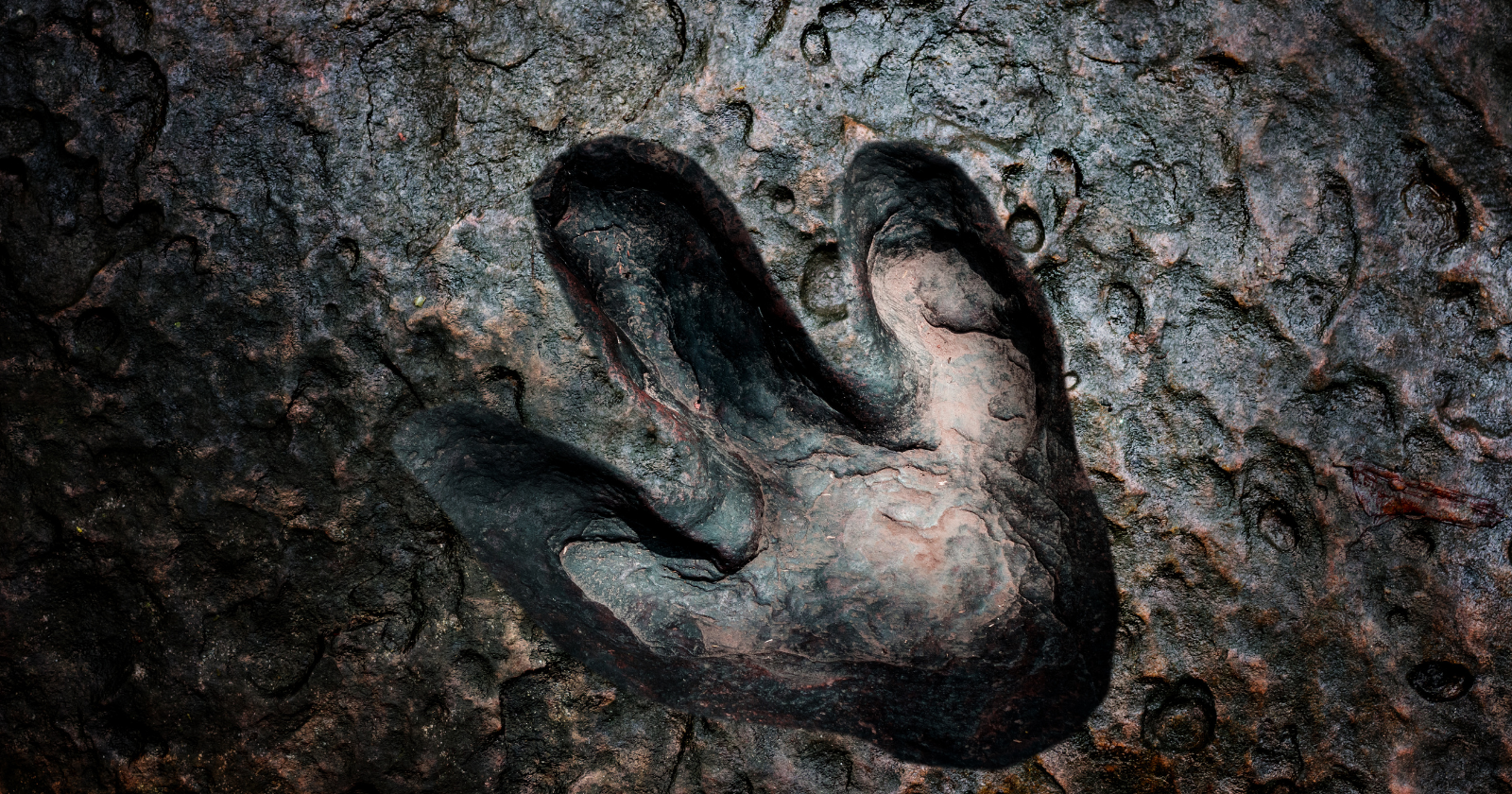
The dinosaurs that left the tracks at Dewars Farm Quarry were walking across Oxfordshire approximately 166 million years ago, in the Middle Jurassic period, when the geographical area now occupied by central England was a warm, shallow tropical sea dotted with mudflats and lagoons. The land was not the same shape it is today. The Atlantic Ocean had not yet fully opened. The supercontinent Pangaea was in the process of breaking apart. The first flowering plants had not yet evolved — angiosperms would not appear for another twenty to thirty million years — and the dominant terrestrial plants were ferns, cycads, conifers, and the seed-bearing relatives of modern ginkgos. Across this landscape, on a particular day approximately 166 million years before the present, a herd of sauropods (most likely Cetiosaurus, a 60-foot-long quadrupedal herbivore that weighed up to ten tonnes and walked on four columnar legs) crossed a particular stretch of mudflat at a measured pace of approximately five kilometres per hour. Sometime later — moments, days, or weeks; the geological record cannot resolve the difference — a single Megalosaurus, a 30-foot-long bipedal predator walking on three-toed clawed feet, walked along approximately the same route, in some sections directly overlapping the tracks of the sauropod that had passed through ahead of it.
According to the Oxford University Museum of Natural History’s official account of the Dewars Farm excavation, the discovery was made when Johnson noticed the regular spacing of the bumps under his vehicle and reported them to the quarry manager, who in turn contacted Dr Emma Nicholls at OUMNH and Professor Richard Butler at the University of Birmingham. A team of more than 100 researchers, students, and volunteers spent a week in June 2024 carefully removing the overlying clay from the trackway surfaces, exposing approximately 200 footprints across five extensive trackways. The longest single trackway from the 2024 dig stretched more than 150 metres in continuous length. Four of the five trackways were attributed to sauropods, most likely Cetiosaurus — an 18-metre-long, ten-tonne herbivore whose name means “whale lizard.” The fifth trackway, with its distinctive three-toed clawed prints approximately 25 inches long, was attributed to Megalosaurus, the nine-metre-long carnivorous theropod that has the historical distinction of being the first dinosaur ever scientifically named, in 1824, by the Oxford geologist William Buckland.
The two-hundred-year coincidence
The temporal symmetry of the Dewars Farm discovery is not accidental. As reported by the Natural History Museum’s coverage of the find, 2024 marked the 200th anniversary of the scientific naming of dinosaurs as a category — an event that occurred when William Buckland, working in Oxford, formally described a partial jawbone and other fossil fragments recovered from the slate quarries of Stonesfield, Oxfordshire, and assigned them to a new genus he named Megalosaurus, meaning “great lizard.” Buckland’s description, published in 1824 in the Transactions of the Geological Society of London, predated the term “dinosaur” itself by nearly two decades — that word would be coined by Richard Owen in 1842 to encompass Megalosaurus and a small number of other large extinct reptiles that had been described by the early 1840s — and is the historical event that conventionally marks the beginning of dinosaur palaeontology as a scientific discipline. The Dewars Farm discovery, occurring 200 years almost to the month after Buckland’s original description, recovered tracks from the same species, in the same English county, less than twenty miles from the quarry where Buckland’s jawbone had originally been found.
The behavioural information embedded in the tracks substantially exceeds what could be extracted from the body fossils alone. Per NPR’s coverage of the stride-length and speed measurements derived from the trackways, each Megalosaurus footprint at Dewars Farm is approximately 25 inches long, with consecutive footprints separated by approximately 8.8 feet of stride. The standard biomechanical formulae for inferring locomotion speed from track dimensions place the Megalosaurus’s walking pace at approximately 5 kilometres per hour, or roughly 3 miles per hour — essentially identical to a brisk human walking pace. The sauropods, despite being substantially larger animals, were moving at approximately the same speed. Where the two types of trackway intersect, the geological evidence is clear that the Megalosaurus came through after the sauropod: the back of one Megalosaurus footprint partially deforms the displaced mud rim around a Cetiosaurus print, indicating the carnivore stepped on tissue that had already settled around the herbivore’s track. Whether this represents active predation, opportunistic scavenging, or merely coincidental use of the same path is a question the geological record cannot definitively answer. The geometry is suggestive.
What the 2025 expedition added
The June 2024 excavation was the first phase of what is now an ongoing multi-year research programme at Dewars Farm. As covered by the University of Oxford’s announcement of the 2025 follow-up expedition, the same team — joined in 2025 by researchers from Liverpool John Moores University — returned to the quarry in summer 2025 for a second week-long dig. The 2025 work uncovered four additional sauropod trackways, hundreds more individual footprints, and what has now been identified as Europe’s longest sauropod dinosaur trackway: a continuous 220-metre sequence of prints from a single individual sauropod, walking in a continuous line, with footprint preservation good enough to track the animal’s gait, stance, and the small variations in its stride from one step to the next. The trackways continue under the quarry walls, suggesting that further excavations in subsequent summers will continue to extend the documented length. Other 2025 finds included a fossilised crocodile jaw, marine invertebrates, and plant material from the same sediment layers — fragments of the broader ecosystem in which the trackway-makers were living.
The geological mechanism that preserved the Dewars Farm trackways for 166 million years is, in retrospect, a sequence of fortunate accidents. The dinosaurs walked across mud soft enough to take the impression of their feet but firm enough to hold the impression without immediately collapsing. The surface was then rapidly flooded, depositing a layer of clay-rich mud over the existing prints. The clay filled the impressions without disturbing them. Subsequent millions of years of further sediment deposition compressed the layered material into rock — the original mud becoming the soft clay layer that Gary Johnson’s digger eventually stripped off, the impressions themselves preserved as compressed depressions in the underlying limestone. The dinosaurs that made the tracks belonged to a world in which Oxfordshire was tropical, in which the first flowers had not yet evolved, in which the rotation of the Earth was very slightly faster and the day very slightly shorter, in which Pangaea had not finished breaking apart, and in which a Megalosaurus walking briskly across mud could expect, without knowing anything about the future, that the marks it made would still be there 166 million years later — to be uncovered, in 2024, by a quarry worker driving a digger, in the very same county where the first dinosaur ever named had originally been described.
