
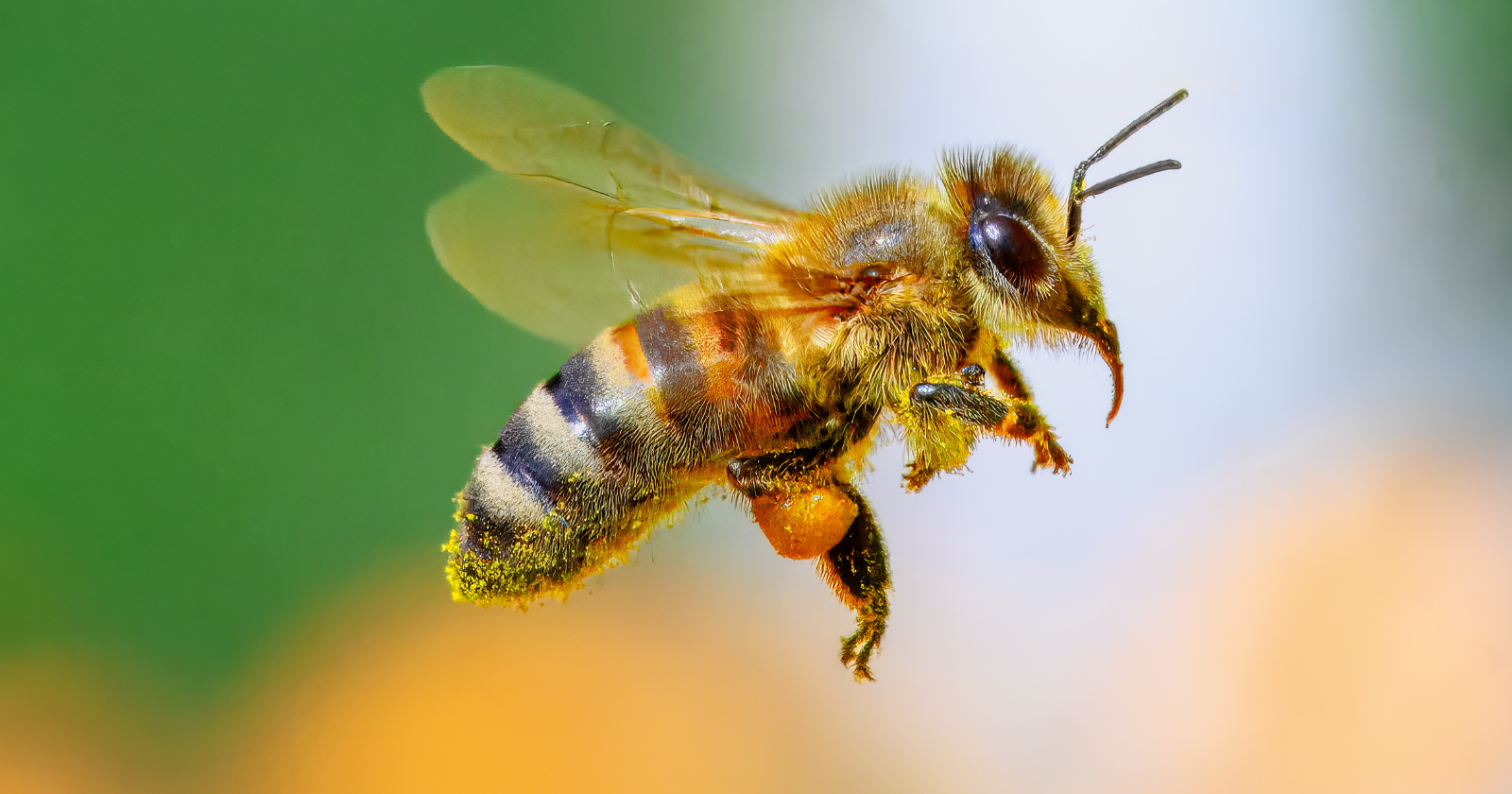
The standard popular framing of human facial recognition treats it as a problem so complex that large brains and specialised neural regions are required to solve it. The human fusiform face area, a section of the temporal lobe that activates specifically when a person looks at a face, has been studied for decades as the neural basis for this ability. The framing is plausible. It is also, by a 2005 finding that has been replicated and extended in the years since, not quite right. Honeybees, with brains roughly one millimetre across containing about a million neurons, can be trained to recognise individual human faces.
The result was published in the Journal of Experimental Biology by Adrian Dyer, then at Johannes Gutenberg University in Mainz and the University of Cambridge, working with Christa Neumeyer of Mainz and Lars Chittka of Queen Mary, University of London. According to the team’s 2005 paper, individual bees trained on photographs from a standard human psychology test could discriminate a target face from a similar distractor face with greater than 80 percent accuracy, and could continue to recognise the trained face two days after training. The bees had never previously been exposed to human faces in any evolutionary or developmental sense. They learned the task because Dyer’s team offered them sugar water for getting it right.
How the experiment worked
The methodology took advantage of the bees’ famously robust associative learning capabilities. Bees are accomplished pattern learners; they have to be, because the flowers they forage from come in an enormous diversity of shapes and colours, and accurate recognition of rewarding flower types is central to their lives. Dyer reasoned that the same machinery might be applicable to any visual pattern, including one with no evolutionary relevance to the bee at all.
The team presented bees with photographs of human faces taken from a face-recognition test originally developed for human psychology research. The photographs were cropped to face and neck only, with standardised lighting and background, to prevent the bees from using clothing or other contextual cues. One face was associated with a drop of sucrose solution. The other faces were associated with a drop of bitter quinine solution. Over repeated training trials, individual bees learned to fly to the rewarded face and avoid the others.
The key result came in the non-rewarded test trials, in which both faces were presented without any sugar to confirm that the bees were not simply following residual scent. The bees continued to approach the trained face with 80 to 90 percent accuracy. According to Science magazine’s coverage of the paper, the bees’ memory for the faces persisted at least two days after training, and the recognition was robust to changes in the position of the face on the test board.
The same strategy human brains use
The deeper finding came in a 2010 follow-up by Aurore Avargues-Weber and Martin Giurfa of the Université Paul Sabatier in Toulouse, working with Dyer. That study, also in the Journal of Experimental Biology, tested how the bees were recognising the faces. The team trained bees on highly simplified face-like images consisting of two dots for eyes, a vertical dash for a nose and a horizontal dash for a mouth, then tested whether the bees were learning the individual features, the relationships between the features, or both.
The bees were learning the configuration. When the features were rearranged into a non-face-like pattern, the trained bees no longer recognised the image as rewarded, even though all the individual features were present. When the features were scaled, slightly rotated, or moved across the visual field together as a group, recognition was maintained. The strategy the bees used is what cognitive scientists call configural processing: identification by the relative spatial arrangement of features rather than by the features themselves. It is the same strategy that the human visual system uses when processing faces, which is why face inversion, which disrupts configural cues, dramatically impairs human face recognition but has little effect on recognition of other categories of object.
Giurfa, quoted in the team’s press materials, framed the implication as follows: “What is really amazing is that an insect with a microdot-sized brain can handle this type of image analysis when we have entire regions of brain dedicated to the problem.”
What this implies about brain size
The honeybee brain contains roughly 960,000 neurons in a volume of about one cubic millimetre. The human brain contains roughly 86 billion neurons in a volume of about 1,200 cubic centimetres. The ratio is approximately one ten-thousandth. According to a December 2013 Scientific American feature co-written by Elizabeth Tibbetts of the University of Michigan and Adrian Dyer, now at RMIT University in Melbourne, the bee finding is part of a broader pattern in animal cognition research showing that several complex visual tasks, including individual face recognition, can be performed by neural circuits far smaller than the mammalian fusiform face area.
The implications go in two directions. First, the existence of a specialised face-processing region in the human brain may not mean that face recognition requires a specialised region, only that the human brain has dedicated one to a task that humans perform frequently. The bee result suggests that general-purpose visual learning machinery can solve the face-recognition problem given enough training, with no specialised hardware required. Second, it suggests that the actual computational problem of face recognition is less inherently difficult than the mammalian brain architecture has implied. Computer scientists working on artificial face-recognition systems have taken some notice; Dyer’s group has explicitly proposed that the bees’ configural-processing approach could inform algorithm design for systems that need to work with limited computational resources.
The broader cognitive picture is that complex social and visual abilities have evolved more than once, in lineages with very different brain architectures, on the basis of general learning principles that do not require large brains. Bees do not need to recognise human faces in their natural environment. The fact that they can, when offered a sugar-water incentive to try, is a piece of evidence for the surprising flexibility of small neural systems and the surprising tractability of a problem that human neuroscience has long treated as exceptional.
