

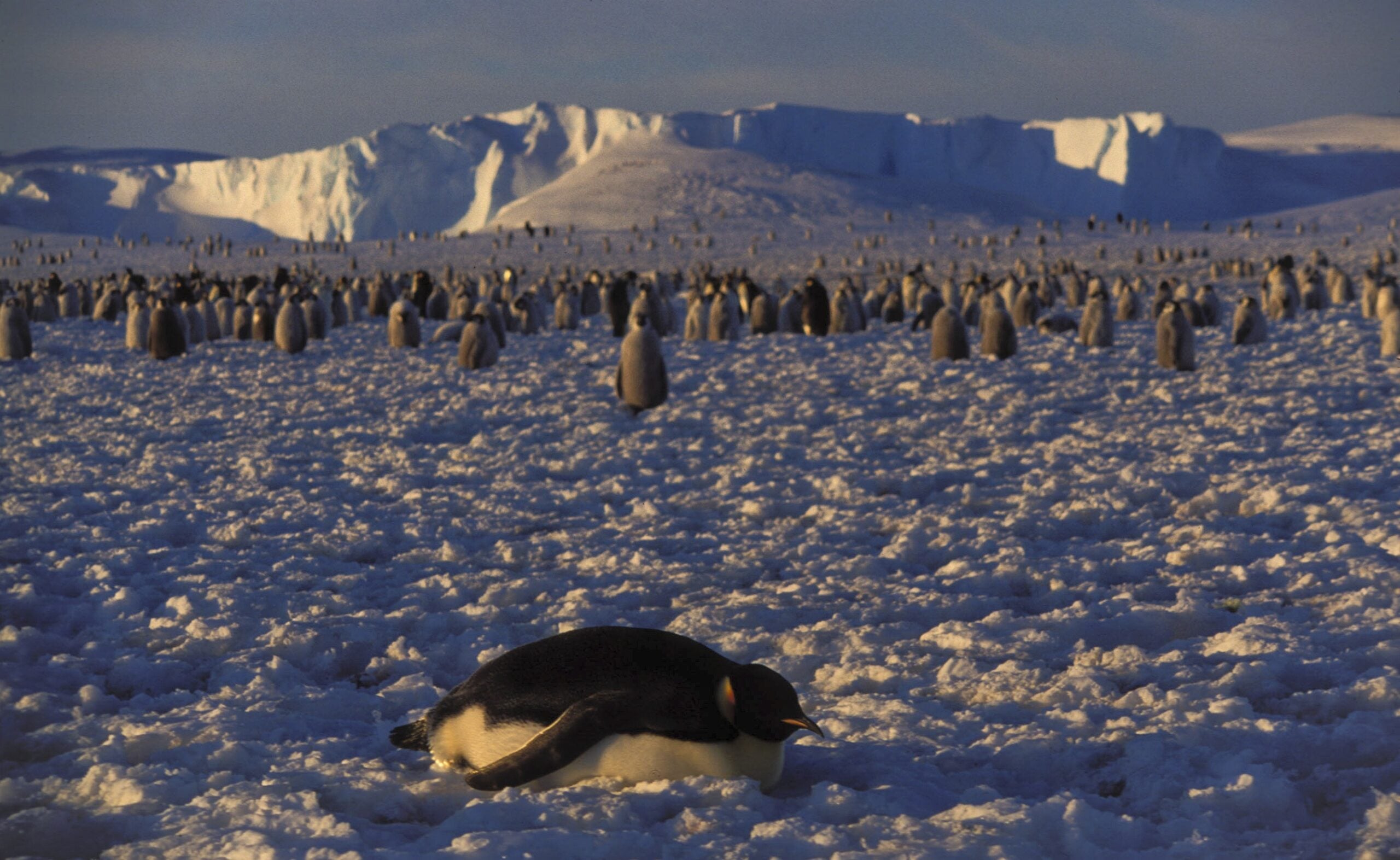
The timing is what makes it strange. Emperors are the only bird that breeds through the Antarctic winter rather than fleeing it, and they do so in the open, well away from the water they feed in. A colony forms on the sea ice in autumn. The female lays one egg, passes it to the male in a transfer that has to be quick and clean because an egg left on the ice freezes within minutes, and then walks back to the sea to feed. The male is left holding the egg through the darkest and coldest stretch of the year, with no way to feed himself until she returns.
In the physics literature on penguin huddling, researchers work with conditions down to minus 50 degrees Celsius and winds of up to 200 kilometres per hour.
What the fast costs
Body-mass figures show the scale most clearly. They come from decades of physiological work led largely by Yvon Le Maho and colleagues at the CNRS laboratory in Strasbourg. A male arrives for the breeding fast at roughly 38 kilograms and can fall to around 18 kilograms in the leanest birds by the time he returns to sea, a range reported by Jean-Patrice Robin and colleagues in the American Journal of Physiology in 1988. Field measurements put the daily loss at something like 120 grams.
For most of the fast the bird runs almost entirely on fat, sparing its own muscle protein, which is what lets it last as long as it does. A 1976 study by Le Maho and colleagues found the emperor’s lower critical temperature, the point below which it has to spend extra energy simply to stay warm, sits around minus 10 degrees Celsius. Antarctic winter is well past that, and the gap is what the huddle exists to close.
The huddle does most of the work
Emperor penguins pack together at roughly 21 birds per square metre, dense enough that the group behaves like a jammed solid. Inside a tight huddle, air temperatures can climb above freezing while the outside stays lethal. At that density almost nobody can move, and a bird caught on the cold windward edge needs a way back in.
Daniel Zitterbart and colleagues measured how the group solves this, in PLoS ONE in 2011. Every 30 to 60 seconds the penguins take small coordinated steps of five to ten centimetres, and those steps travel through the huddle as a wave at about 12 centimetres per second. Over hours, the waves reshuffle the whole formation, moving birds between the warm interior and the cold perimeter. A 2013 follow-up in the New Journal of Physics, led by Richard Gerum with Zitterbart, reproduced the wave from simple rules between neighbouring birds, closer to the mathematics of a traffic jam than to anything coordinated from above.
No bird stays on the outside for long. Positions rotate across thousands of animals, continuously and in small increments, so the huddle is never truly static even when it looks it.
How long a male can hold out
Work reviewed by René Groscolas and Jean-Patrice Robin identifies a physiological threshold well short of starvation. Once a male’s fat reserves drop below a critical level, his behaviour changes, he grows restless, and he will eventually leave the egg and head for the sea. The shift appears to be set off by an internal signal before reserves reach a lethal point.
So the chick’s chances often come down to timing. The female’s return with food, if it arrives before the male reaches that threshold, decides whether the egg survives; past that point the male leaves and the attempt fails.
Why the winter timing
Winter breeding serves a purpose. It means the chicks reach independence during the comparatively mild Antarctic summer, when food near the colony is more reliable. The cost of that schedule lands almost entirely on the male.
What researchers track is the set of conditions that decide whether he makes it: stable fast ice under the colony, how far the female has to travel to open water, and his condition when the fast begins. None of those is fixed, and the cycle runs with little slack, which is part of why the colonies are watched as closely as they are.