

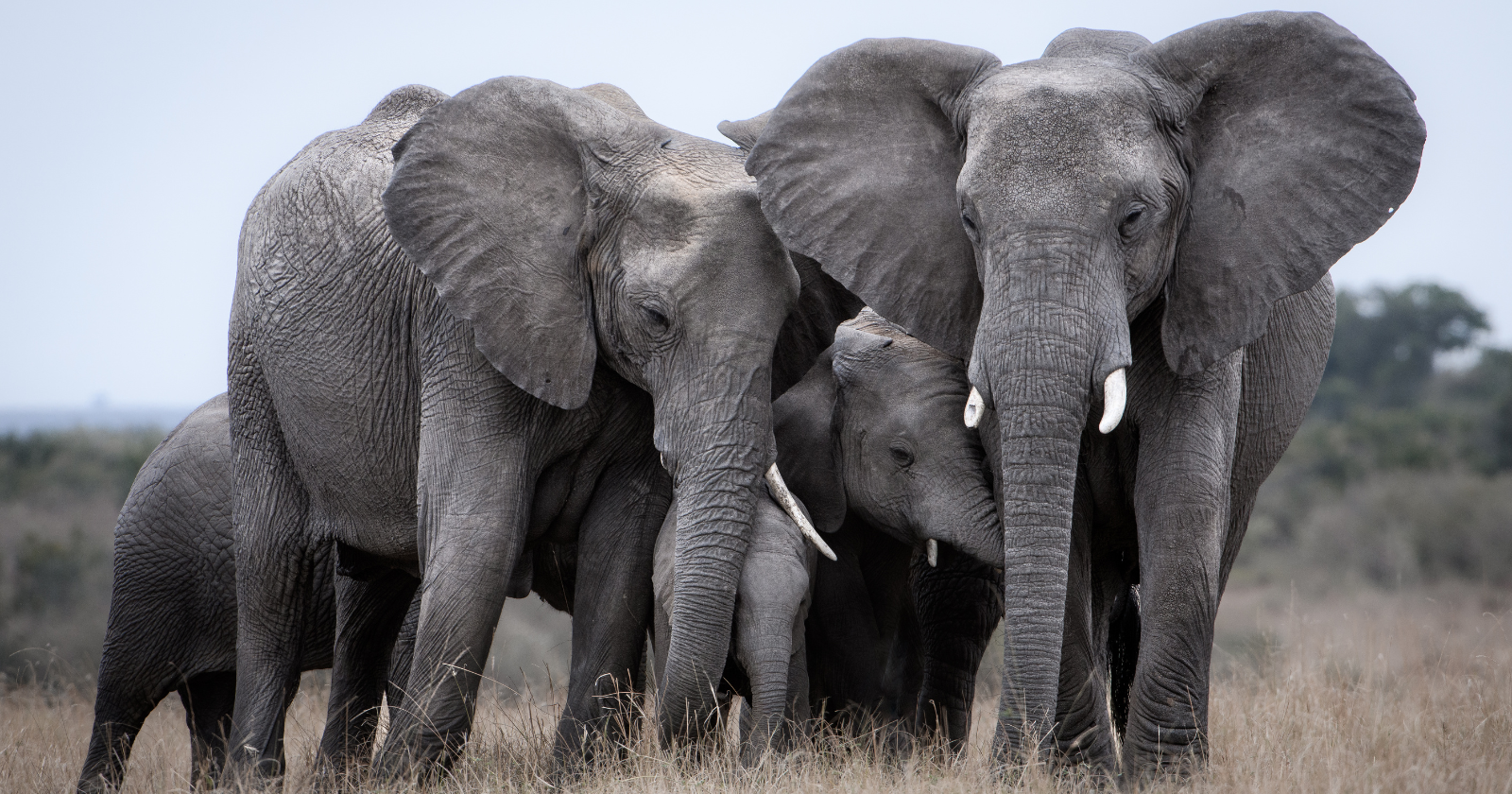
Elephants make deep rumbles that sit mostly below the range of human hearing. Those same low-frequency calls do something less obvious: they push vibrations into the ground, and other elephants appear to pick those vibrations up through their feet and trunks. A call that leaves as sound also leaves as a tremor, and the tremor can outlast it.
The idea that an animal this large communicates seismically was not an easy sell. Seismic signalling had been documented in spiders, scorpions, some frogs and kangaroo rats, all of them small. Extending it to the biggest land mammal took years of work, and much of the strongest evidence still comes from a handful of research groups working with captive animals and computer models rather than from confirmed long-range detection in the wild.
The person who moved the idea from field hunch to testable claim is Caitlin O’Connell-Rodwell, an ecologist affiliated with Stanford. Working at Etosha National Park in Namibia in the early 1990s, she noticed elephants doing something odd at a waterhole. They would freeze, lift a foot and point a toe at the ground, without the ear-spreading that usually goes with straining to hear an airborne call. She proposed in 1997 that the animals were reading vibrations through the earth, drawing on her earlier work recording the seismic courtship signals of Hawaiian planthoppers. She later wrote up the whole line of enquiry in her 2007 book The Elephant’s Secret Sense.
What the experiments established
To test the theory, O’Connell-Rodwell and colleagues buried electronic transmitters that convert recorded sound into ground vibration, then played back calls of known meaning: a warning, a greeting, and the herd equivalent of a signal to move. In work at facilities in Africa, India and the United States, and back at Etosha, elephants responded to messages delivered through the ground alone. A 2007 review she wrote for Physiology summarised the case, building on acoustic measurements her group published in the Journal of the Acoustical Society of America in 2000.
Discrimination is the more striking result. Her group reported that elephants in Namibia could tell the difference between the seismic version of an alarm call from a neighbouring group and one from unfamiliar animals recorded in Kenya. That is closer to reading an address on an envelope than simply feeling a knock at the door.
How the detection works is less settled than the fact that it happens. The leading account combines two routes: bone conduction, in which vibration travels up the skeleton to the inner ear, and pressure-sensitive receptors in the feet and trunk. Both are plausible and supported by anatomy, but the 2018 modelling work below notes plainly that the detection step is the part of the process most in need of further research.
What the 2018 modelling added
The most quantitative recent contribution came from Beth Mortimer and colleagues at the universities of Oxford and Bristol, working with the Kenyan organisation Save the Elephants. Their paper, published in Current Biology in 2018, recorded the ground vibrations of wild elephants walking and calling, then applied seismological modelling to ask how far those signals could travel and still be distinguished.
Two findings stood out. First, the forces were larger than expected: a cow’s rumble registered a peak seismic force of around 2,546 newtons, against roughly 946 newtons for a fast walk. Second, the modelled reach was considerable: that rumble was estimated to travel up to about 6.4 kilometres and a fast walk up to 3.6 kilometres, with specific behaviours remaining distinguishable in the model out to around 1,000 metres regardless of terrain and background noise.
Hold onto that word: modelled. These are estimates of how far a signal could remain physically detectable under favourable conditions, on quiet, sandy ground.
They are not a record of an elephant six kilometres away receiving a call and acting on it.
What the research does not show
This is where the popular version of the story runs ahead of the evidence. That gap, between a vibration that can travel several kilometres and a distant herd that detects and responds to it, is exactly what the studies have not yet closed. Mortimer and colleagues are explicit that detection at those ranges in the field remains to be quantified, and that discrimination between sources under real-world conditions of distance and noise needs more work.
The often-repeated tsunami anecdote belongs in the same category. Reports that elephants in Thailand moved to higher ground before the 2004 Indian Ocean tsunami are widely cited as proof of seismic warning, but they are anecdotal accounts, not controlled observations, and they do not establish what the animals actually sensed. It is a good story.
It is not a result.
What the evidence does support is narrower and still interesting: elephants produce seismic signals, those signals carry usable information, and captive animals can respond to and discriminate between them. The leap from that to a fully mapped underground communication network across the landscape is a leap the data has not yet made.
Why it may matter beyond the herd
The seismic angle has a practical tail. If different behaviours leave distinct signatures in the ground, then buried sensors could in principle monitor elephants remotely, and a sudden burst of panicked running could flag a poaching event in progress. Mortimer’s group pursued that idea in a 2021 study led by Michael Reinwald in the Journal of the Royal Society Interface, which found that seismic recordings could locate a calling elephant at least as accurately as microphones.
Human activity complicates the picture in both directions. The 2018 Current Biology paper noted that engine, machinery and exploration noise in the 20 to 25 hertz band sits close enough to elephant frequencies to interfere with seismic signals. A separate 2021 paper in Proceedings of the Royal Society B, titled “Noise matters,” went further: it reported that wild elephants in Kenya not only detected human-generated seismic cues but tended to move away from them, which the authors read as risk avoidance.
The open question is not whether elephants send these signals, which is well supported, but how reliably they read them at distance in the noisy conditions of a real habitat. Answering it means instrumenting the receiving animal, not just the ground it stands on. That is the experiment still to be done properly.