
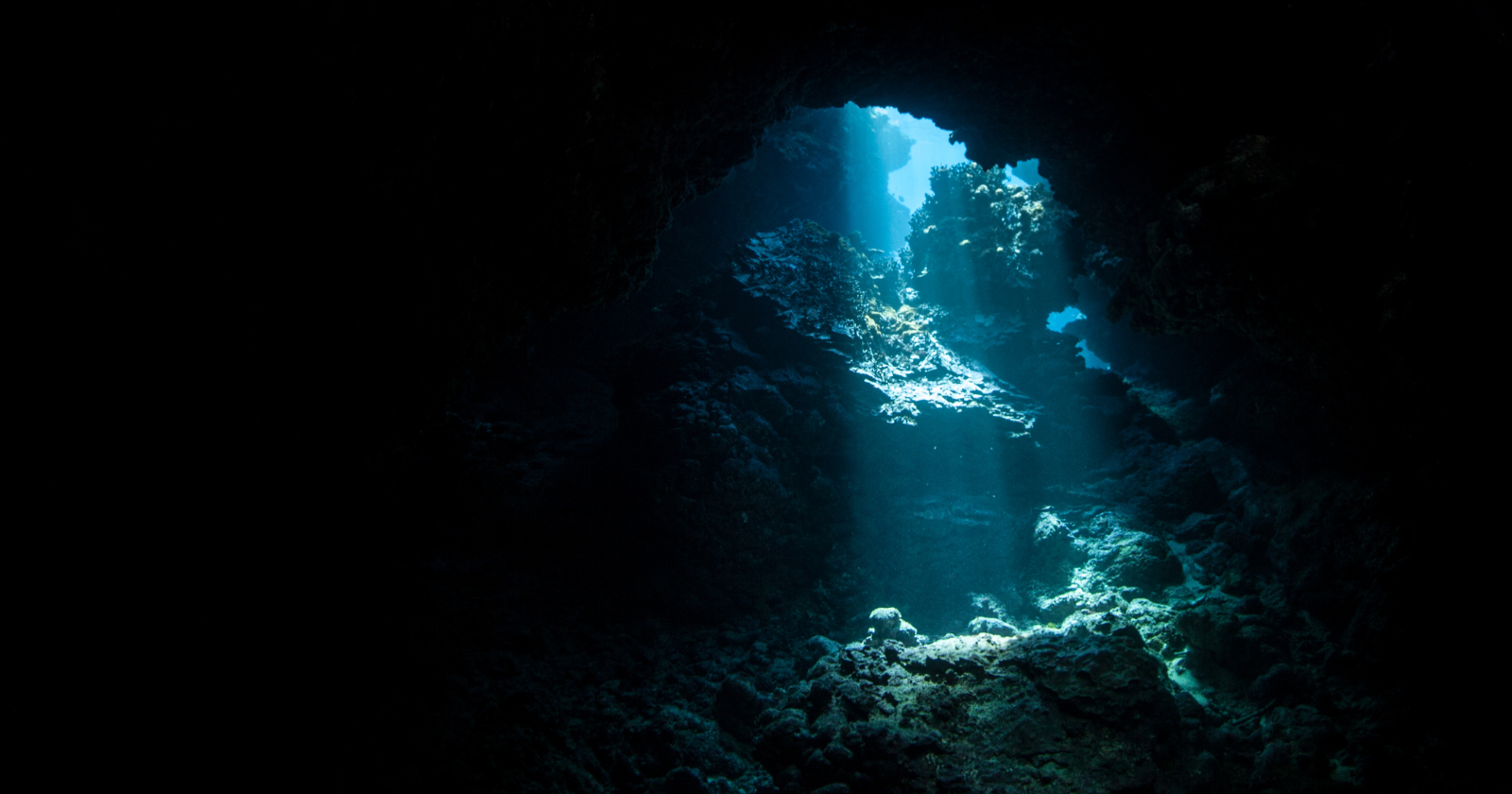
Somewhere beneath a mountain in southern Albania, in a region called Vromoner near the small town of Leskovik on the Greek border, a body of warm mineral water has been sitting in complete darkness for an indeterminate but very long time, with no human aware of its existence, no light reaching its surface, and no possibility of being entered by anyone except via a hundred-metre vertical drop through a limestone shaft. In 2021, a team of Czech speleologists became the first humans to make that drop. They were led by Marek Audy, a veteran Czech cave explorer who had spent several years investigating the underground hydrology of the Albanian-Greek mountain borderlands. The team had been tracking high-temperature springs and tall columns of steam that emerged from cracks in the surface limestone — the visible exhaust of a hidden hot-water system that had to be coming from somewhere below. Following the steam back to its source, the speleologists located a vertical shaft they later named Atmos, approximately a hundred metres deep, leading downward into a previously unmapped cavern. At the bottom of the shaft, in the darkness, was a thermal lake.
According to Radio Prague International’s coverage of the discovery and subsequent confirmation, the 2021 initial exploration produced a preliminary map of the cave system, drawn with the equipment the team had on hand at the time, that strongly suggested the underground lake was extraordinarily large. The team needed more precise instruments to confirm this. Mapping the full dimensions of a body of water in complete darkness, at the bottom of a hundred-metre vertical shaft, with limited working space and toxic hydrogen-sulphide air, required a mobile LIDAR scanner — a piece of equipment that the team did not own and could not initially afford. The Czech Neuron Foundation, a scientific funding organisation supported by private benefactors, provided approximately one million Czech crowns to purchase the necessary equipment. The expedition returned to the cave system in late 2024 with the LIDAR scanner and a team of 18 researchers. The measurements they took confirmed the lake’s full dimensions: 138.3 metres long, 42 metres wide, with a perimeter of 345 metres and a total volume of approximately 8,335 cubic metres of hot mineral water.
How big the lake actually is
The numbers translate into more intuitive comparisons that the team has used in subsequent communications. As reported by Euronews Albania’s coverage of the announcement, the lake’s volume is equivalent to approximately 3.5 Olympic-sized swimming pools. The cavern containing the lake is approximately three times the size of the main hall of the National Theatre in Prague. The previous record-holder for the world’s largest underground thermal lake was substantially smaller; the Lake Neuron measurements nearly double the previous record. The cavern is large enough that the LIDAR scanner had to be moved to multiple positions to capture the full geometry, and parts of the lake remain partially unexplored — the team plans to return with sonar equipment to measure the underwater portion of the cavern, which extends below the visible waterline and whose depth is not yet known.
The water itself is the unusual feature of the find. The lake is saturated with hydrogen sulphide — the gas responsible for the distinctive rotten-egg smell that hangs in the air throughout the cavern and that is toxic at high concentrations. The hydrogen sulphide, on contact with the atmosphere at the lake’s surface, oxidises into sulphuric acid. This is also why the cavern that contains the lake exists at all. Most caves in karst topography are formed by carbonic acid — slightly acidic rainwater dissolving limestone over millions of years. The Albanian cavern was formed by a fundamentally different process: sulphuric acid, generated by the oxidising hydrogen sulphide rising from the lake, has been gradually dissolving the limestone into soft gypsum from below. The technical term is sulphuric acid speleogenesis. It produces caves that are larger, more chemically active, and substantially more dangerous to explore than the carbonic-acid caves that dominate most karst regions.
What was down there before anyone got there
The lake is, in essential terms, an ecosystem operating in complete darkness, fuelled by chemistry rather than sunlight, sealed off from the surface biosphere for an unknown but presumably substantial period of time. As described in the Jerusalem Post’s coverage of the confirmed measurements, the researchers expect the lake to host extremophile microorganisms — bacteria and archaea adapted to high temperatures, no light, and high concentrations of hydrogen sulphide and dissolved minerals. Communities of this kind have been documented in other thermal and sulphurous cave systems, where they form the base of food webs that are entirely independent of photosynthesis, drawing their energy instead from chemical reactions between dissolved minerals and the surrounding water. Whether the Lake Neuron community contains microbial species new to science is a question the research team plans to investigate in subsequent expeditions.
The broader scientific significance of the find runs in several directions. The cave hydrology is connected, at some unknown depth, to the surface springs that originally led the speleologists to look for a hidden source. Mapping the connection between the underground lake and the surface water system will substantially improve hydrologists’ understanding of how groundwater moves through the karst terrain of the western Balkans. The presence of a previously unknown body of thermal water of this size raises questions about how many other comparable underground lakes might exist beneath similar mountain ranges around the world, where the geological conditions for sulphuric-acid speleogenesis are present but no surface evidence has yet been investigated. The Czech team’s discovery is, in technical terms, a sample of one — but it is a sample of one that is unusually large and that suggests the broader population may be larger than has previously been recognised.
The exploration itself
The story is also, separately, a story about contemporary speleology — a science that retains an unusually high proportion of physical risk and discovery for an activity that takes place in the 21st century. As covered by Monitor Magazine’s coverage of the team’s broader work, descending a hundred-metre vertical shaft in a karst cave system, breathing air contaminated with hydrogen sulphide, with no possibility of rescue if anything goes wrong, is not work that most scientific fields require their practitioners to do. The Czech speleological tradition, which has been mapping the underground of central and south-eastern Europe for several generations, sits at the intersection of mountaineering, scientific exploration, and a particular kind of physical patience that the broader scientific establishment has largely outgrown. Marek Audy and his team’s discovery of Lake Neuron is, by every available measure, the most significant single find of their careers. It is also a reminder that the planet still contains substantial unmapped territory, sitting in complete darkness beneath mountains that humans have lived alongside for thousands of years, waiting for someone to find a vertical shaft and decide to go down it.