
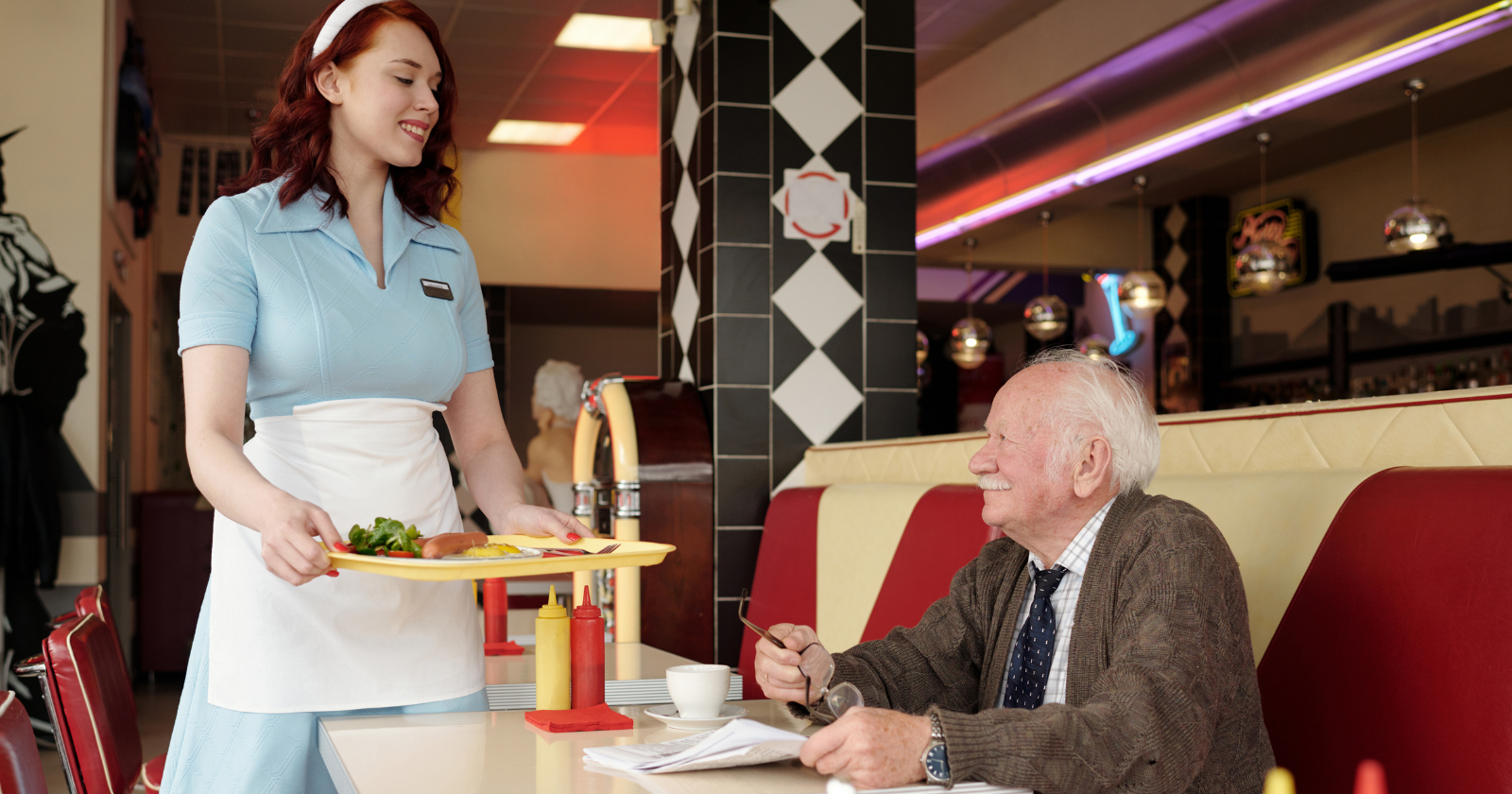
There is a particular kind of adult who, when they walk into a familiar diner, does not look at the menu. They sit down. They exchange pleasantries with the waitress. They order the thing they always order. They do not, in any conscious sense, debate the order with themselves. They do not consult the day’s specials. They do not consider, even briefly, whether they might, this morning, want something different. The order arrives. They eat it. They leave.
The cultural framing of this behavior tends to read it as a small failure of imagination. The diner regular, in the standard reading, is someone who has gotten into a rut. They are missing out on the variety the menu offers. They are being, in some implied way, slightly boring. The more adventurous person, the framing suggests, would try something new.
The framing misses, on close examination, what the diner regular is actually doing. The diner regular is, in most cases, running a small but useful way of reducing decision load in modern life. The strategy involves the deliberate reduction of unnecessary decisions in the small, low-stakes corners of the day, in order to preserve cognitive bandwidth for the parts of the day where the bandwidth actually matters. The regular order is not about the food. The regular order is about the relief of not choosing.
What the body is actually carrying by Thursday morning
It is worth being precise about why the relief of not choosing is, in fact, a relief, because the cultural register has not, until recently, had particularly good language for what is being relieved.
The average adult makes, by various estimates, somewhere in the range of thirty-five thousand decisions per day. Most of these decisions are small. Most of them are made beneath conscious awareness. Most of them, individually, would not register as effort if examined in isolation. The cumulative effect, however, is not nothing. Researchers studying decision fatigue have documented that the brain has a limited capacity for high-quality decision-making across any given day, and that once that capacity is drained, even the most astute individuals struggle to make sound choices. The system, in other words, has a finite resource. The resource is being spent, all day, on choices most people do not consciously notice making.
By Thursday morning, the adult walking into the diner has, in most cases, been spending this resource since six in the morning. The decisions have been small. The cumulative cost has not been small. The adult has decided what time to set the alarm. Whether to hit snooze. Which clothes to wear. Whether to make breakfast at home or to go out. What to do about the email that arrived overnight. Whether to take a shower before or after the dog walk. What route to take to the diner. Whether to wait for the second pedestrian light or to risk the first. By the time they sit down at the booth, the resource has been drawn on, in some real way, dozens of times. The adult is not, by any external metric, tired. The adult is, by the metric of cognitive bandwidth, already partially depleted.
The diner menu offers, at this moment, another decision. The decision is small. The decision involves choosing among twenty or thirty breakfast items, each of which has been engineered to appeal to some segment of the customer base. The decision, on its face, is a small pleasure. The decision is also, on close examination, another draw on the same finite resource that has already been drawn on dozens of times since six in the morning. The adult who orders the same thing every time is, in some real way, declining to make this additional draw. The decline is not a failure of imagination. The decline is, more accurately, a small piece of cognitive housekeeping that the adult has, by long practice, learned to perform.
The structural function of the regular order
What the regular order is doing, structurally, is converting a recurring choice into a routine. Research on decision fatigue management consistently identifies the establishment of routines as one of the most effective strategies for preserving cognitive resources across the day. The principle is that any choice that does not need to be made anew each time is a choice that can be removed from the daily cognitive ledger. The removal frees up the bandwidth for the choices that do require active engagement. The adult does not, by following the routine, become less of a chooser. The adult, more accurately, conserves their choosing for the contexts in which the choosing actually matters.
This is the structural reason high-functioning adults, across a wide range of professions, tend to standardize the small recurring choices of their lives. The famous examples involve people like Steve Jobs and Barack Obama, who restricted their daily wardrobes to a small set of standardized options in order to preserve cognitive bandwidth for the larger decisions of their work. The diner regular is doing, at a smaller scale, exactly the same thing. The standardized breakfast is, in structural terms, the same operation as the standardized wardrobe. The operation conserves bandwidth. The bandwidth, conserved, is available for the things that warrant active engagement.
What the cultural framing has misread, in classifying the diner regular as boring, is that the choosing itself is the cost. The wider register tends to assume that more choices produce more pleasure. The research, on the available evidence, does not support this. The research suggests, more accurately, that beyond a certain threshold, additional choices produce additional fatigue, and that the fatigue accumulates across the day in ways that affect the quality of every subsequent decision. The diner regular has, somewhere along the way, intuited this. The regular order is the practical expression of the intuition. The intuition is, on the available evidence, structurally correct.
Why the routine produces something more than efficiency
It would be possible to describe the diner regular’s behavior as a piece of pure efficiency. The behavior conserves bandwidth. The bandwidth is available for other use. The efficiency is real.
The behavior is doing, however, something more than efficiency. It is providing, in the small corner of the day it occupies, a particular kind of structural relief that the rest of the day, for most adults, does not offer. The relief is the experience of being in a space where one is not being asked to choose. The space is, in some real way, a small protected zone within the otherwise constant negotiation that adult life consists of. The zone is small. The zone is, in its smallness, also restorative.
What is restorative about it is not the food, exactly. The food is fine. The food is not, in most cases, what the regular is going to the diner for. What the regular is going for is the experience of sitting in a booth, having something familiar arrive in front of them, and being able to eat it without having had to make any contested choice about it. The familiar arrival is, in some real way, a small ongoing daily reassurance. The reassurance is that some parts of life can, in fact, be settled. The settling is rare in adult life. The settling, in this corner, is reliable.
This is, on examination, why the diner regular often becomes so emotionally attached to their particular diner and their particular order. The attachment is not, primarily, about the diner’s food or about the order’s specific qualities. The attachment is about the small protected zone the configuration provides. The zone is, in some real way, a piece of structural mental health work that the wider environment is not providing. The regular has constructed it for themselves. The constructing is unobtrusive. The constructing is also, on the available evidence, doing real work for the system carrying it.
Why this kind of strategy is so easy to dismiss
The cultural register, particularly in environments that prize novelty, variety, and self-expression, tends to read the diner regular as someone who has settled for less. The reading misses, on close examination, what the regular is actually doing.
The regular is not settling for less. The regular is, more accurately, recognizing that the choice of breakfast on a Thursday morning is not, in any reasonable accounting, the place where the day’s available bandwidth should be spent. The bandwidth should be spent on the decisions that warrant active engagement. The decisions that warrant active engagement are not, in most lives, what to eat at the diner. They are the decisions about work, about relationships, about the various larger projects of adult life that, when done well, require the cognitive resources that the small choices have not consumed.
The diner regular has, in some real way, made a strategic allocation. The allocation is to spend zero bandwidth on the breakfast and to preserve that bandwidth for elsewhere. The strategy is, on the available evidence, sound. The strategy is rarely described as a strategy because the strategy is, by its nature, invisible. The regular does not announce it. The regular does not, in most cases, even consciously articulate it. The regular just orders the same thing, day after day, and the same thing arrives, day after day, and the rest of the day proceeds slightly more sustainably than it would have proceeded if the choosing had been done.
The acknowledgment this article wants to leave
The adult who orders the same thing at the diner every time is not, in any meaningful sense, missing out on the variety the menu offers. The adult is, more accurately, performing a small piece of cognitive triage that the rest of their day will, on the available evidence, benefit from. The triage involves the recognition that not every recurring choice needs to be made anew, and that the system carrying the choices has a finite resource that, once depleted, affects everything else the system does.
The order is less about the food than about the relief of not choosing. The relief is real. The relief is, in some real way, one of the small kindnesses the adult can offer themselves on a Thursday morning, when the rest of the day has, since six, been asking them to negotiate. The booth is, briefly, a place where the negotiation pauses. The order arrives. The order is eaten. The day continues.
This is, on examination, an underrated form of self-care. It does not require any of the equipment that the more visible self-care strategies require. It costs almost nothing. It produces, reliably, a small piece of structural rest in the middle of a week that does not, in most cases, offer many other places where structural rest is available. The adult who has figured this out has, in some real way, figured out something that the wider culture has not, until recently, been ready to acknowledge as a strategy at all. The figuring-out is invisible. The figuring-out is also, on the available evidence, doing real work. The work is small. The work is, in the aggregate of a long adult life, considerable.
