
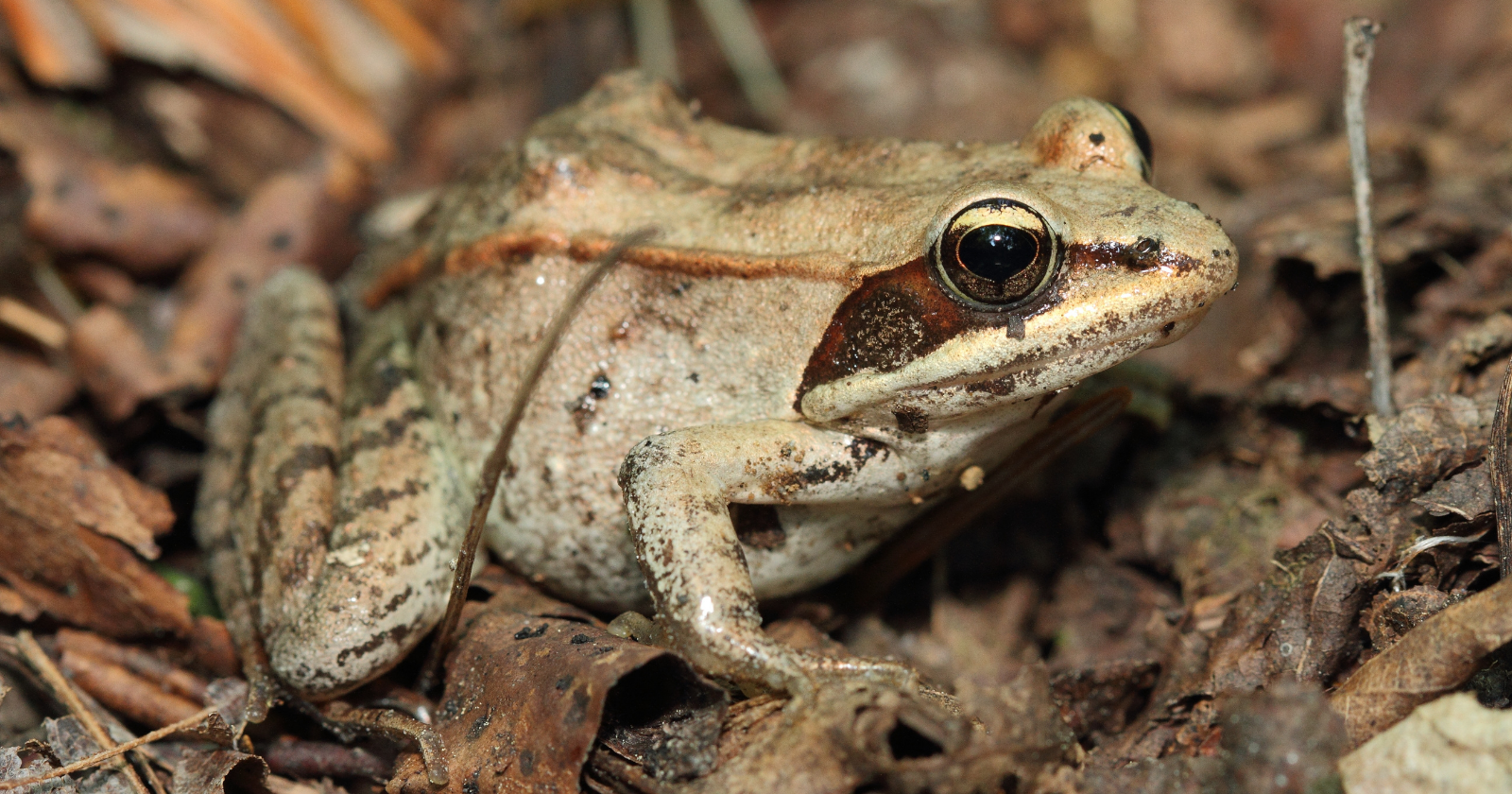
Pick up a wood frog in the middle of a Canadian January and it feels like a rock. Ice crusts the eyelids. There is no heartbeat, no breathing, no measurable nerve activity, and close to two thirds of the water in its body sits frozen in the gaps between its cells. “For all intents and purposes, this animal is clinically dead,” Shannon Tessier, a researcher at Massachusetts General Hospital, told The Scientist. Then spring arrives, the animal thaws, and it hops off to find a pond as though nothing has happened.
That trick is now a research programme.
What happens inside a frozen frog
Freezing starts on the outside. Ice forms on wet leaf litter, touches the frog’s permeable skin, and creeps inward. Within minutes the liver begins tearing apart its glycogen stores and flooding the body with glucose, which works as a natural antifreeze inside the cells. Kenneth Storey of Carleton University, who has spent decades on this animal, sums it up in a review of wood frog physiology: 65 to 70 per cent of total body water turns to ice in extracellular masses, with so much water pulled out of the cells that the organs visibly shrink.
Ice outside the cells is survivable. Ice inside them is a death sentence.
Frogs also stockpile urea, rebuild their cell membranes and raise antioxidant levels before the first hard frost, changes he and Janet Storey catalogued in Physiological Reviews. Northern populations push the whole system harder. Wood frogs from interior Alaska survive freezing at -16°C, 10 to 13 degrees colder than their Ohio relatives manage. Work led by M. Clara F. do Amaral traced the difference to a larger liver glycogen reserve that mobilises faster once ice appears.
Why transplant surgeons started reading amphibian papers
Every donated organ is on a clock from the moment it leaves a body. Standard practice is static cold storage, which is about as low-tech as it sounds. Korkut Uygun, a chemical and systems engineer who works alongside Tessier at Mass General, put it plainly in that same feature: pack the organ in ice and race it to the recipient, and you are counting hours, not days.
Hours means every transplant runs as an emergency. Distance kills matches. In the United States alone, federal transplant figures put more than 100,000 people on the waiting list, with about thirteen dying each day before an organ reaches them. Stretch storage from hours to days and the whole business becomes logistics instead of a race.
Which is why a frog that can idle for months at a time has everyone’s attention.
Borrowing the frog’s antifreeze
Glucose at frog concentrations would poison mammalian tissue, so researchers reached for 3-O-methyl-D-glucose instead, a modified sugar that cells take up but cannot metabolise. Combined with supercooling, which chills tissue below zero without letting it freeze outright, the approach produced a clinical-scale result in 2019. Writing in Nature Biotechnology, Reinier de Vries, Tessier, Uygun and colleagues held five human livers at -4°C and kept them viable for 27 hours, nearly triple the usual window. The National Institutes of Health, which helped fund the work, noted that human livers had previously been considered good for around nine hours.
Letting ice in on purpose
Cryobiology’s founding assumption was that ice is the enemy and must be avoided entirely. Tessier’s group challenged that in 2022, taking whole rat livers down to between -10°C and -15°C and holding them for five days with ice present, then recovering them on a perfusion rig. Reporting in Nature Communications, the researchers credited the wood frog directly, borrowing both the glucose analogue and the animal’s habit of seeding ice in controlled spots so it forms where it does least harm. Preservation time went up fivefold.
One study, in rodents, with no transplant at the end of it. That gap has since closed, mostly.
The same partial freezing approach reached a pig kidney in 2025. A Mass General team preserved it at high subzero temperature for ten days, then rewarmed and transplanted it into a living pig, restoring kidney function, as reported by a National Science Foundation-funded preservation centre involved in the trial.
Rewarming is the harder half
Getting cold is easy. Getting warm again is where organs crack, literally. Vitrification, which cools tissue so fast it sets into a glass instead of crystallising, has existed for decades. The sticking point has always been the thaw: warm too slowly and ice forms anyway; warm unevenly and thermal stress splits the tissue.
Engineers at the University of Minnesota went at that problem with iron oxide nanoparticles, flushing them through an organ’s blood vessels and then heating them from within using alternating magnetic fields. Their 2023 study in Nature Communications describes rat kidneys stored for up to 100 days, rewarmed, rinsed clean of nanoparticles and transplanted into rats whose own kidneys had been removed. The animals lived.
What the frog has not handed over
No single molecule explains any of this, and that is the frustrating part. As Uygun sees it, freeze tolerance is not one clever trick but a tightly sequenced set of biological changes working in concert. Ice nucleation, sugar loading, membrane changes, metabolic shutdown and antioxidant defence all fire in order, and a laboratory has to reproduce enough of that sequence in tissue which never evolved to cooperate. Rasha Al-Attar, a biologist in Tessier’s lab, is testing gene editing to make ordinary cells tolerate cryoprotectants better. Writing with Storey in Comparative Biochemistry and Physiology, Al-Attar has argued the frog works best as a template rather than a blueprint.
The animal has one real advantage over any transplant team. It only has to save itself, once a year, in a body it has been rehearsing with since the last ice age. A surgeon has to do it to somebody else’s liver, on a Tuesday, first go.
