
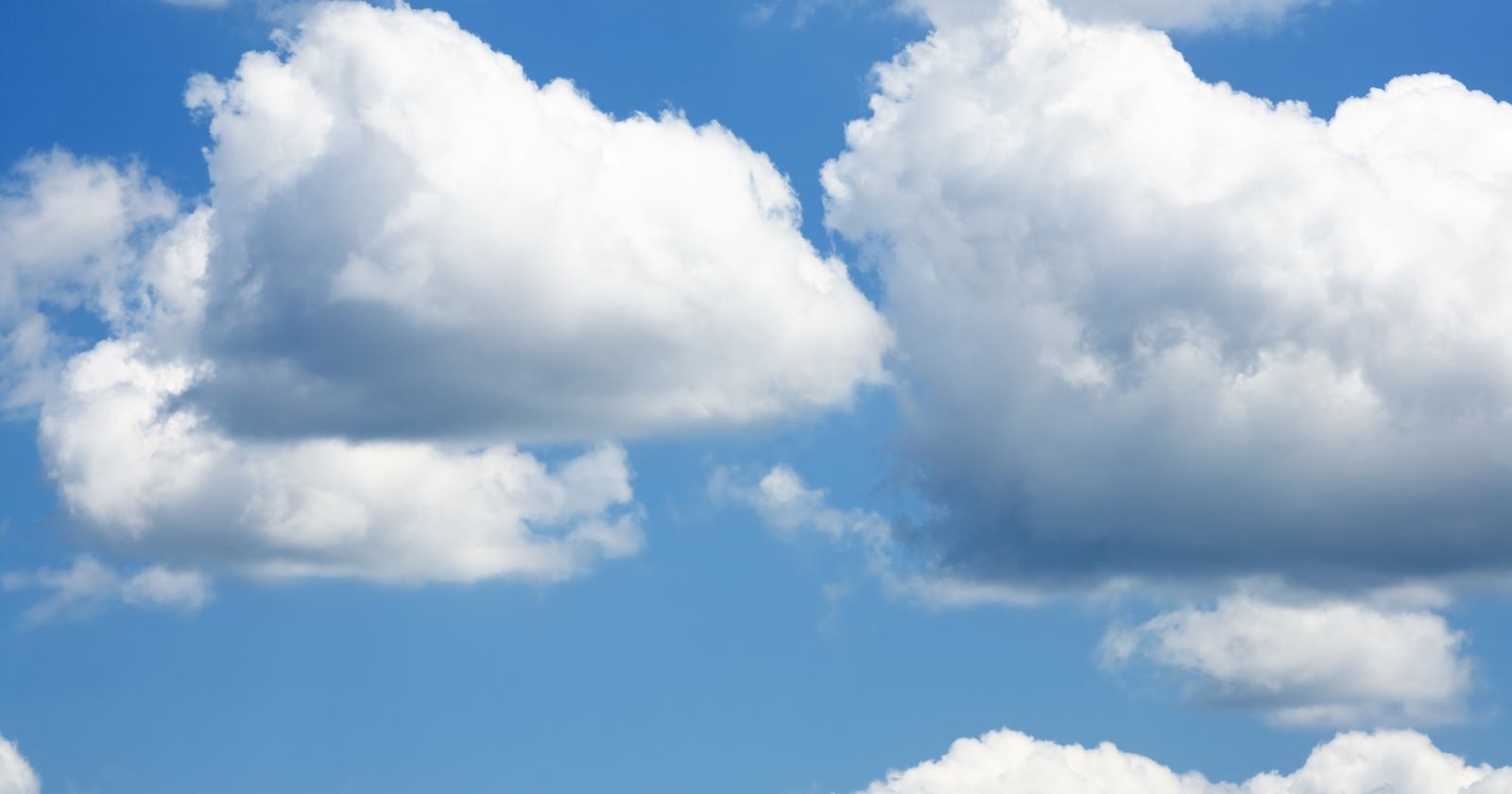
A typical fair-weather cumulus cloud, the kind that drifts across a summer sky looking like a fluffy white pillow, contains roughly half a million kilograms of water suspended in the air. Translated into more familiar units, that is about 1.1 million pounds, or 550 short tons (about 500 metric tonnes). Comparable weights include 100 adult African elephants, five adult blue whales, or rather more than a fully loaded Boeing 747. The cloud weighs all of this, and yet it does not fall. The reasons it does not fall combine three distinct physical mechanisms, working together rather than in order of importance.
The calculation is straightforward, and the United States Geological Survey’s Water Science School publishes the standard version of it. A typical cumulus cloud occupies roughly one cubic kilometre of atmosphere, or one billion cubic metres. Atmospheric scientists estimate the average liquid-water density of a cumulus cloud at about half a gram per cubic metre. Multiplying these two figures together gives 500 million grams, or 500,000 kilograms. The cloud is mostly empty air, with a small mass of water droplets distributed through a very large volume. The water is the heavy part. The air is the support.
Why a cloud floats: three contributing factors
The popular explanation for why clouds float treats them as a kind of mist of tiny droplets held aloft by air resistance against gravity. This is part of the story, but not the whole story. The full picture combines three physical effects, which together account for the cloud’s quiet suspension above the ground.
One factor, and the one most often missed in popular explanations, is buoyancy. The reason a cloud sits on top of the air below it is in some ways the same reason oil floats on water: the cloud-laden air is, on average, less dense than its surroundings, and the denser surrounding medium supports it from below. This sounds counterintuitive, because the cloud contains water and the air around it does not. The resolution is that water vapour, the gaseous form of water, is actually lighter than air. A water molecule (H₂O, molecular weight 18) is less massive than a nitrogen molecule (N₂, weight 28) or an oxygen molecule (O₂, weight 32), and a parcel of warm, moisture-laden air is therefore less dense than a parcel of cool, dry air at the same pressure. Once water has condensed into liquid droplets, the situation is more complicated, but the parent air parcel that produced the cloud is still typically warmer and less dense than the dry air around it.
A second factor is the active one. Cumulus clouds do not just hover; they are also held up by rising columns of warm air, called updrafts. According to NASA’s reference on convective cloud formation, cumulus clouds form when surface air warmed by the sun-heated ground rises, expands and cools as it ascends, and reaches the dew point at which water vapour begins to condense around airborne aerosol particles such as dust, sea salt or pollen. The condensation releases latent heat, which further warms the parcel and accelerates its rise. The result is a continuous updraft beneath and within the cloud, typically moving upward at metres per second. The water droplets are held aloft not by stillness but by motion: they are riding an active column of rising air.
The third factor is the one most often cited in popular accounts. The droplets themselves are extraordinarily small, with typical cumulus cloud droplets measuring roughly 20 micrometres in diameter, or 0.02 millimetres. A droplet of this size, falling through still air, has a terminal velocity of around 1 to 2 centimetres per second. Updrafts in even a modest cumulus cloud move air upward an order of magnitude faster than this. A droplet trying to fall at one centimetre per second through air rising at, say, two metres per second simply does not fall. It is suspended in a fluid whose net motion is upward, with only a small downward component contributed by its own weight. By comparison, a typical raindrop is about 2 millimetres across, a hundred times the diameter of a cloud droplet, and falls at roughly 9 metres per second, fast enough to fall through even strong updrafts.
What changes when it rains
The transition from a floating cloud to a raining one is a transition in droplet size. Cloud droplets grow primarily by collision and coalescence: small droplets, jostled by turbulence within the cloud, bump into and merge with their neighbours, gradually accumulating mass. A droplet that grows from 20 micrometres to 200 micrometres has increased its terminal velocity from about 1 centimetre per second to about 70 centimetres per second. A droplet that grows to 2 millimetres falls at 9 metres per second. At some point in this size progression, the falling speed exceeds the updraft speed, and the droplet begins to fall through the cloud rather than being carried along by it. The droplets that emerge from the bottom of the cloud as rain have grown roughly a thousand times in mass during their time within the cloud.
A thunderstorm cloud, technically a cumulonimbus rather than a cumulus, contains far more water than a fair-weather cumulus. A typical thunderstorm cloud can have a mass on the order of a million tons of water rather than five hundred tons, with a corresponding requirement for far more vigorous updrafts to keep it aloft. Updrafts in severe thunderstorms can exceed 30 metres per second, enough to hold hailstones the size of golf balls suspended for many minutes while they grow by accreting layer after layer of supercooled water. When the updraft finally weakens, all of that mass falls at once, which is why thunderstorms produce heavy precipitation in short bursts.
A fair-weather cumulus cloud, by contrast, is in a quiet equilibrium. It is roughly a kilometre across, contains roughly half a million kilograms of suspended water, and is held aloft by a combination of buoyancy from being warmer and less dense than its surroundings, an active updraft from the convection that produced it, and the very small terminal velocity of its constituent droplets. Take any of these three away and the cloud changes character: cool the parcel and it begins to sink; remove the updraft and it begins to settle and dissipate; let the droplets grow and it starts to rain. The cloud as it appears, suspended quietly above a summer field, is the product of three physical processes in balance.
