
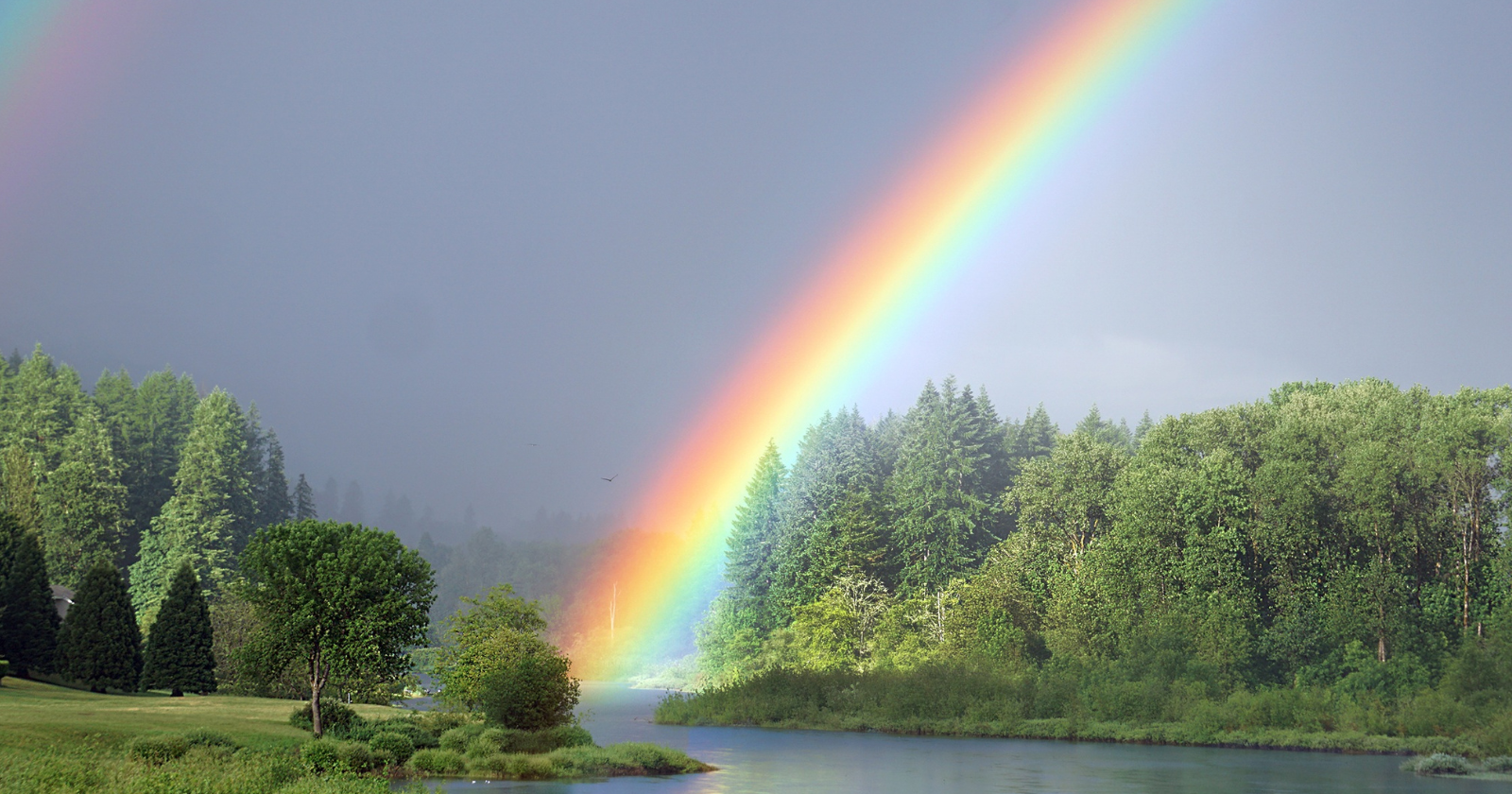
A rainbow looks like an object in the sky. It appears to have a definite location: starting somewhere over the trees, arcing across the field, ending somewhere near the horizon. Walk toward it and it retreats. Walk away from it and it recedes. The reason it behaves this way is that it has no fixed position at all. A rainbow is a viewing-angle phenomenon, formed by the geometric relationship between the sun, the raindrops in the air, and the observer’s eyes. Every person looking at what appears to be the same rainbow is, technically, looking at a different rainbow, formed by a different set of raindrops, centred on a different point. Even your two eyes are looking at slightly different rainbows.
The physics is well-understood and has been worked out in detail since the seventeenth century. The cleanest modern technical treatment is in a 2002 review article by John A. Adam, “The mathematical physics of rainbows and glories,” published in Physics Reports. Adam states the key fact directly. The cones of light that define the rainbow “will be different for each observer, so each person has his or her own personal rainbow.”
What is actually happening with the raindrops
When sunlight enters a spherical raindrop, three things happen in sequence. The light slows down as it passes from air into water, which bends it (refraction). The light then strikes the back curved surface of the raindrop and reflects internally. On its way back out, it passes from water to air again and bends a second time. Different wavelengths of light bend by different amounts, because the refractive index of water depends on wavelength. Red light, with a longer wavelength, bends slightly less than violet light. The result is that white sunlight entering a raindrop comes back out as a spread of colours, separated by angle.
The crucial number is the angle. For the dominant emerging beam, which is the one that produces the visible rainbow, the deviation from the original path of the incoming sunlight is approximately 138 degrees. The supplementary angle, the one between the observer’s line of sight to the raindrop and the line from the observer to the antisolar point, is therefore about 42 degrees. The antisolar point is the imaginary point exactly opposite the sun from the observer’s position, located on the line that runs from the sun, through the observer’s head, and out the other side. The shadow of the observer’s head sits on the antisolar point.
Every raindrop in the sky that lies on a 42-degree cone centred on the antisolar point, with its apex at the observer’s eye, will refract some sunlight back toward the observer. Those raindrops together form the rainbow. Drops at slightly smaller angles produce violet light; drops at slightly larger angles produce red. The full sequence of colours from red on the outside to violet on the inside is the result of seeing the same physical process at slightly different angles across the cone.
Why your rainbow is yours
The cone is defined relative to a specific antisolar point, and the antisolar point is defined by the position of a specific pair of eyes. If you and a friend are standing a metre apart looking at the same approximate region of sky, your antisolar points are also a metre apart. The 42-degree cones extending from your respective eyes pass through different raindrops. Your friend’s rainbow is being formed by one set of falling water droplets in the sky. Your rainbow is being formed by a different set. The two rainbows appear to overlap, because you and your friend are close together, but the actual photons reaching each pair of eyes have travelled through different drops.
According to National Geographic’s reference on rainbow formation, this means that “no one sees the same rainbow—each person has a different antisolar point, each person has a different horizon.” A person standing where you see the end of the rainbow is seeing a rainbow extending from their own horizon, not the one you are seeing. The famous question about whether there is a pot of gold at the end of the rainbow has a quiet physical answer: there cannot be an end of the rainbow that any other observer would agree was at the same place, because each observer’s rainbow ends somewhere different.
The effect even applies between your own two eyes. Your left eye and your right eye are separated by roughly six centimetres. The two cones of viewing angle that produce the rainbows visible to each eye pass through slightly different raindrops. When you look at a rainbow with both eyes open, your brain fuses two slightly different optical phenomena into a single perceived image, the same way it fuses two slightly different views of any object into stereoscopic depth perception. The fusion is so seamless that the underlying difference is undetectable. The rainbow you see with one eye closed is not quite the rainbow you see with the other eye closed.
Why the rainbow is always at 42 degrees
The 42-degree angle is not an accident of any particular rainbow. It is a fundamental property of how water refracts visible light, derived from the refractive index of water (about 1.33) and the geometry of light entering and exiting a sphere. Every raindrop, anywhere on Earth, in any era, refracts sunlight at the same set of angles. This is why every primary rainbow, no matter where or when it forms, sits at the same angle relative to the antisolar point. The rainbow you see today and the rainbow somebody saw in ancient Greece are geometrically identical at the level of angle, despite being separated by thousands of kilometres and thousands of years. What differs is the raindrops doing the work.
The secondary rainbow, sometimes visible as a fainter arc outside the primary, forms at about 51 degrees from the antisolar point. It is produced by light that reflects twice inside each raindrop rather than once, which is why it is fainter (each internal reflection costs some light) and why the colour order is reversed (the geometry of the double-reflection inverts the angular order of the wavelengths).
What the rainbow actually is
The mathematically clean way to describe a rainbow is to say it is the set of directions, relative to the observer’s eye, from which water droplets are sending the maximum intensity of refracted sunlight at each visible wavelength. That set of directions forms an arc, centred on the antisolar point, at angular radii that depend on wavelength. The arc is not at any particular distance. The raindrops doing the work can be near or far. As long as a raindrop sits on the 42-degree cone, it contributes. Move toward the rainbow and you bring new raindrops into the cone while losing the old ones. The rainbow appears to retreat because it is doing exactly that, in the sense of being formed by a constantly updating set of drops as you move.
What this means for the everyday observer is that the rainbow is a deeply personal optical event. It is centred on a point that exists only relative to you. It is built out of raindrops that no other observer is using. It looks like a thing in the sky because the brain is good at extracting object-shaped patterns from sensory input, but the underlying physics describes not an object but a geometry. The rainbow is your rainbow, no one else has the same one, and a moment from now even you will be looking at a different one, formed by raindrops that have fallen slightly further toward the ground.
