
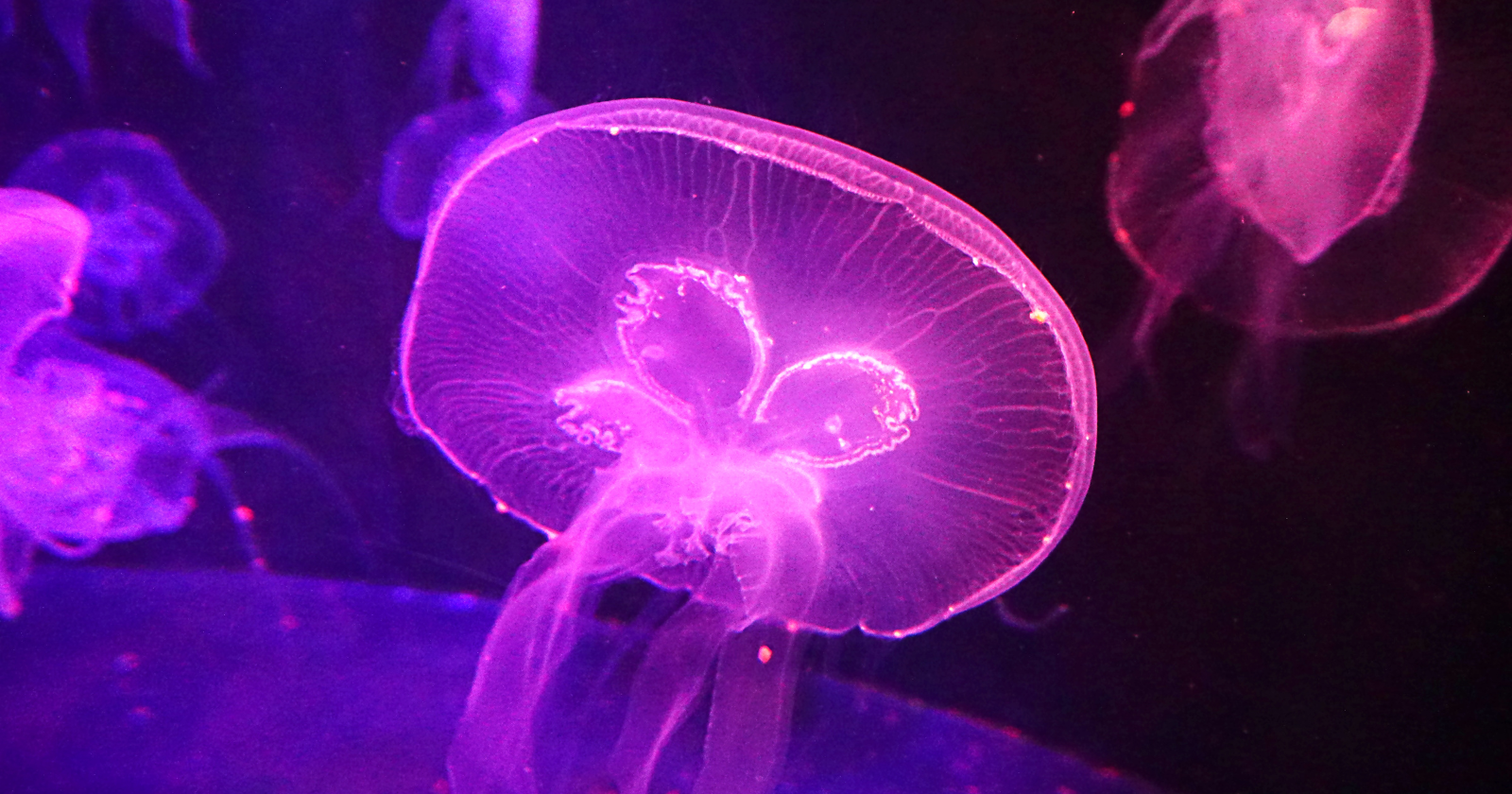
Shine ultraviolet light on a droplet of glowing jellyfish protein and, for a moment, it stops behaving like biology and starts behaving like a solar cell. An electron leaves the molecule, a circuit picks it up, and current flows.
That was roughly the pitch out of Gothenburg in the late 2000s, where a small group at Chalmers University of Technology built exactly that: a photovoltaic device whose light-absorbing material was the protein that makes Aequorea victoria glow green. No rare earths. No dye synthesised in a fume hood.
What the protein was doing there
Green fluorescent protein, GFP to anyone who works with it, is the most famous molecule most people have never heard of. Osamu Shimomura pulled it out of Pacific jellyfish in 1962, and by the 1990s it had become biology’s universal highlighter: splice its gene onto another gene, and whatever that gene builds will glow. That line of work earned Shimomura, Martin Chalfie and Roger Tsien the 2008 Nobel Prize in Chemistry.
Fluorescence and electricity are separate tricks, though. A fluorescent molecule swallows a high-energy photon, loses a little of the energy as heat, and spits out a lower-energy one. Ultraviolet in, green out. A solar cell asks for something rougher, which is for the excited electron to leave the molecule altogether and go do a job.
Getting from the first behaviour to the second is the entire engineering problem.
A gap thirty nanometres wide
Zackary Chiragwandi and colleagues at Chalmers and the University of Gothenburg laid out the hardware in Applied Physics Letters in 2006: two oxide-coated aluminium electrodes sitting 30 nanometres apart on a chip, with a droplet of enhanced GFP bridging the gap. Enhanced GFP is the lab-brewed version, grown in bacteria, with no tentacles involved. Left alone, it self-assembles into strands across the gap.
A follow-up paper in the Journal of Physical Chemistry C put the device through its paces. Current appeared with no external voltage applied at all: the detail that separates a solar cell from a light-triggered switch. That current tracked GFP’s own absorption spectrum, confirming the protein really was the light harvester. Output fell steadily as temperature rose, which the authors read as an orderly, liquid-crystal-like arrangement of protein strands coming undone.
Then there is the number that decides everything.
Chiragwandi told CNN in 2010 that the goal was nanodevices that could work from inside the body, chasing applications such as reversing blindness or fighting tumours. One contemporaneous report, from DogoNews, put the actual output at tens of nanoamperes. A nanoampere is a billionth of an amp, and a phone charger pushes around two amps. For nanoscale medical devices, where almost nothing else fits and toxicity rules out most alternatives, a trickle was enough to matter.
Why the idea stalled
Two papers from one group amount to a starting point, not a field, and the jellyfish cell never scaled beyond the lab bench. No follow-up study pinned down exactly why, but a few likely culprits stand out. Proteins are wet, fragile and fussy about temperature, which matches what the Chalmers group’s own data showed. GFP absorbs hardest in the ultraviolet, a thin slice of what the sun actually delivers to the ground. Silicon, over those same years, got cheaper by roughly an order of magnitude, which alone tends to flatten the case for anything unproven. Together, they read like a plausible account of where the project ran out of road, though nothing in the record confirms it.
Biology did make it into working photovoltaics, but by way of whole organisms rather than isolated proteins. Researchers at the University of Cambridge, working with the chip designer Arm, sealed blue-green algae into a container the size of an AA battery and ran a low-power microprocessor on it for more than a year using nothing but ambient light and water. Paolo Bombelli, first author on the paper in Energy and Environmental Science, said the team had expected the thing to quit within weeks.
Where the protein earns its keep
Photons, as it happens, are GFP’s real trade. A luminescent solar concentrator is a transparent sheet dosed with fluorescent dye: the dye catches sunlight across the whole panel, re-emits it, and the sheet channels that light sideways into narrow strips of ordinary silicon along the edges. Most versions rely on rare-earth or toxic emitters, an awkward look for anything sold as a green window.
A team led by Rute Ferreira at the University of Aveiro built one around enhanced GFP and reported it in Green Chemistry in 2020, reaching a power conversion efficiency of roughly 0.35 per cent once coupled to silicon cells. Modest numbers, plainly reported. A 2025 paper in Small, led by Sihan Lei at the Technical University of Munich’s Straubing campus, locked a cousin of GFP called T-Sapphire into solid epoxy instead of water. The optical efficiency reached 7.41 per cent, and the solid version outlasted the liquid one thirty-two times over before the signal faded: eight days against six hours. Optical efficiency describes how well a sheet delivers light to its edges, so it does not compare directly with a solar panel’s rating, and one paper remains one paper.
Aequorea victoria has drifted off the Pacific coast of North America for a very long time with no stake in the electricity market. Its glow protein has turned out to be a poor generator and a decent usher, catching light in one place and handing it to silicon somewhere else. That is a job in windows rather than on roofs, a smaller ambition than the 2010 headlines carried, and a good deal more likely to survive contact with a factory.
