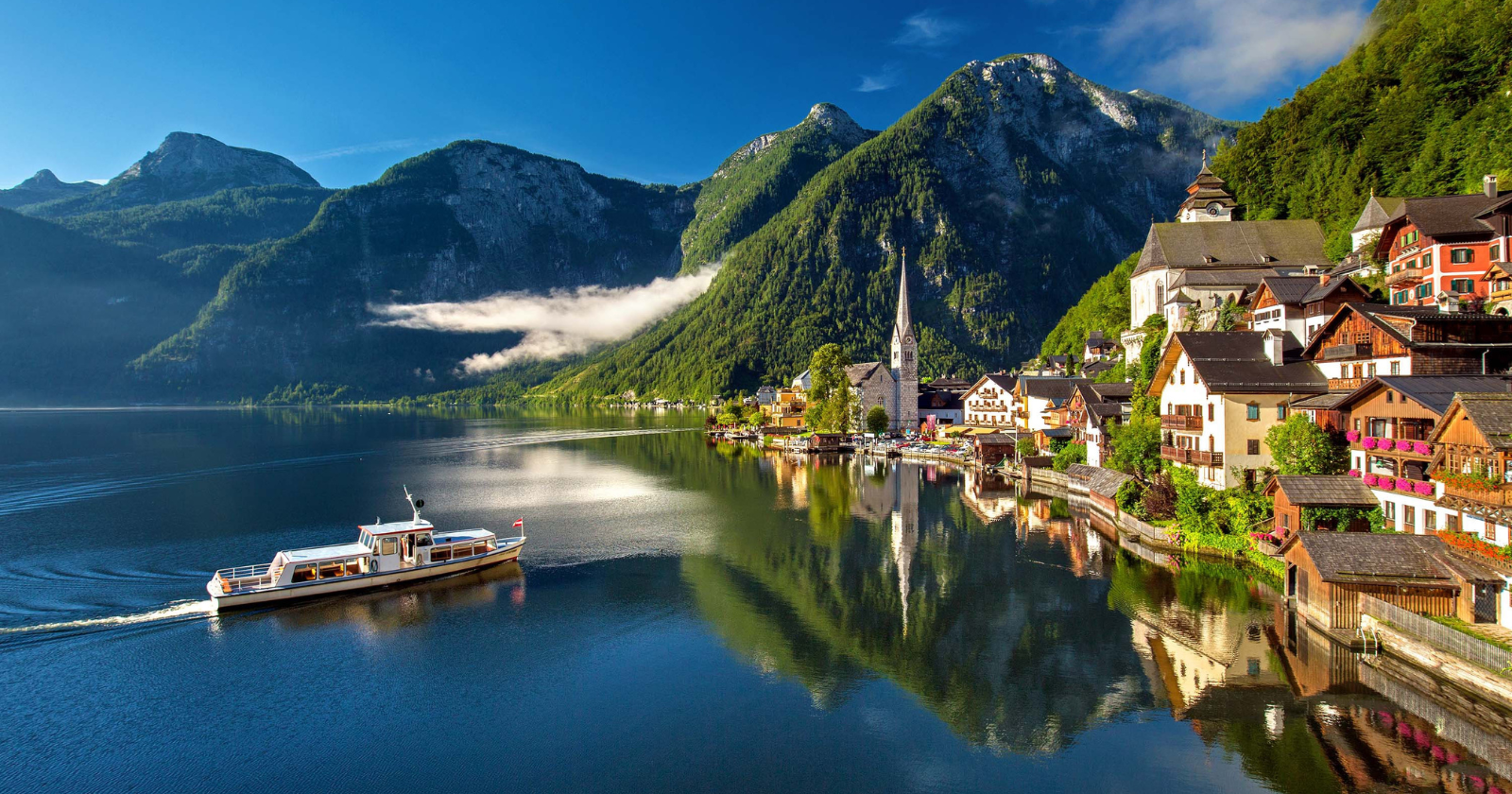
In 2011 a guest at a Hallstatt hotel let something slip, and a village of 800 people found out it was being photocopied.
Staff from a Chinese property developer had spent months in the lanes with cameras and notebooks, blending in with the day-trippers, photographing the buildings and taking their measurements. Nobody thought twice about it. In Hallstatt, everybody is being photographed all the time.
Minmetals Land, the property arm of China’s largest metals trader, was rebuilding the whole place at full size, almost 9,000 kilometres away in subtropical Guangdong.
What US$940 million buys in Guangdong
Radio Free Europe/Radio Liberty put the spend at US$940 million, and the shopping list is roughly what you would guess: a church spire, a town square ringed with pastel buildings, angel statues, and, off to one side, Mickey Mouse. It opened to the public in June 2012, in Huizhou, on the eastern edge of the Pearl River Delta.
Hallstatt’s mayor, Alexander Scheutz, flew out for the ribbon-cutting and signed a cultural exchange agreement. Not everyone in the delegation was as relaxed. Hotel owner Monika Wenger, whose guest had given the game away, told the Associated Press that the developer should have asked the people who owned the buildings, and never did.
The copy became an advertisement
Forty-seven Chinese visitors came to Hallstatt in 2005. By 2011, with the clone half built and the story running in newspapers everywhere, the figure was 8,700, numbers cited by Austria’s consul in Guangzhou, Martin Wolle, at a ceremony covered by China.org.cn.
Asian audiences had already met the place through the Korean drama Spring Waltz, filmed there and first aired in 2006. Then came the rumour that Disney modelled Arendelle on it, which nobody at the studio has confirmed. The clone landed on top of all that, and the coverage it drew put the town in front of audiences who had never heard of it.
Word got around that there was an original.
Ten thousand visitors, one road in
Coach traffic tells the story fastest. Scheutz told Euronews that 7,917 buses came through in 2014 and 21,254 came through in 2019, while overnight stays roughly doubled across the decade to 145,260. Day visitors passed a million a year.
Peak days bring up to 10,000 people into a town of fewer than 800 residents, a ratio Lonely Planet has set out in plain figures. They arrive on one road, which reaches the houses through a tunnel cut between the lake and the cliff.
In August 2023, about 100 locals stood in that tunnel and shut it for a quarter of an hour. Their placards asked for an emergency brake. Long-time resident Friedrich Idam told NBC News that his home was no longer living on tourism, it was being squashed by it. Three months earlier the council had put up a wooden screen to spoil the most photographed view, which went down about as well online as you would expect.
The screen came down.
Idam described a quieter adjustment too. With the market square permanently full of strangers, residents shifted their weekly farmers’ market to a less obvious corner of town, which is roughly what it looks like when a place starts hiding from its own visitors.
Under the postcard, 3,000 years of salt
Salt is the reason any of this exists. UNESCO listed the surrounding landscape in 1997 because the mountain has been mined since the Bronze Age, and the town’s name means salt settlement. An entire prehistoric culture, the Iron Age society that traded across Europe from here, is named after the place.
In 2002, archaeologists from the Natural History Museum Vienna found a wooden staircase in the prehistoric workings. Dendrochronology dated it to 1344 BC, making it the oldest timbered stair known in Europe, and the salt had preserved it so thoroughly that all eight metres survived. Researchers scanned and dried more than 70 sections, then rebuilt the whole thing 400 metres underground, where visitors can stand in front of it.
Why a daily cap is harder than it sounds
Booked time slots for coaches have already done real work. Scheutz told The Local that daily bus numbers have halved and still sit under the ceiling of 54, even though overnight and day-visitor figures are back where they were before the pandemic. He has resisted a Venice-style entry ticket, arguing it would make the town feel more like a museum and would be a nightmare to police.
Deputy mayor Alfred Gamsjäger has been blunter. Speaking to Kurier and quoted in further reporting by The Local in 2025, he said his town is literally overrun and wants a digital reservation system capped at roughly 5,000 to 5,500 visitors a day. The obstacle is geography. That single road carries on to other communities up the valley, so metering Hallstatt means metering the neighbours.
Guangdong has none of these problems. When Hong Kong Free Press visited in 2015, the sales office inside the church said about 65 per cent of the houses had sold and not one was occupied, while the square outside filled up daily with wedding photographers. Estates nearby carry names like Evian and Royal Garden, so the borrowing was never a one-off.
Copy the gables and you get a stage set, and a stage set will absorb any number of people. What the crowds actually travelled for, the salt under the hill, the Bronze Age stair, the residents trying to get to the shops, is still wedged between a lake and a cliff in Upper Austria, and there is no second one.