
Research context: The findings come from laboratory assays and mouse experiments described by UC Davis and in the linked peer-reviewed paper. They are not clinical findings.
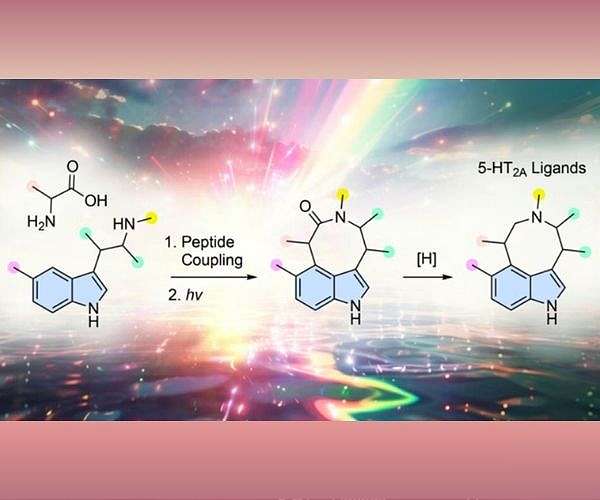
UC Davis researchers have developed a light-based method for making compounds that interact with the serotonin 5-HT2A receptor. In laboratory tests and mouse experiments, one candidate activated the receptor without producing the head-twitch response commonly used as a proxy for psychedelic-like activity in mice. The study does not establish that these compounds are non-hallucinogenic, safe or effective in people.
The research was recently published in the Journal of the American Chemical Society.
“The question that we were trying to answer was, ‘Is there whole new class of drugs in this field that hasn’t been discovered?” said study author Joseph Beckett, a Ph.D. student working with Professor Mark Mascal, UC Davis Department of Chemistry, and an affiliate of the UC Davis Institute for Psychedelics and Neurotherapeutics (IPN). “The answer in the end was, ‘Yes.'”
The researchers say the method could provide a more streamlined way to create and screen new serotonin-receptor compounds. Further research would be needed before any candidate could be considered for testing as a treatment in people.
“In medicinal chemistry, it’s very typical to take an existing scaffold and make modifications that just tweak the pharmacology a little bit one way or another,” said study author Trey Brasher, also a Ph.D. student in the Mascal Lab and an affiliate of IPN. “But especially in the psychedelic field, completely new scaffolds are incredibly rare. And this is the discovery of a brand-new therapeutic scaffold.”
The researchers created a library of potentially therapeutic molecules by coupling various amino acids with tryptamine, a metabolite of the essential amino acid tryptophan. They then irradiated these molecules with ultraviolet light to transform them into new compounds of medicinal value.
Computer simulations were used to test the binding affinity of 100 of these compounds at the 5-HT2A receptor.
Five candidates were selected for further lab testing to determine efficacy and potency. Efficacies of the selected compounds ranged from 61% to 93%, with the latter representing a full agonist – a compound capable of producing the maximum biological response from the 5-HT2A system.
The team labeled the full agonist in the group as D5. They expected that administering the compound to mouse models would induce head twitch responses, a hallmark of hallucinogenic-like behaviors.
However, that wasn’t the case. Despite fully activating the same receptor as psychedelics, D5 didn’t induce head twitch responses.
“Laboratory and computational studies showed that these molecules can partially or fully activate serotonin signaling pathways linked to both brain plasticity and hallucinations, while experiments in mice demonstrated suppression of psychedelic-like responses rather than their induction,” Beckett and Brasher said.
The team plans to conduct follow-up studies to better understand if other serotonin receptors in the brain modulate or suppress the hallucinogenic-like effects of D5.
“We determined that the scaffold itself possesses a range of activity,” Brasher said. “But now it’s about elucidating that activity and understanding why D5 and similar molecules are non-hallucinogenic when they’re full agonists.”
Additional authors on the paper include Mark Mascal and Lena E. H. Svanholm, of UC Davis; Marc Bazin, Ryan Buzdygon and Steve Nguyen, of HepatoChem Inc.; John D. McCorvy, Allison A. Clark and Serena S. Schalk, of the Medical College of Wisconsin; and Adam L. Halberstadt and Bruna Cuccurazza, of UC San Diego.
The research reported on here was funded by grants from the National Institutes of Health and Source Research Foundation.
Research Report:Transforming Amino Acids into Serotonin 5-HT2A Receptor Ligands Using Photochemistry
Editor’s note: Updated September 14, 2026, to clarify that the findings are preclinical and do not establish effects in people.
