

Telescope images indicate that the missing U.S. Contour space probe may have been destroyed when it fired its engine to escape Earth orbit on Thursday, a NASA official said Friday.
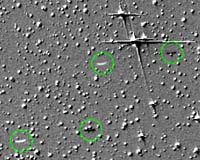
Images from astronomers working at SpaceWatch asteroid observation program at the University of Arizona show the probe may have broken in two, the official said.
NASA trief througout Friday to regain contact with its Contour space probe. “We’re still trying to get a telemetry link,” said Robert Farquhar, Contour mission director at the Johns Hopkins University Applied Physics Laboratory, in nearby Laurel, Maryland.
“We’re trying to send commands to the spacecraft to switch between its two transmitters and use different on-board antennas, in case they turned off for some reason. But we really won’t know what happened until we contact it.”
But in images taken by Jim Scotti using the Spacewatch 1.8-meter telescope on Kitt Peak on 2002 August 16, two parallel trails near one of the predicted positions of the Contour spacecraft were identified and measured by Jeff Larsen during his re-examination of the data.
According to a SpaceWatch news release caption “the curvature of the trails is a natural characteristic of the drift scanning process at this high declination.”
“The fact that there are two trails indicates that the spacecraft must have separated into two pieces that are still moving in nearly parallel directions,” the release said.
The probe’s engines were to fire Thursday at 4:49 pm (0849 GMT) 140 kilometers (87 miles) above the Indian Ocean, an orbit too low for detection by NASA’s antennas.
The burn was meant to accelerate the probe to 6,912 kilometers (4,295 miles) per hour to overcome the pull of Earth’s gravity.
Mission commanders should have reestablished radio contact at 5:35 pm (0935 GMT) but several hours later there was nothing but silence.
The Comet Nucleus Tour probe, or Contour, was launched July 3 from Kennedy Space Center on a Delta II rocket.
NASA hopes that by analyzing the hearts of two comets close up, Contour will reveal the secrets of the hydrogen-rich celestial bodies, which could become mobile fueling stops for future interplanetary explorations.
The Contour probe was scheduled to pass through the comet Encke on November 12, 2003, and the comet Schwassmann-Wachmann 3 on June 19, 2006, traveling within 100 kilometers (62 miles) of each comet’s nucleus. Both comets are less than 50 million kilometers from earth.
If it survived the two encounters, the 970-kilogram (2,138-pound) probe, shielded in Kevlar, was to be sent to a third, as yet undetermined, comet.
