
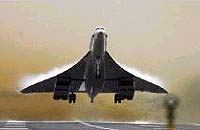
Under Concorde’s sleek curves and technical prowess lurks a history strewn with technical, environmental and commercial obstacles that have beset the world’s first and only supersonic passenger plane to enter service.
What started off in the 1950s as a post-war pipe dream finally took to the skies in 1969 – the same year that man first walked on the moon – when all 112 tonnes of Concorde 001 left the tarmac at Toulouse, southern France.
The project was spawned from military research in the wake of World War II, with Britain and France both launching separate studies on the possibility of building an airliner capable of flying faster than the speed of sound.
The two countries joined forces in November 1962. But the coalition of two governments, two aircraft makers and two engine makers was plagued by technical and political snags, not to mention cultural and language barriers.
It was one thing to build a supersonic fighter jet capable of carrying a small military crew kitted out in pressure suits; it was quite another to make one to carry a large number of passengers sipping champagne and eating caviar.
‘It really is an extraordinary achievement and made possibly more extraordinary because when they started the project in 1962 they didn’t really realise how difficult it was going to be,’ said former Concorde pilot Christopher Orlebar, author of ‘The Concorde Story’.
In June 1963 US President John F Kennedy dropped the bombshell that the United States would press ahead with a project to rival Concorde, a scheme quietly abandoned eight years later.
In the end though it was Russia that stole a march on everyone when in December 1968 the Tupolev Tu-144 – dubbed ‘Concordski’ – made the first ever flight by a supersonic airliner, although a crash at the 1973 Paris Air Show ended any commercial prospects for the jet.
Concorde, a name first coined by French president Charles de Gaulle, made its own maiden flight on March 2, 1969 when pilot Andre Turcat eased it off the Toulouse asphalt. In October the same plane exceeded the speed of sound for the first time.
But many of Concorde’s problems were only just beginning, and it was seven more years before the aircraft flew its first paying passengers. The oil shocks of 1973 and 1979 meant that few airlines were lining up to buy the gas-guzzling jet, and a series of tentative deals to buy Concorde were cancelled.
Environmental concerns were also always one of Concorde’s biggest hurdles. The plane suffered a huge blow when it was banned from landing in New York for over a year in 1976 because of noise concerns. Restrictions on overland flying because of the sonic boom also prevented Concorde plying many lucrative international routes.
So instead of selling a few hundred planes as Concorde’s makers had once hoped, in the end only BA and Air France, both state-owned at the time, took any.
‘The triumph was that it worked at all, and worked so well,’ said Mr Orlebar. ‘The tragedy was that no one else bought it.’
It was on July 25, 2000 that the plane suffered arguably its biggest ever crisis: an Air France Concorde crashed in a fireball after take-off from Paris Charles-de-Gaulle airport, killing all 109 people on board and four on the ground. The plane took to the skies again 16 months later.
But in April of this year, with passenger numbers dwindling and fuel costs rising, BA and Air France simultaneously announced the retirement of their Concorde fleets, now destined to spend the rest of their days in museums.
