
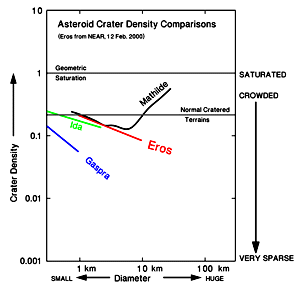
Impact crater populations on asteroids visited by spacecraft are compared on this plot. The higher locations on this plot indicate more craters; sparse cratering is lower on the graph.
Craters can never be as numerous as indicated by the “geometric saturation” line, where they would lie cheek-by-jowl, totally crowding the surface.
An important difference between asteroids is whether or not large craters dominate coverage of the surface compared with small craters (indicated by a line sloping to the upper right) or, instead, if smaller craters dominate the surface (a line sloping to the upper left).
As shown by this plot, Eros has similar numbers of smaller craters as Mathilde and Ida (observed by NEAR and Galileo, respectively). But Eros lacks the numerous huge craters present on Mathilde.
Eros shares with Ida and Mathilde a trait for which Gaspra, so far, remains the exception: their larger numbers of craters indicate that they are rather old compared with the more sparsely cratered Gaspra.
