
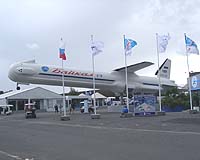
Innovative Russian engineers on Sunday showed off a reusable robot booster at the Paris airshow here, claiming their brainchild can lead to major cost savings for rocket launches.
The Baikal, which the co-designers, the Khrunichev Space Centre, hope will make its maiden flight in 2004, comprises the first stage of a two-stage rocket.
It contains 110 tonnes of fuel, which is used during liftoff and the early boost phase to take the rocket to a height of about 60 kilometers (38 miles).
At that point, the booster separates and the rocket’s second stage ignites to take the payload out of the Earth’s lingering gravitational pull and into orbit.
As for the booster, it deploys a pair of wings enabling it to glide back through the thin layers of the upper atmosphere. An onboard jet engine at the front of the pencil-shaped craft then fires up and Baikal flies back to land back at base, using its own navigation system. It can then be readied for the next launch.
“This is the first step towards a fully reusable (launch) system,” Khrunichev senior engineer Yuri Polushkin told AFP.
It could offer savings of as much as 30 percent on the cost of a launch, he said.
In addition, Baikal means that there is no need to take extensive measures to protect or evacuate the region around launch sites, where habitations could be hit by falling boosters, he said. Such an area may cover hundreds of square kilometers (miles).
Baikal, whose other designer is Molnya, is a revolutionary idea, but whose components are hardy veterans of the aerospace business: the rocket engine is the tried-and-tested RD191, the landing gear from the Yak 42 and the jet engine is the RD33, which powers the MiG 29.
For the time being, the invention exists for public view as a full-scale, 27.1-metre (88-feet) model. The prototype will provide 196 tonnes of thrust, enough to place a payload of 1.9 tonnes into low Earth orbit, a size that is less than half that of conventional telecommunications satellite being launched today.
Khrunichev intends to get around that by strapping four Baikals together, boosting the payload to 22 tonnes for a low Earth orbit, or 3.2 tonnes in geostationary orbit.
“We are using our own international company money for the programme, but it it is possible also that we turn to foreign capital as well,” said Polushkin.
Khrunichev is not the only company to be interested in this field. Boeing is carrying out an assessment for “fly-back” boosters for the US space shuttle. NASA says it can save up to half a billion dollars a year by using reusable boosters.
