
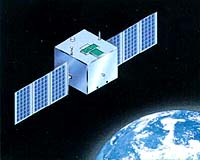
The birth of the HY-1 satellite is more than a decade of planning and development, according to a report in the May 1997 issue of Aerospace China.
As far back as 1987 the State Oceanic Administration (SOA) and the relevant departments of the Ministry of Aerospace Industry realized that China lacked a domestic oceanographic satellite and the ability to receive realtime data from foreign satellites, and the country was 20 years behind technologically in this field compared to the international level. All participating departments then joined force to examine the feasibility of building its own satellite.
The feasibility study concluded that the oceanographic satellite could use a Ziyuan-1 satellite platform (ZY-1, also called China-Brazil Earth Resources Satellite-1 or CBERS-1; Ziyuan means “resource”) and a launch on a Changzheng-4 (LM-4) rocket into a 780-km sunsynchronous orbit.
The satellite would carry a suite of payload including a radar altimeter, a microwave scatterometer, an ocean colour scanner, and a multichannel microwave radiometer. The design lifetime of the spacecraft would be two years.
However, the involved departments had not been able to achieve breakthroughs in several key technologies with microwave remote sensing instruments. Coupled with insufficient funding and limitation in research qualification, construction of a domestic oceanographic satellite suffered a significant delay.
When Chinese remote sensing technologies advanced in the mid-90s, SOA established a long-range plan for oceanographic satellites and their applications. The plan noted that two separate sets of satellites would constitute the satellite series: ocean colour satellites and ocean environmental satellites.
The government listed the ocean colour satellite series in the last five-year economic development plan, the “9 5 Plan”, as one of the national projects. Since 1995 two SOA ocean colour satellite specialist groups, application and technology, have been working on relevant issues.
The feasibility study recognized that the ocean colour satellite would need to obtain wide-area, realtime and repeated observations in order to provide effective monitoring of ocean conditions and resources.
Key scientific applications include: biological resource exploitation and utilization; estuaries, bays and navigation routes monitoring and administration; pollution monitoring and prevention; coastal zone resource exploitation; and oceanographic studies.
To achieve these goals, the study identified several important technical requirements for the mission. These include:
- Wide-field sensors with high sensitivities, high signal-to-noise ratios, and high spectral and radiometric resolutions to detect the weak reflected radiation flux;
- Narrow bandwidth multispectral sensing;
- Optical CCD camera imaging;
- Rapid transmission of data, ideally on a realtime basis;
- Spacecraft with a near-circular sunsynchronous orbit and an equatorial crossing time near noon local time;
- Groundtrack revisit every 2 to 3 days.
The study recommended that the ocean colour satellite would be a microsat, and perhaps launched on a new type of rocket that is dedicated to microsat missions. This arrangement would allow greater flexibility to launch future satellites in the series.
In terms of project management, the study suggested that a special management model would be used to shorten the spacecraft and payload development cycle instead of the traditional model of designing, prototyping and building the flight version of the hardware.
The study further suggested that in payload management, a tender system should be introduced to determine suitable contractors.
