
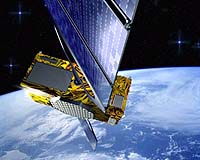
A Chinese state-holding company signed a contract last Wednesday to develop satellite-navigating positioning technology for the European Galileo Project.
China Galileo Industries – a state company owned by China Aerospace Science and Technology Corporation, China Electronics Technology Group Corporation, China Satcom and China Academy of Space Technology – is authorized by the National Remote Sensing Center of China (NRSCC), the European Union-designated Chinese partner on the Galileo Project, to develop Galileo’s satellite and remote sensing technologies and application systems.
According to the cooperation agreement signed by the NRSCC and the Galileo Joint Undertaking in last October, China pledged to invest in research and development in space technologies, ground equipment and application systems for the Galileo Project.
The European Union and the European Space Agency kicked off the Galileo Project in March 2002 to develop a satellite-navigation system independent of the US military-monopolied global positioning system (GPS).
With an investment of roughly 3.5 billion euros, the project will launch 30 navigation satellites, which will provide remote sensing data with resolution of up to one meter. At present, the dataresolution of GPS is only ten meters.
Chinese contractors said that the first navigation satellite for the project could be launched later this year.
Meng Bo, chair of the board of China Galileo Industries, said, “GPS is mainly for military use, with a portion for civilian use.”
Still a dual-purpose platform, Meng said the Galileo system will provide data mainly for civilian use in accordance with subscription contracts.
As the first non-EU partner for the project, China agreed to invest 200 million euros. In the first phase of the Chinese-European cooperation, China will spend 70 million euros. Aside from the five million euro entrance fee, China is allowed to develop technologies and equipment worth 65 million euros.
The NRSCC, a coordination body under the Ministry of Science and Technology, is mandated to choose domestic research institutes and companies to undertake concerned research and development.
Li Jiahong, an NRSCC official, said, “the cooperation between China and Europe on the project will be helpful to China’s independent research on its own satellite-navigating systems.”
The EU estimated that by 2020, the Galileo Project will bring Europe tens of billions of euros in revenues and tens of thousands of job opportunities. Chinese experts expected revenues worth 260 billion yuan (23.6 billion euros) in Galileo systems applications by 2020.
